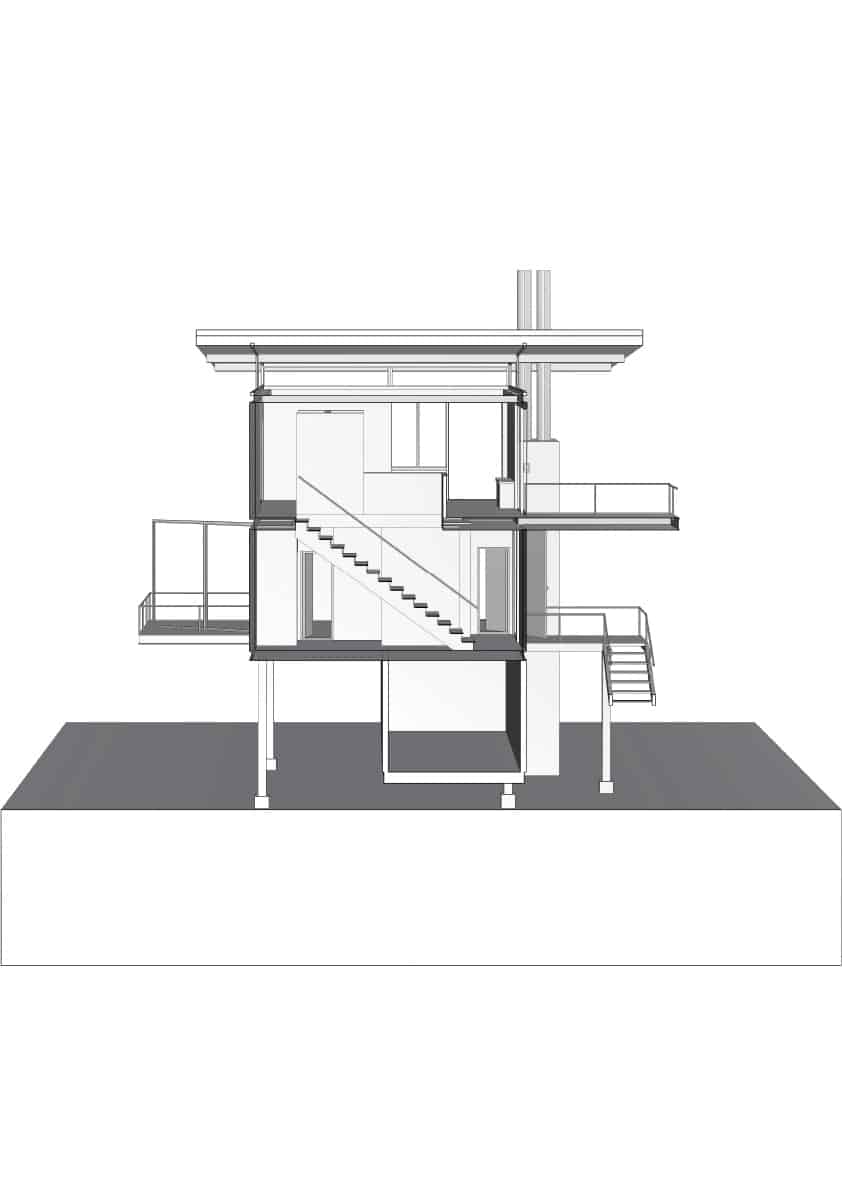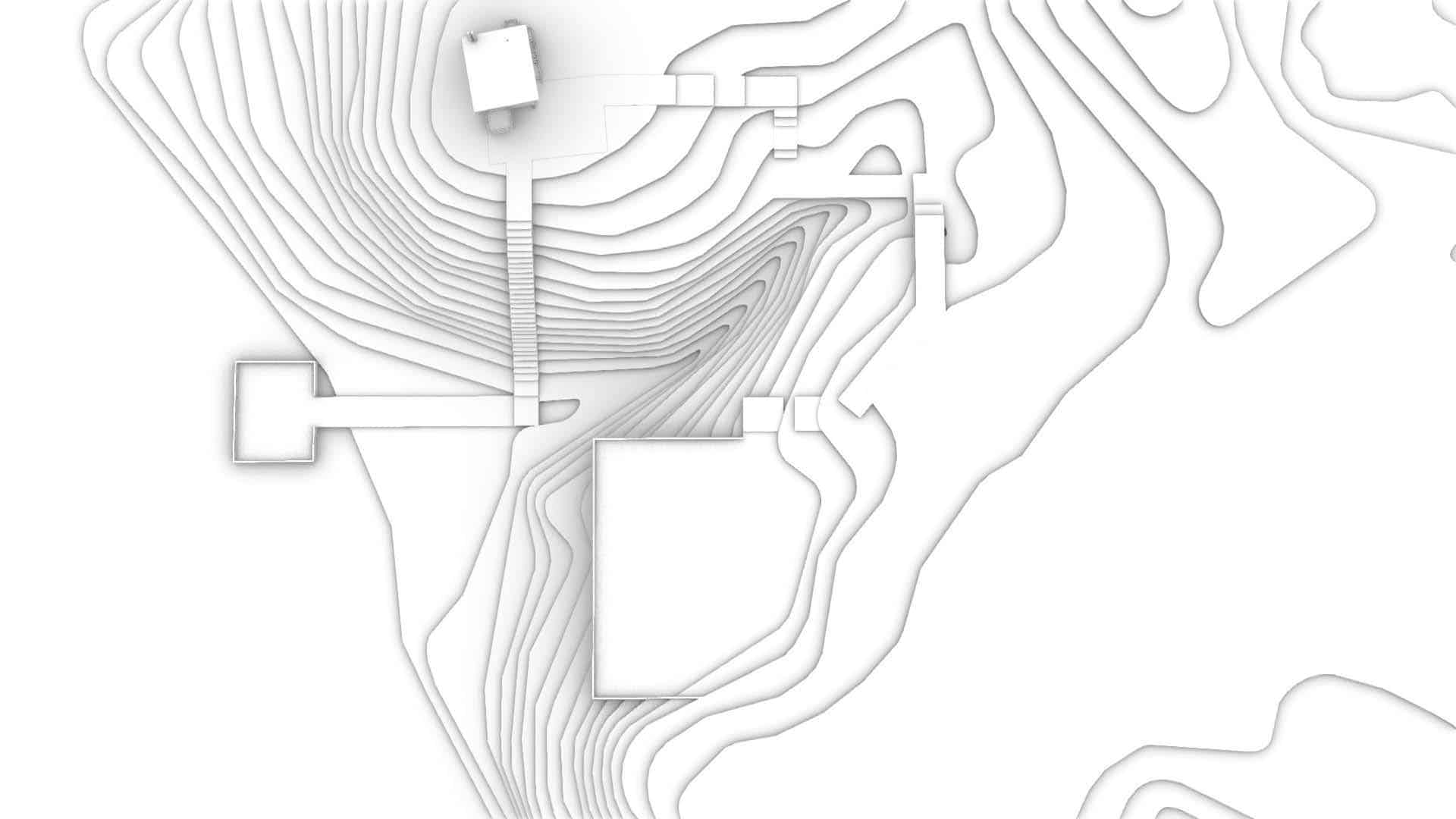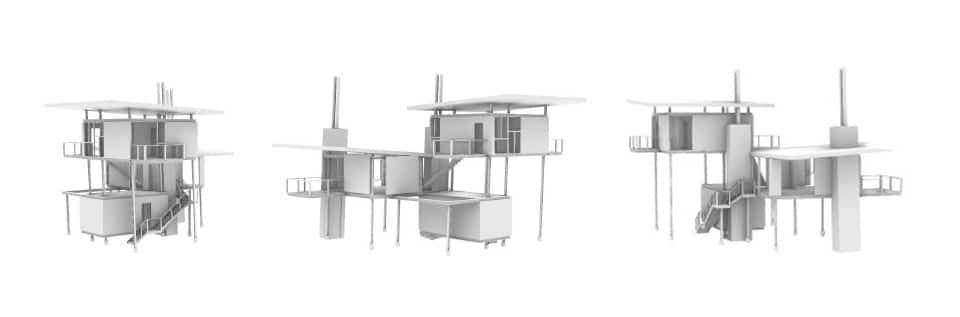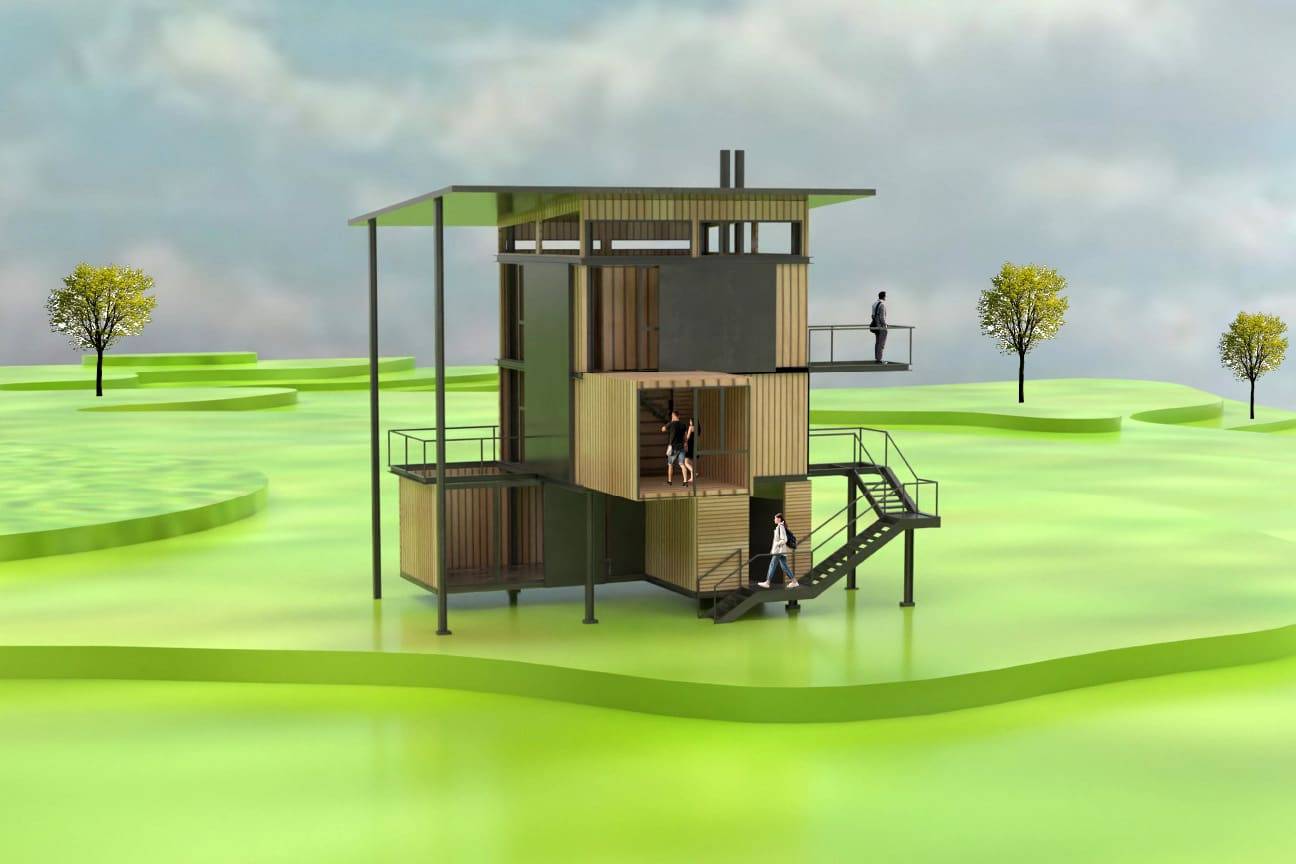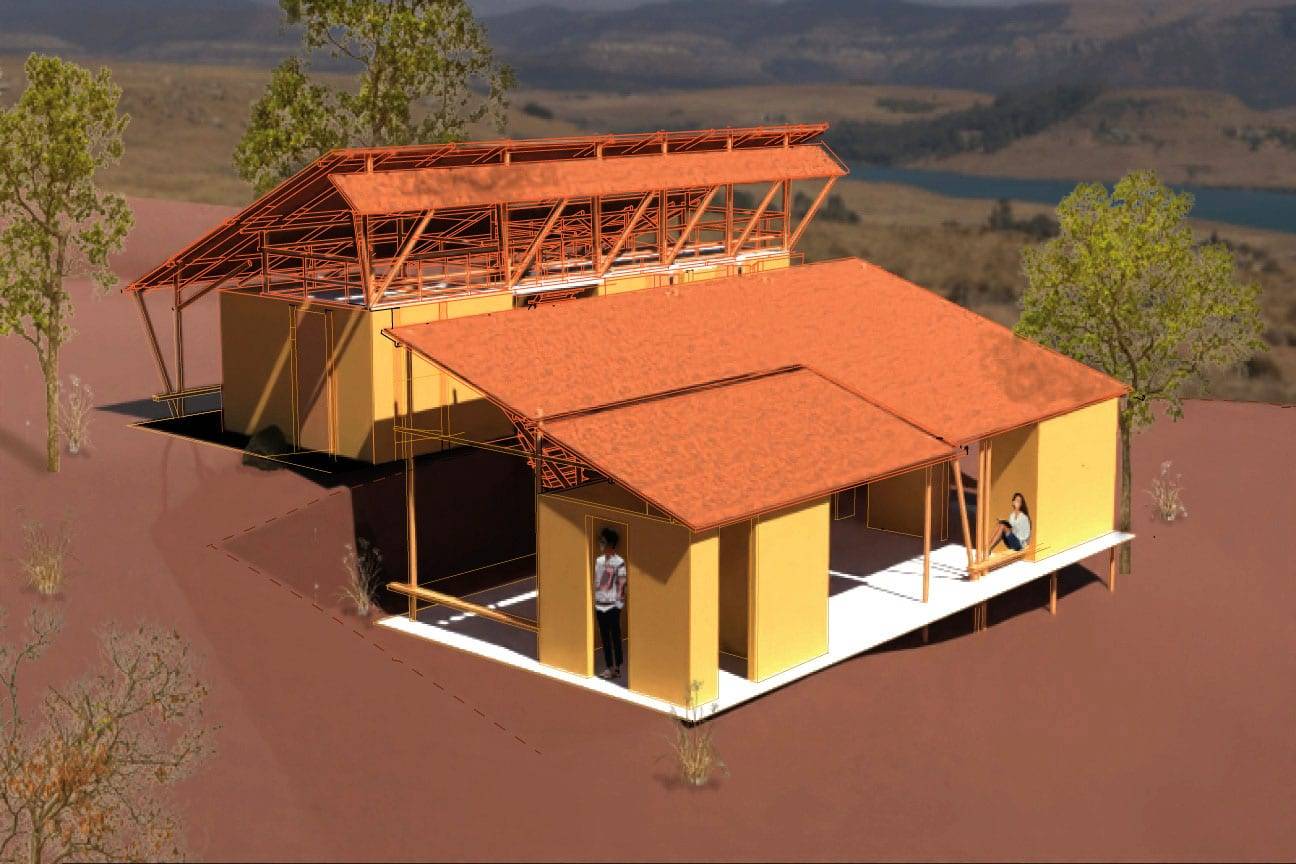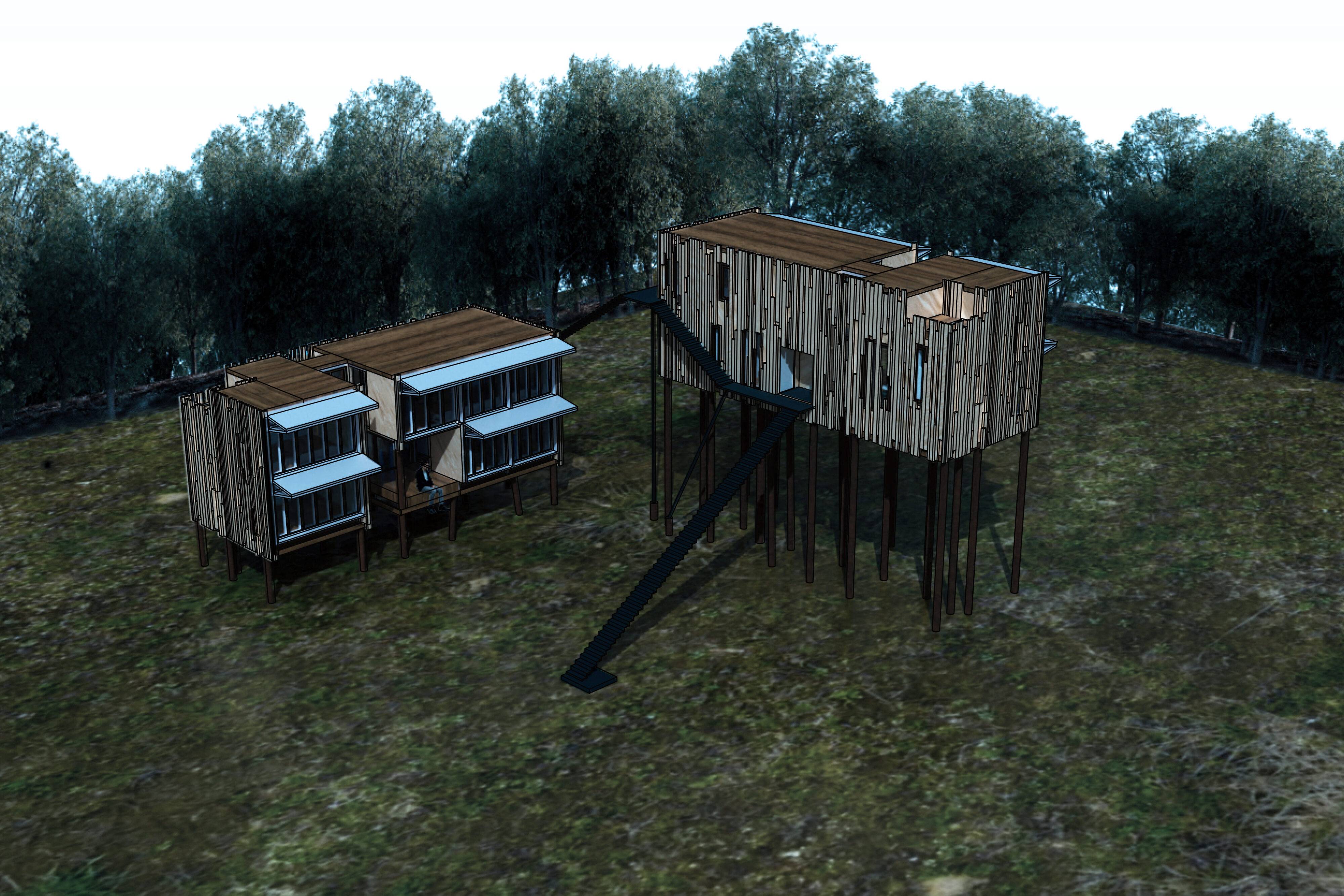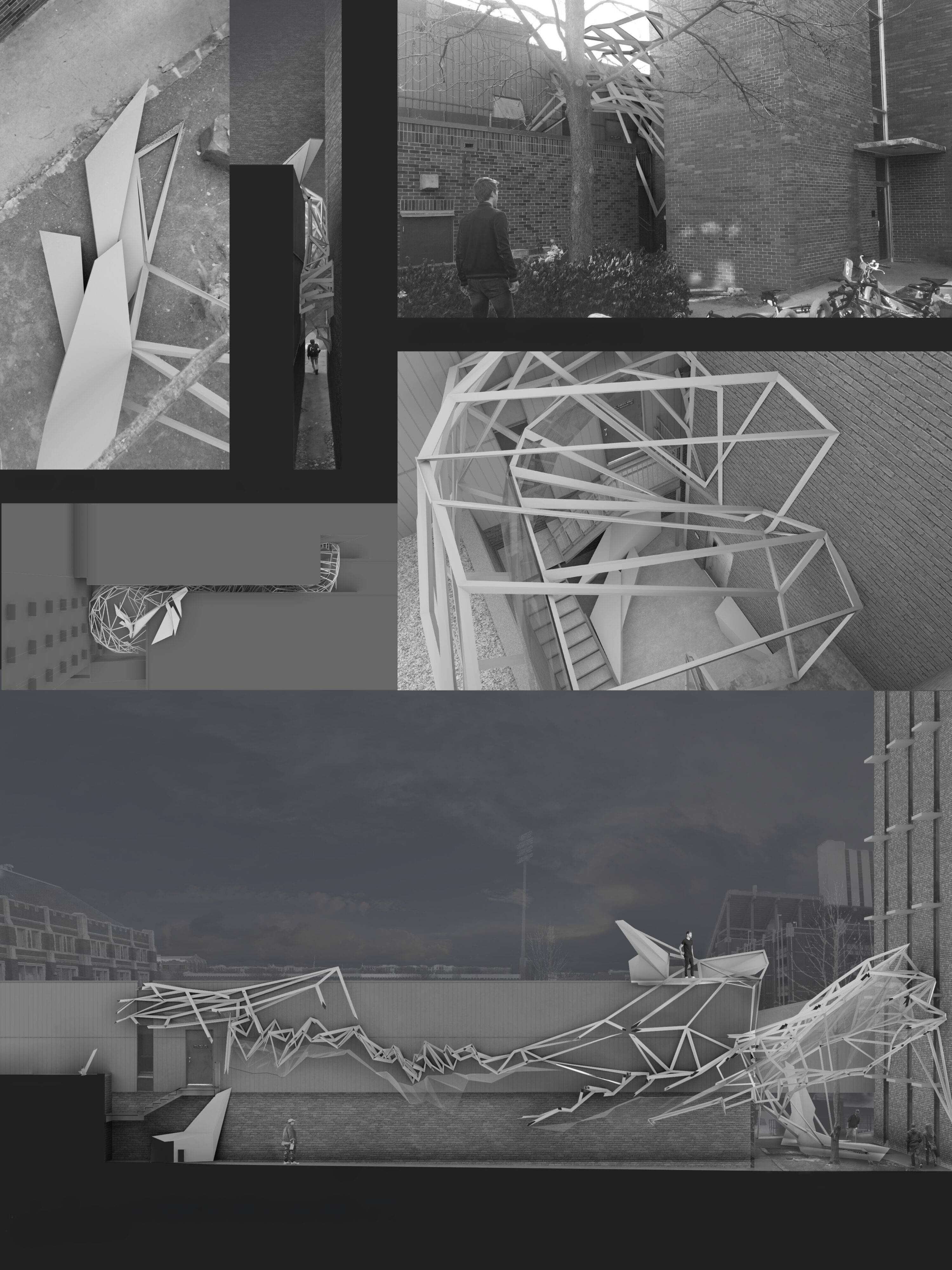
Design 3 : Crafting Place

Design 4 : Structure and Form

ARCH 2456
Second-Year Spring Studio / 2022

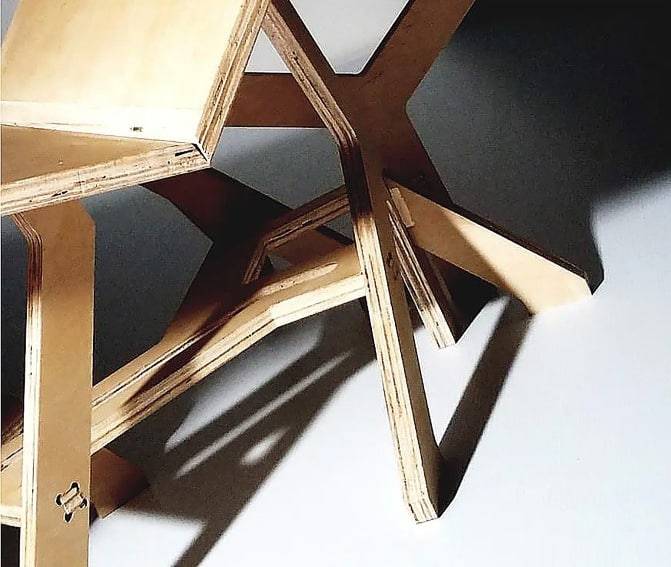
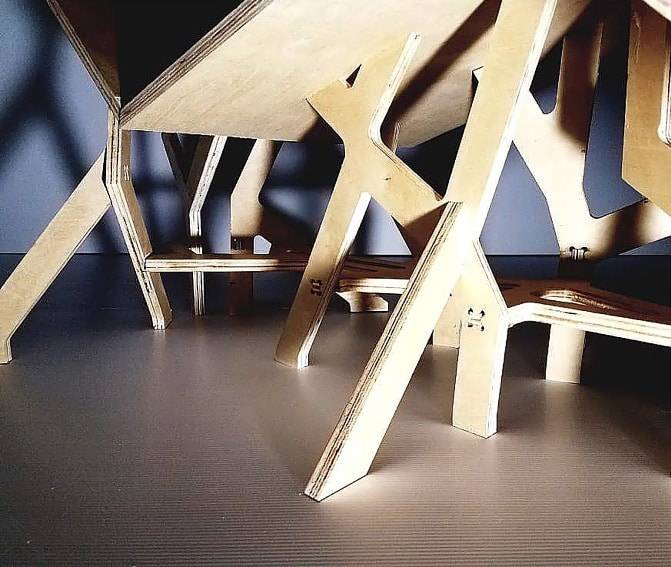
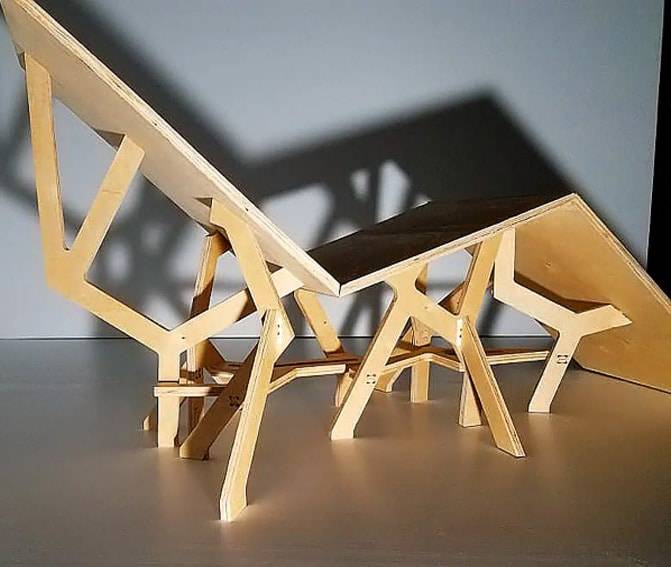
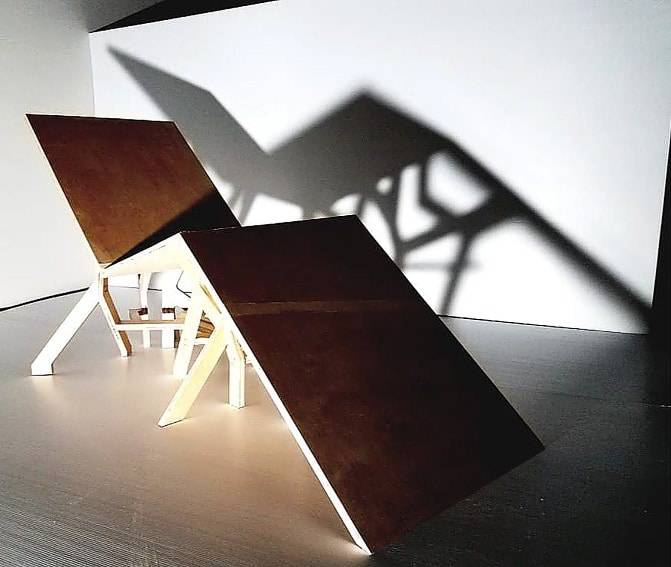
Design 4: Structure and Form investigates the relationship between material, structure, and spatial organization as a framework for architectural design. Students explore how geometry, construction logic, and environmental context shape architectural experience. The studio challenges students to move fluidly between conceptual design and tectonic resolution, translating abstract ideas into constructible form.

Through iterative modeling, drawing, and fabrication, students analyze how structure can both define and transform spatial character. Emphasis is placed on clarity of intent, precision of craft, and the ability to communicate architectural systems through visual and material expression. By connecting design research to real-world conditions, Design 4 cultivates a rigorous understanding of how architecture is made—how ideas become space, and how structure drives form.

Course Overview

Design IV: Structure and Form is an intermediate undergraduate design studio that examines the integration of structural systems and spatial design. The course challenges students to approach architecture as both a conceptual and technical discipline, where form is informed by performance, material, and assembly. Students explore how tectonic principles, site relationships, and environmental factors influence design thinking. Through analysis and experimentation, they learn to synthesize structural clarity, spatial complexity, and contextual awareness into coherent architectural propositions.

The studio emphasizes iterative making and critical inquiry as essential tools for developing design intuition. Students are encouraged to question how materials behave, how forces are resolved, and how spatial order can emerge from construction logic. The result is an evolving understanding of architecture as a synthesis of art, science, and craft.

Objectives

The primary objective of Design IV is to develop an intermediate fluency in design that bridges conceptual thinking and construction logic. Students explore structural systems as compositional tools and examine how materials perform under different conditions. Through analytical studies, digital modeling, and physical prototyping, they learn to translate abstract ideas into tectonic strategies.

Students are expected to refine their visual communication skills, combining digital drawing, hybrid representation, and crafted models to articulate design intent. The course also introduces fundamental environmental and life-safety considerations, teaching students how context, climate, and occupancy affect architectural performance. The studio promotes independent thinking, encouraging students to develop personal design methodologies while working collaboratively within a critical and supportive studio culture.
Projects

Projects in Design IV bridge concept and constructability, guiding students through iterative exercises that address structure, materiality, and context. The semester culminates in a comprehensive design project that integrates site, environmental systems, and tectonic expression into a cohesive architectural proposal.

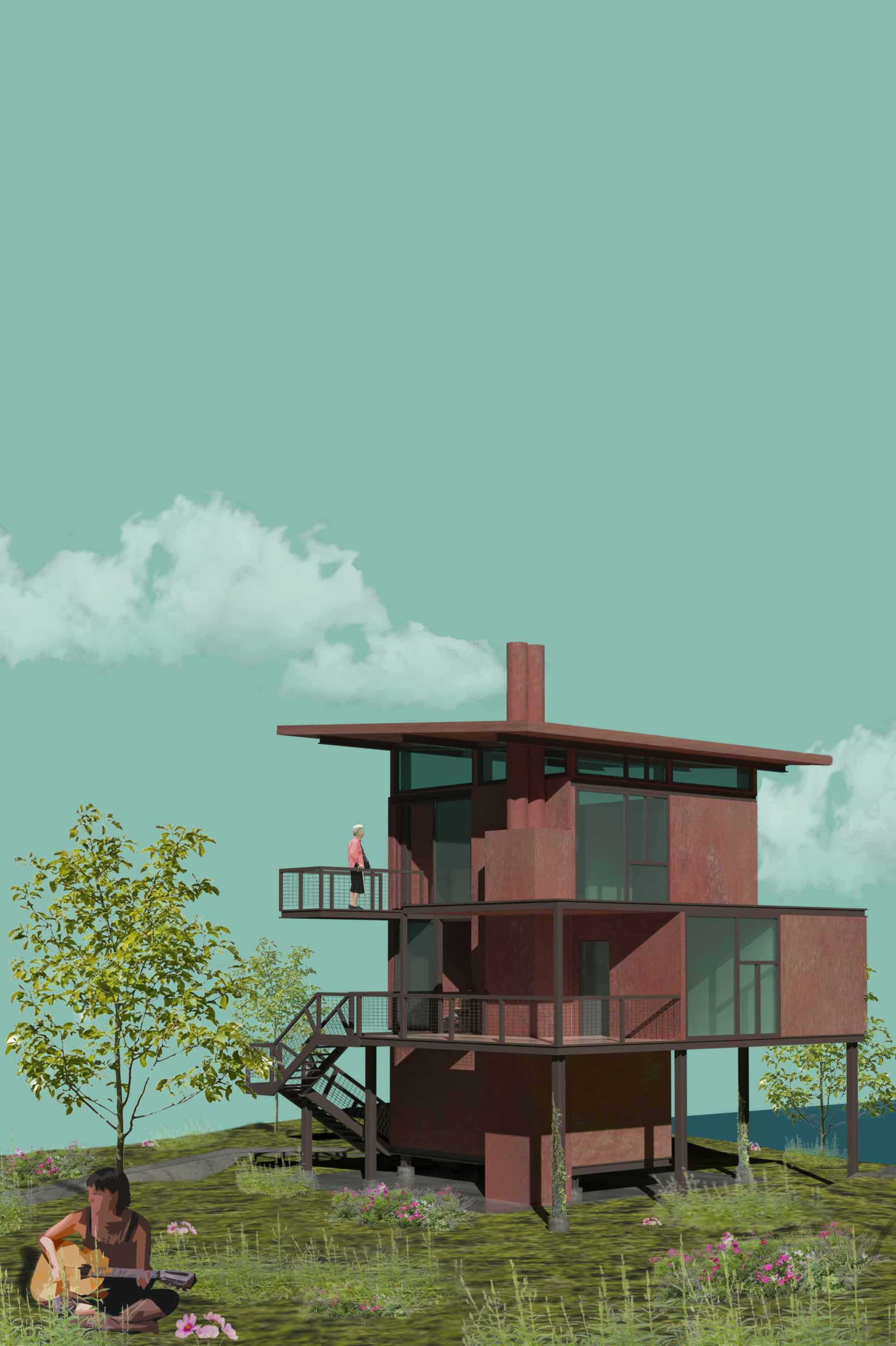
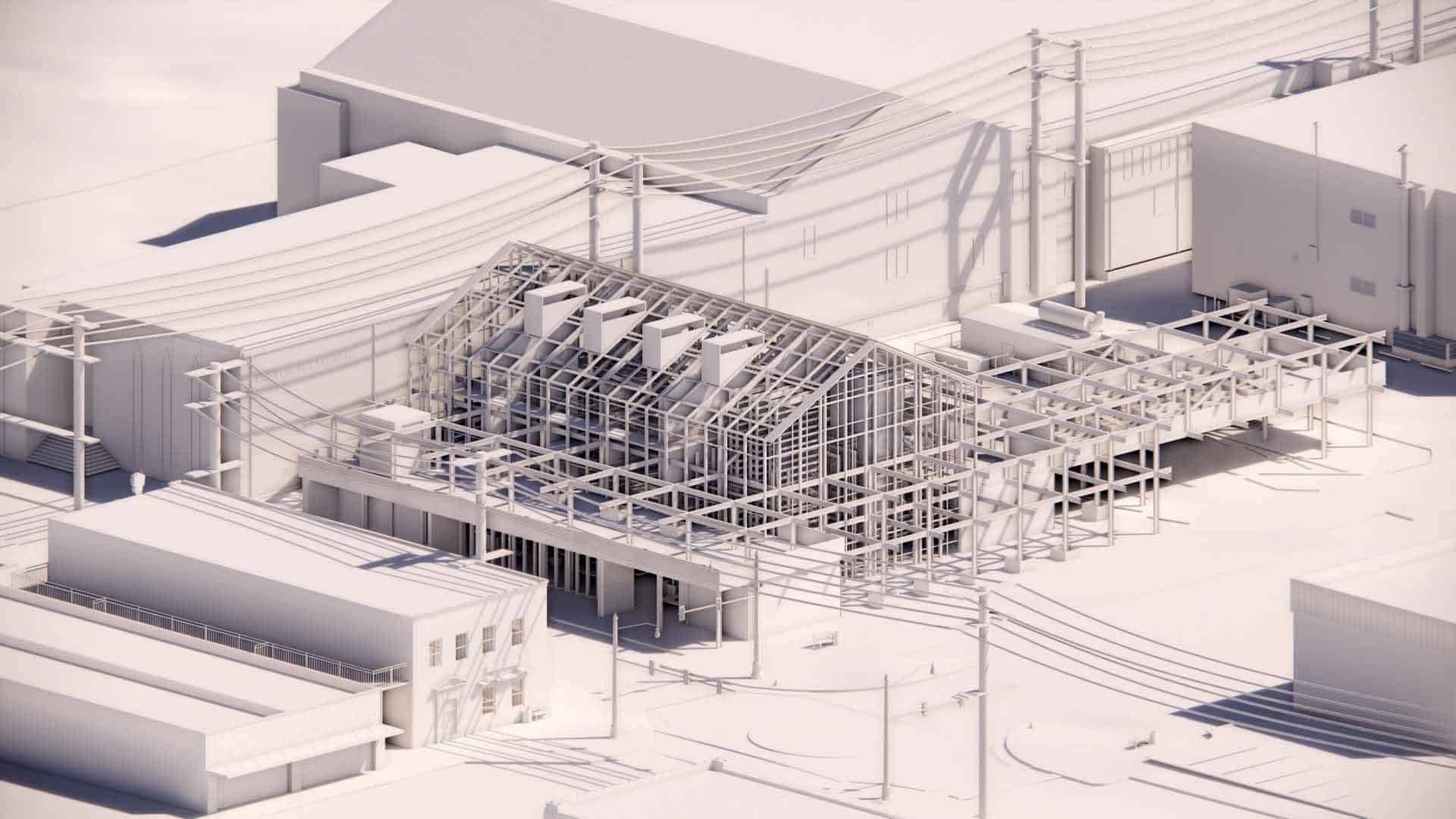
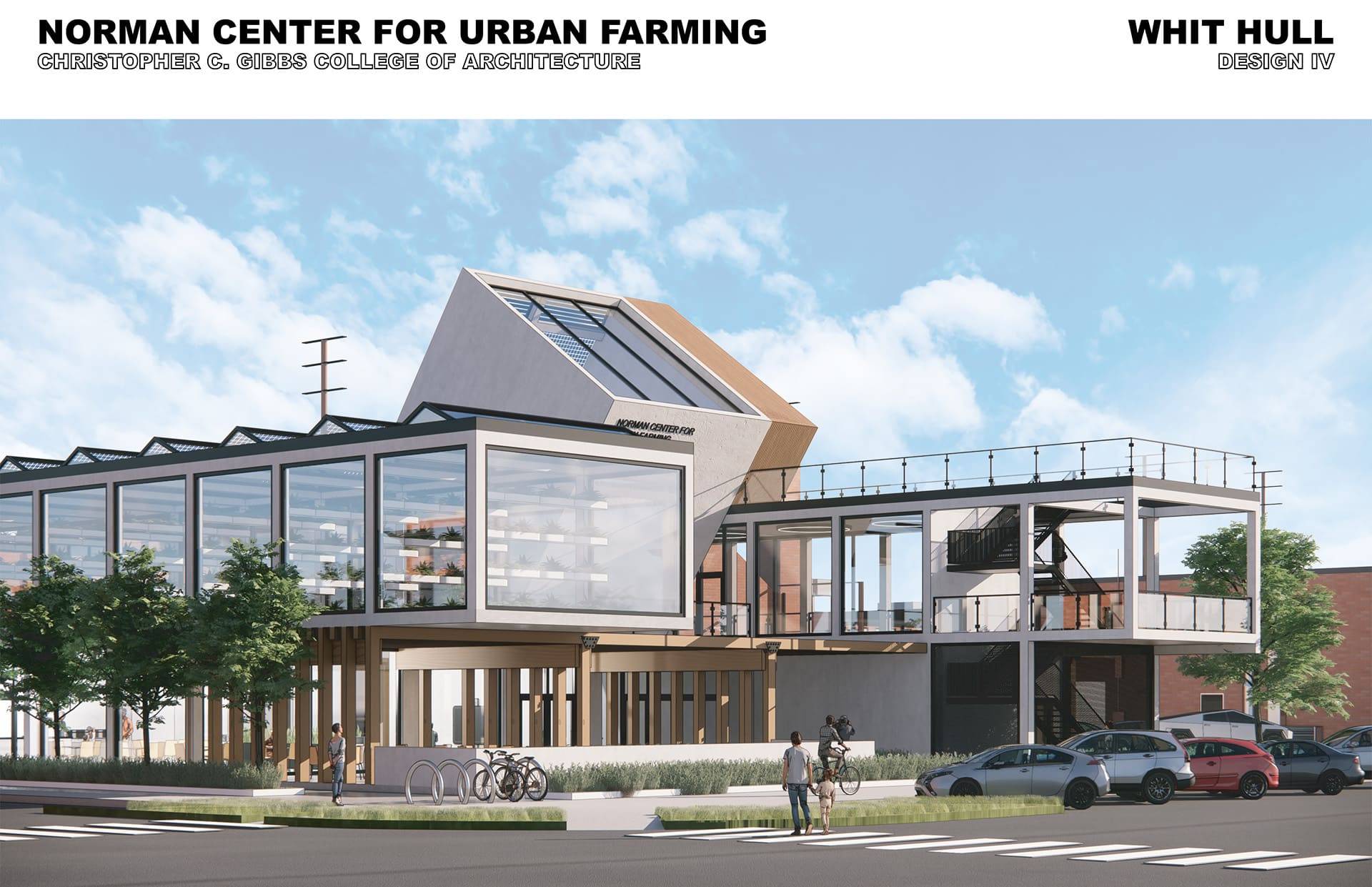
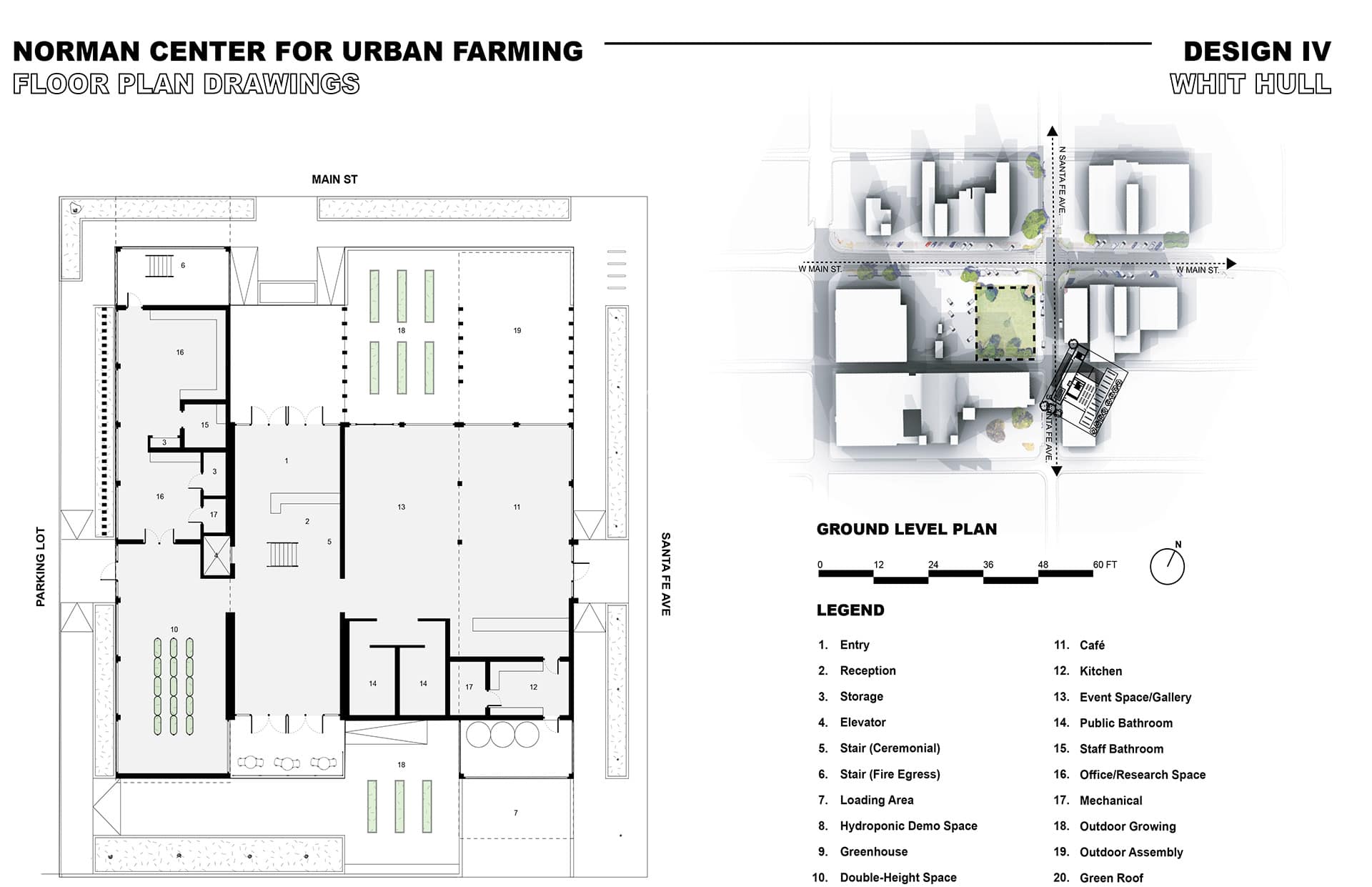
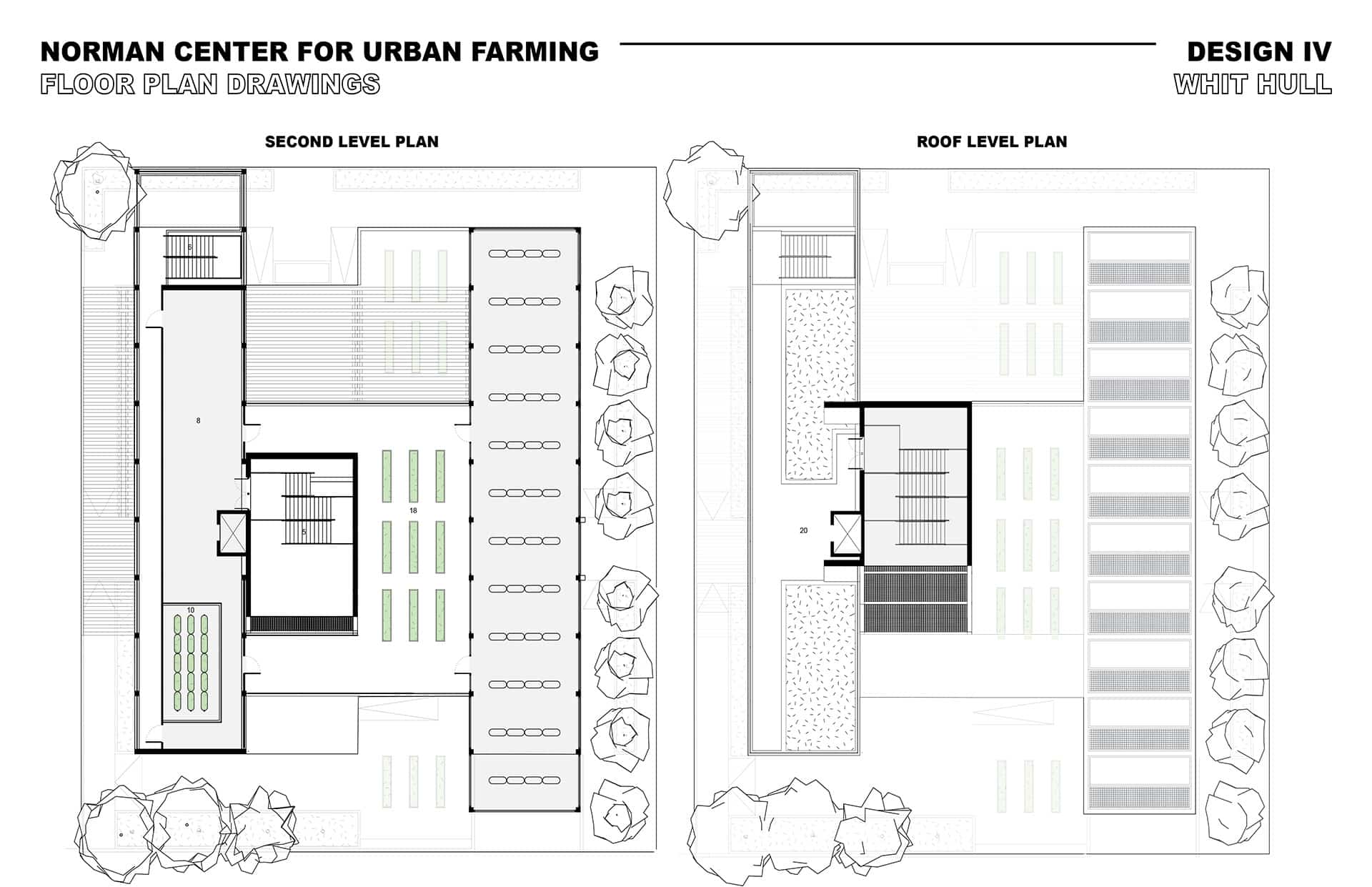
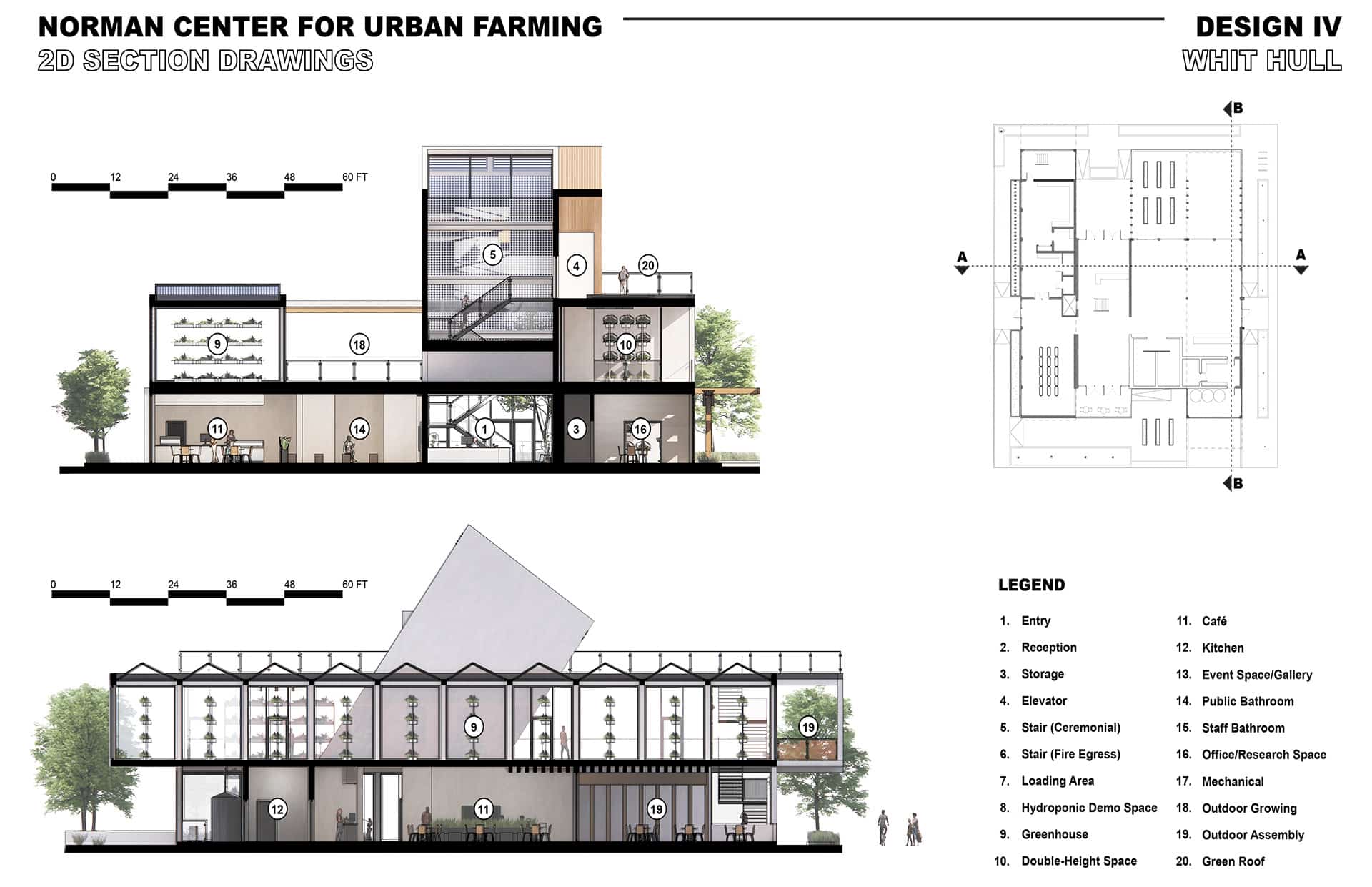
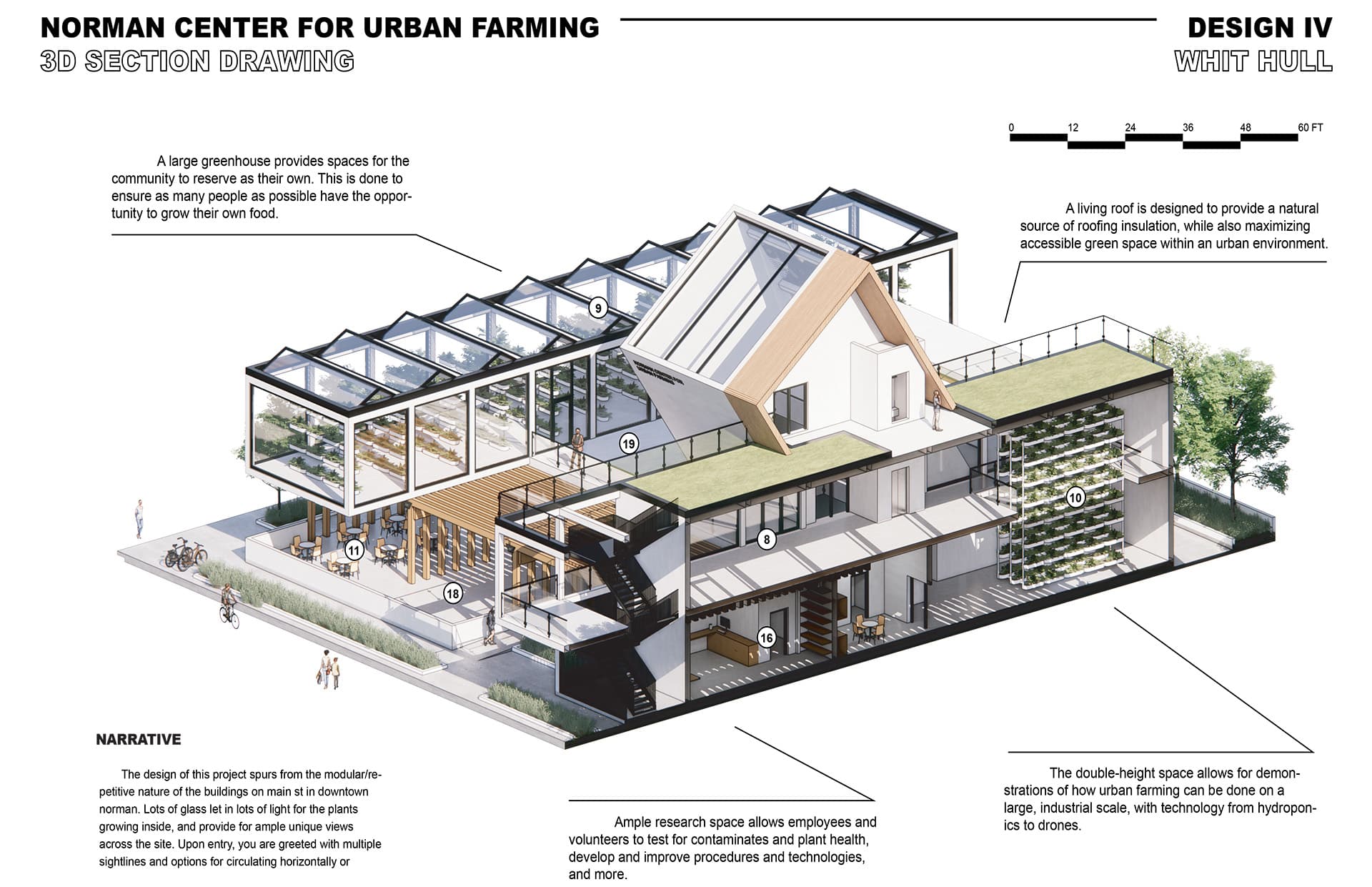
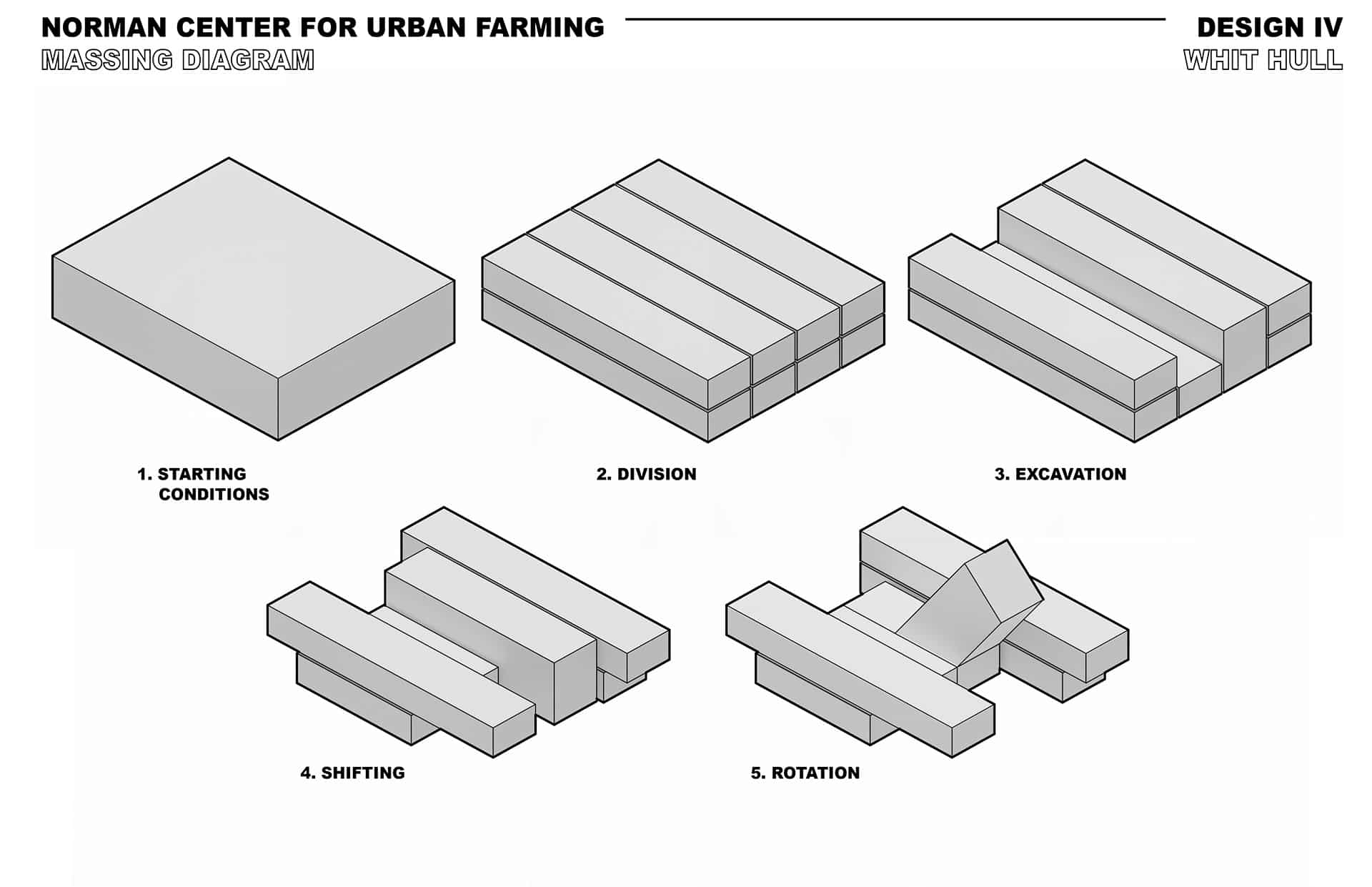
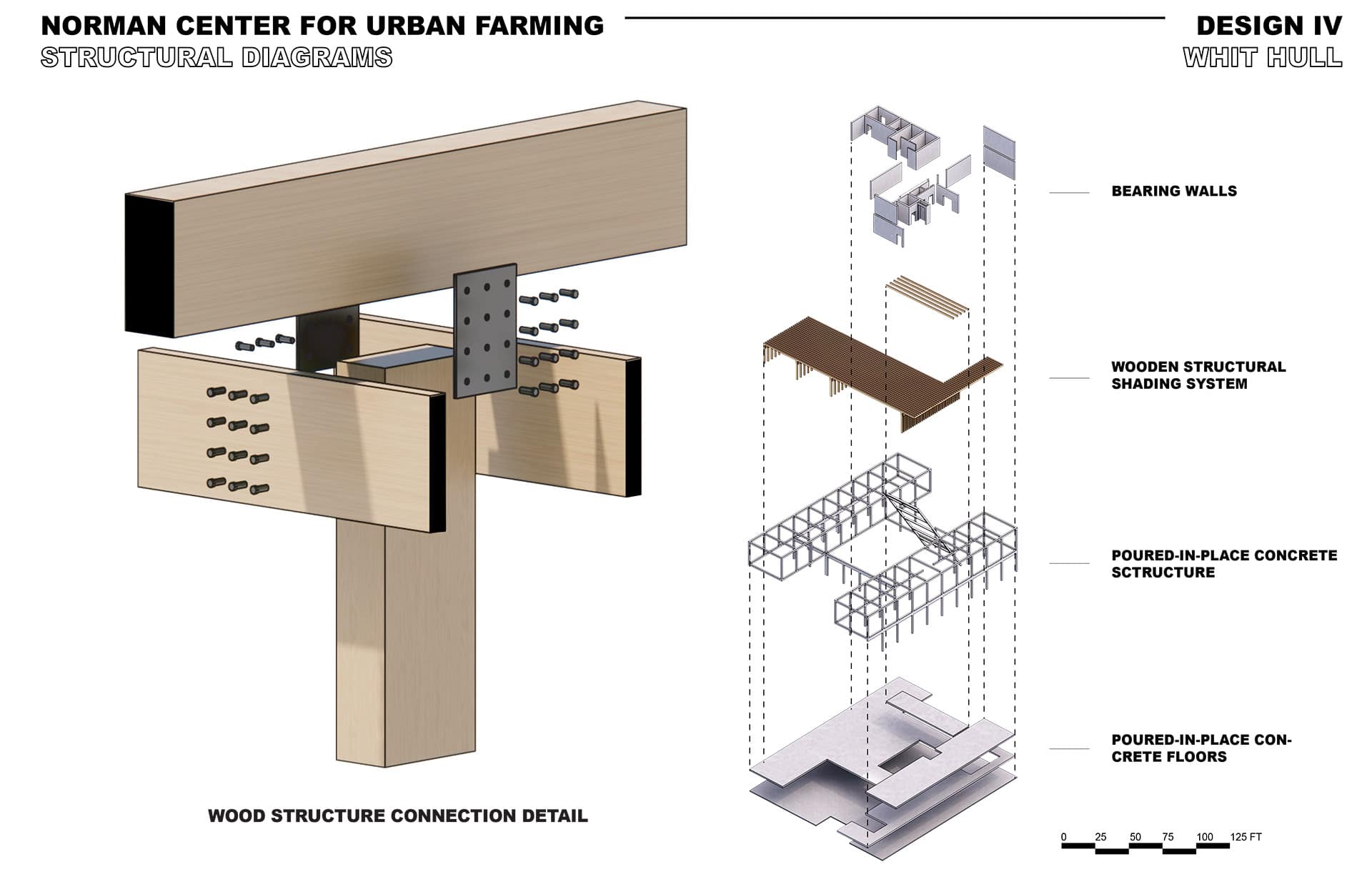
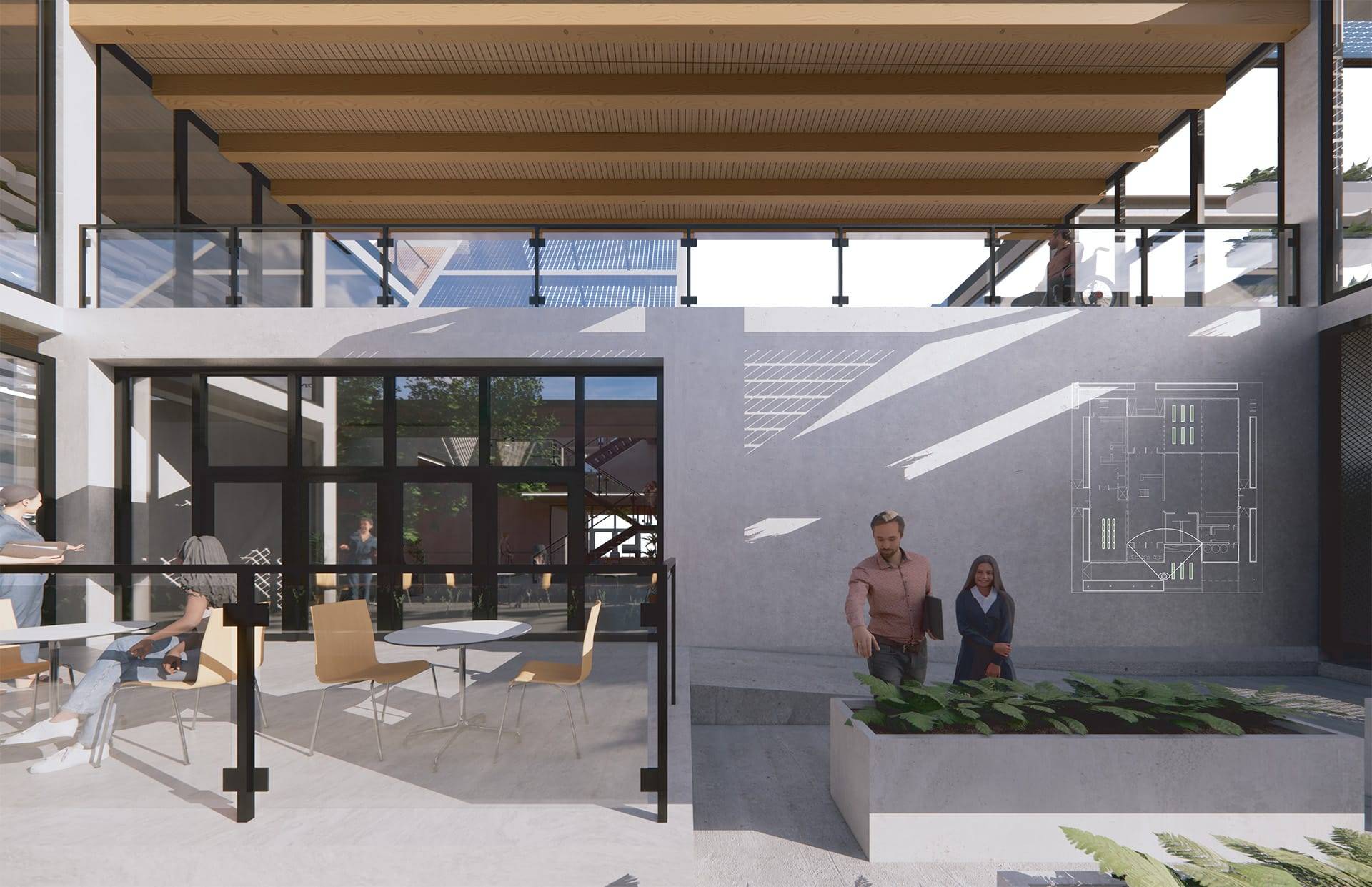
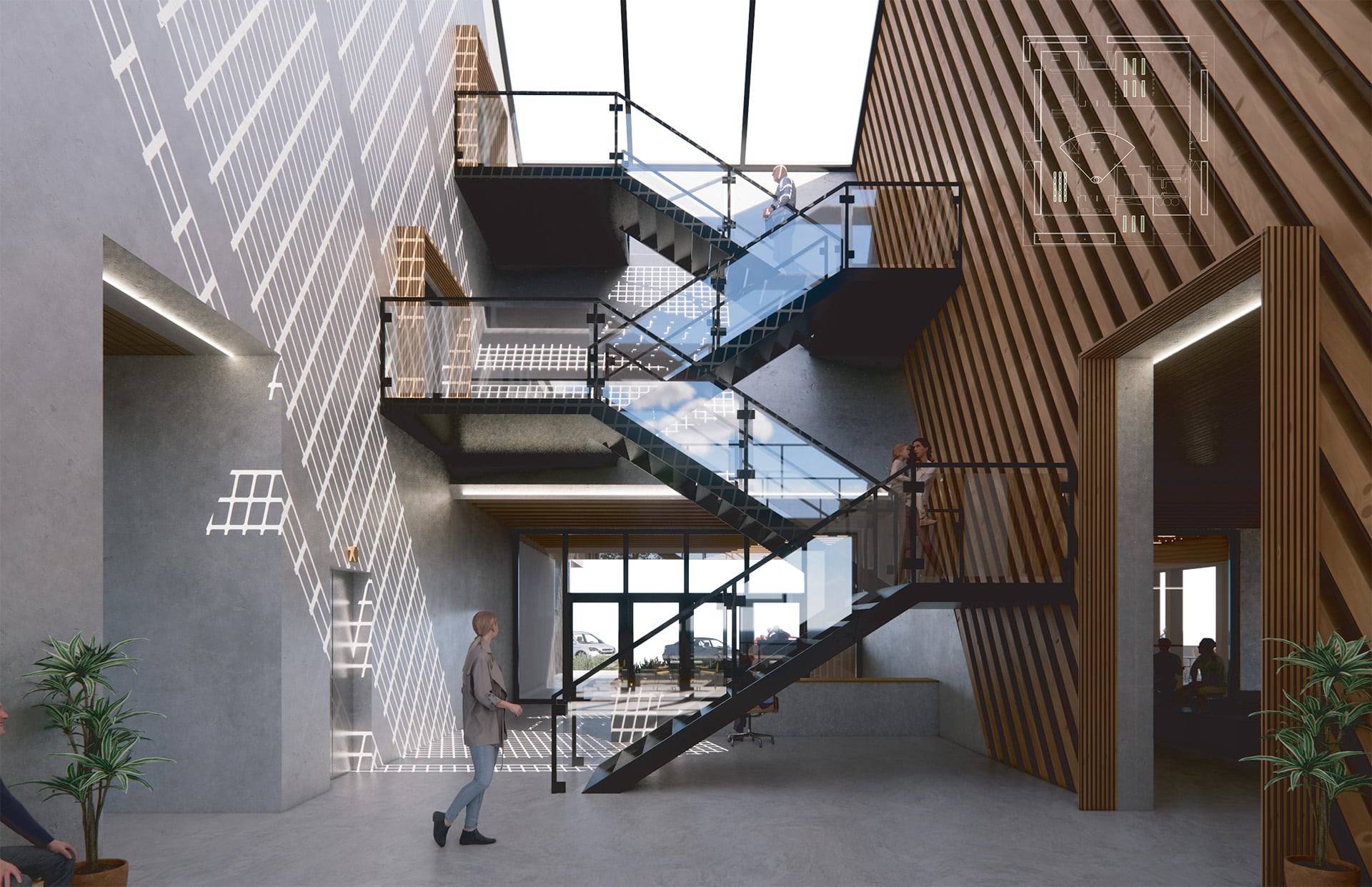
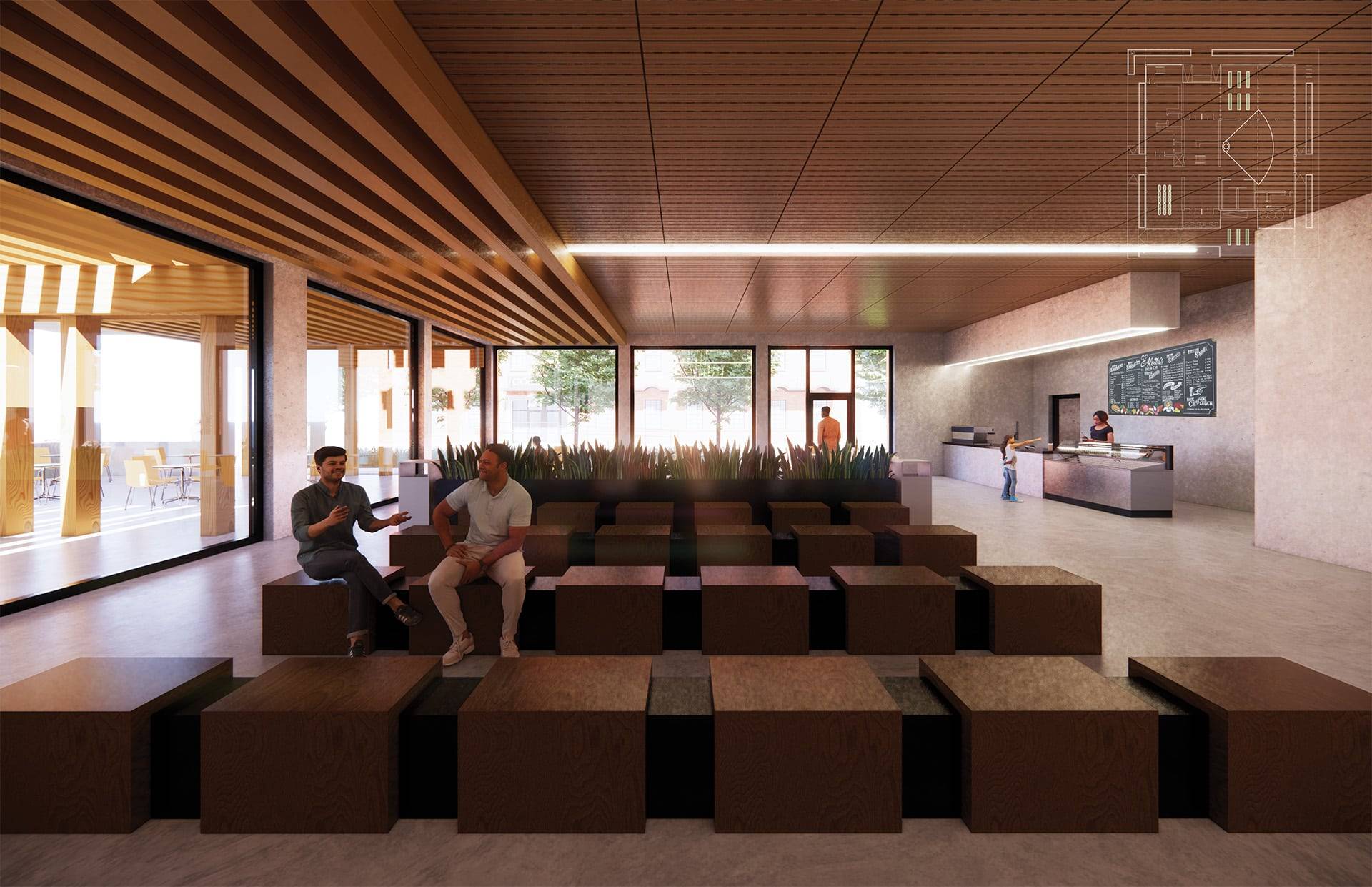
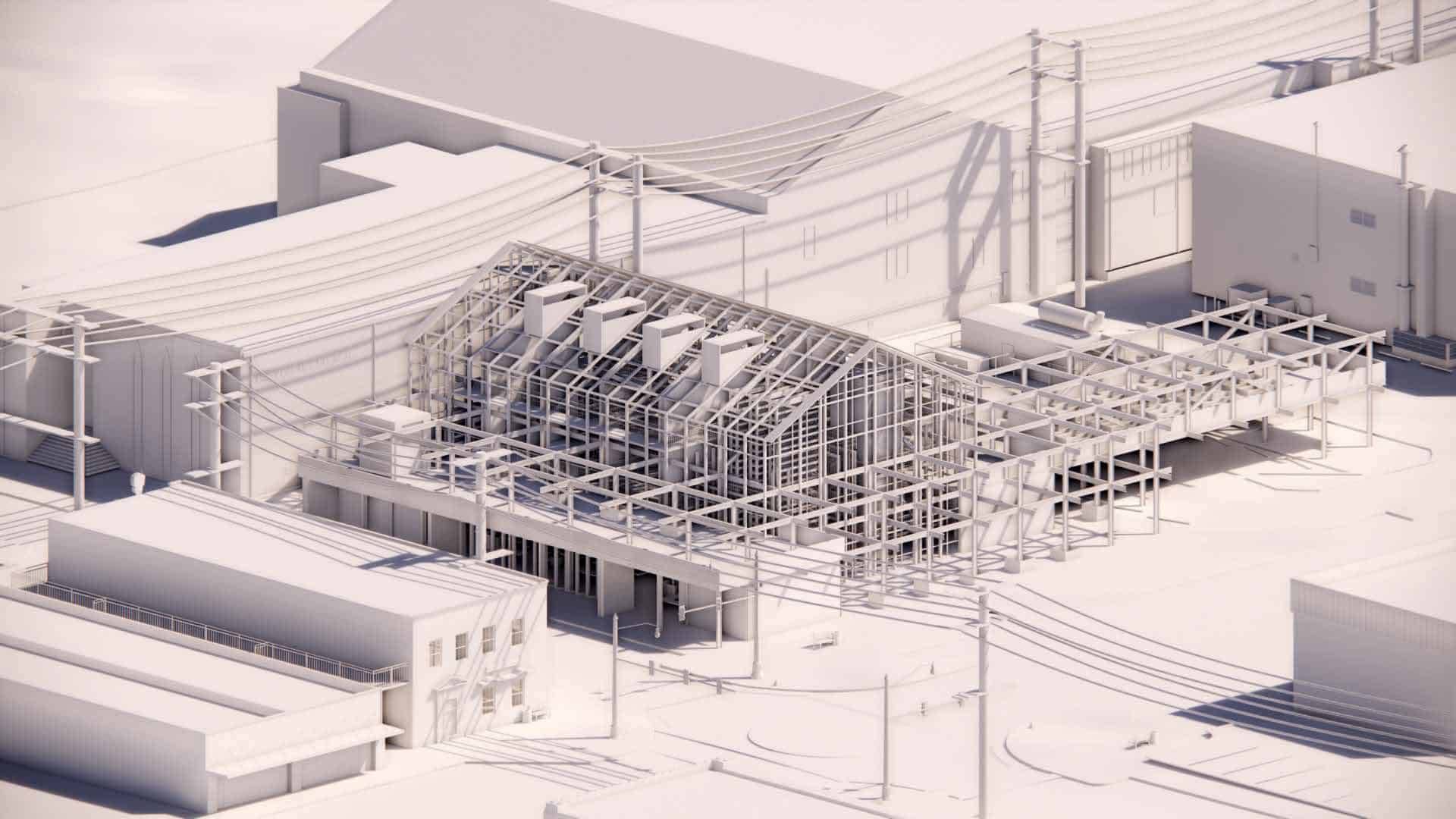
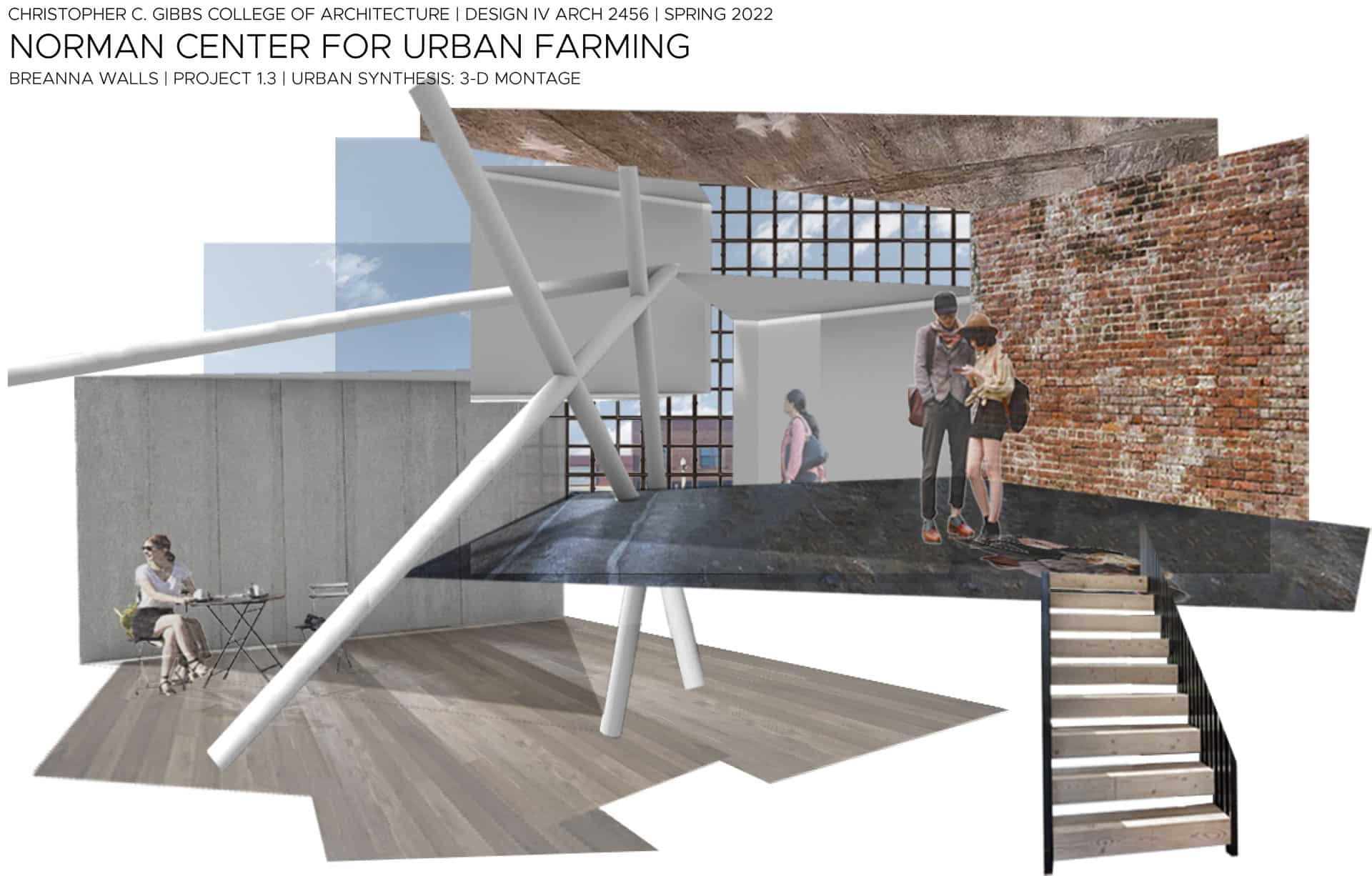
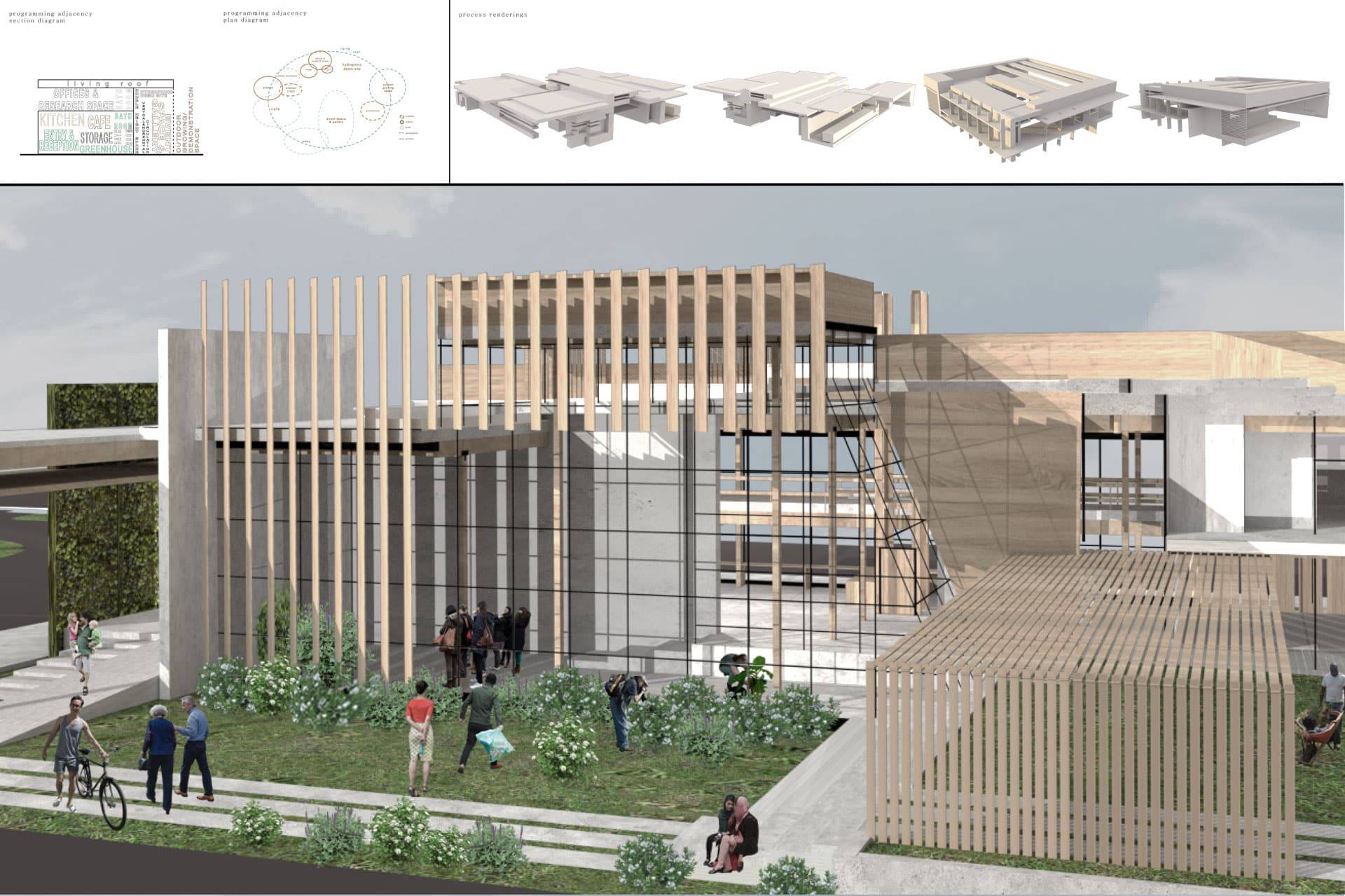
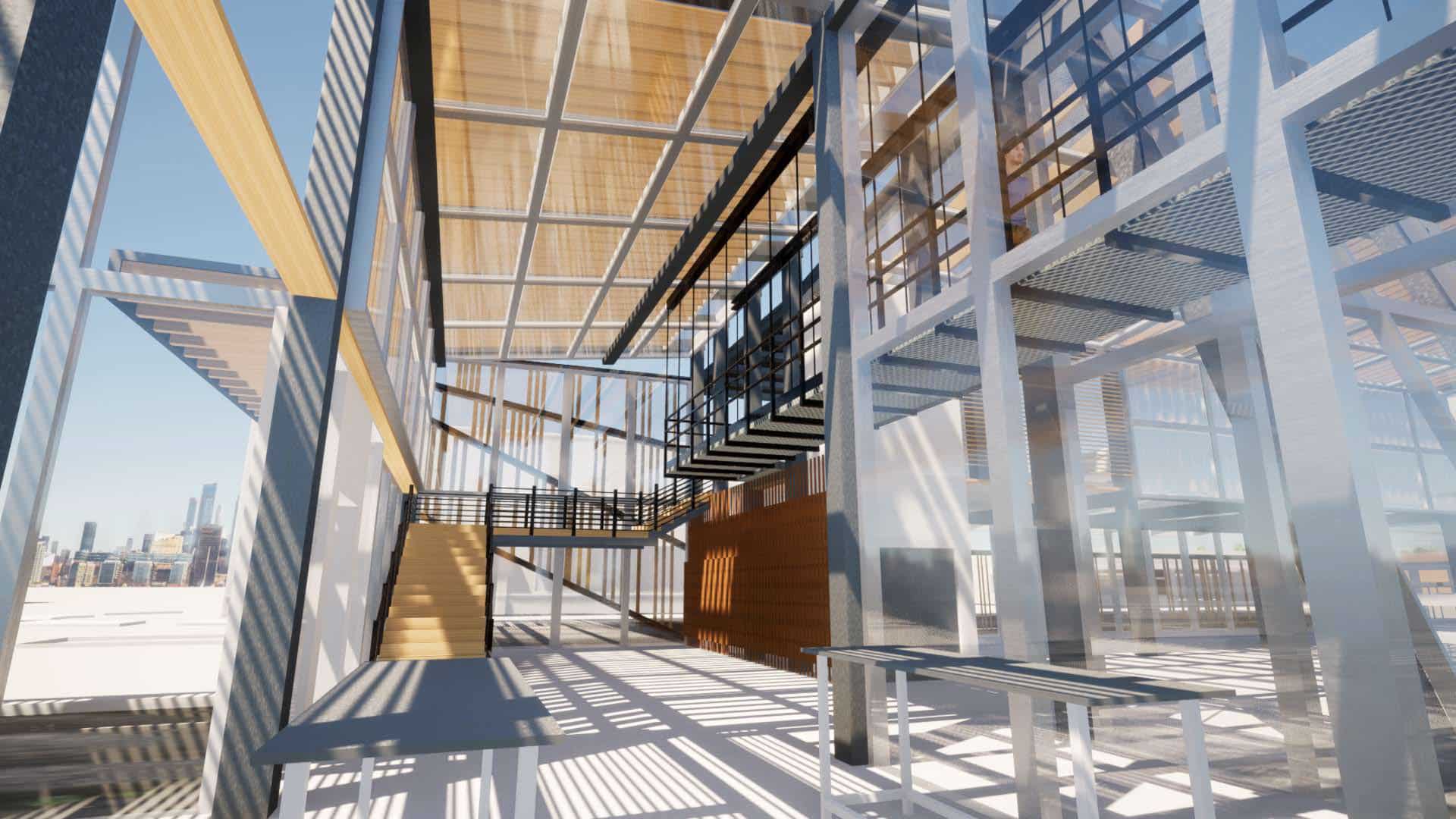
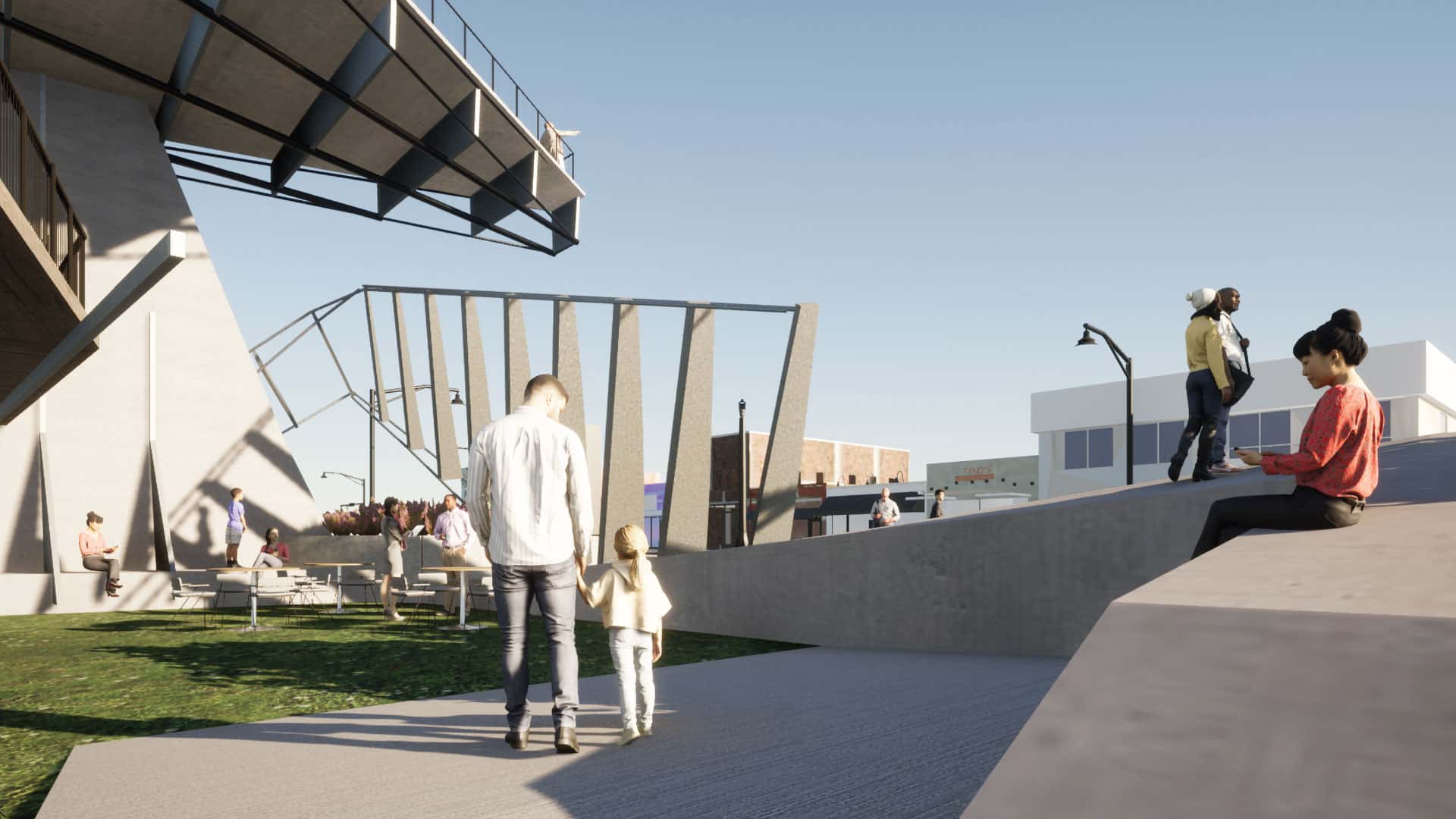
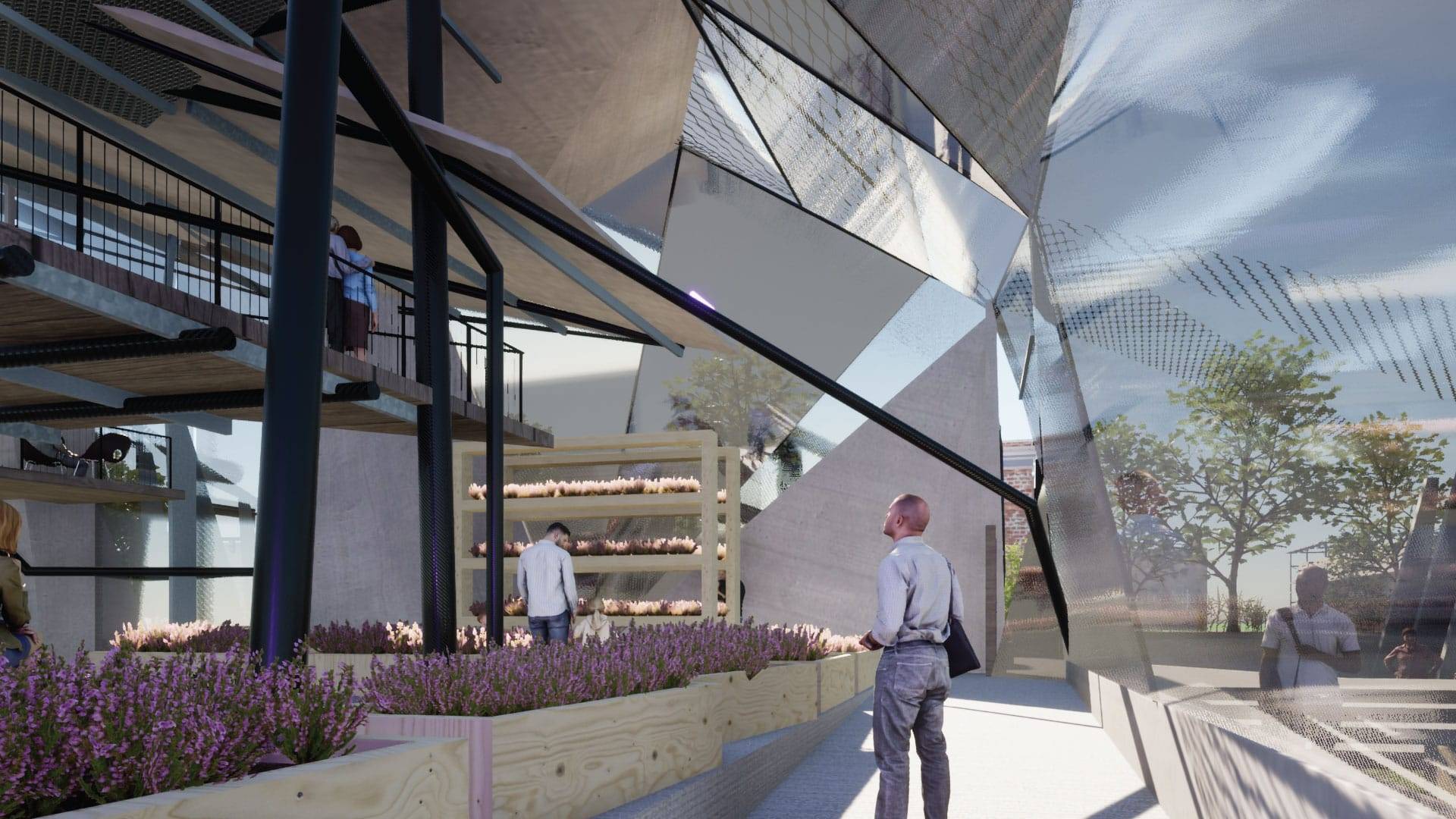
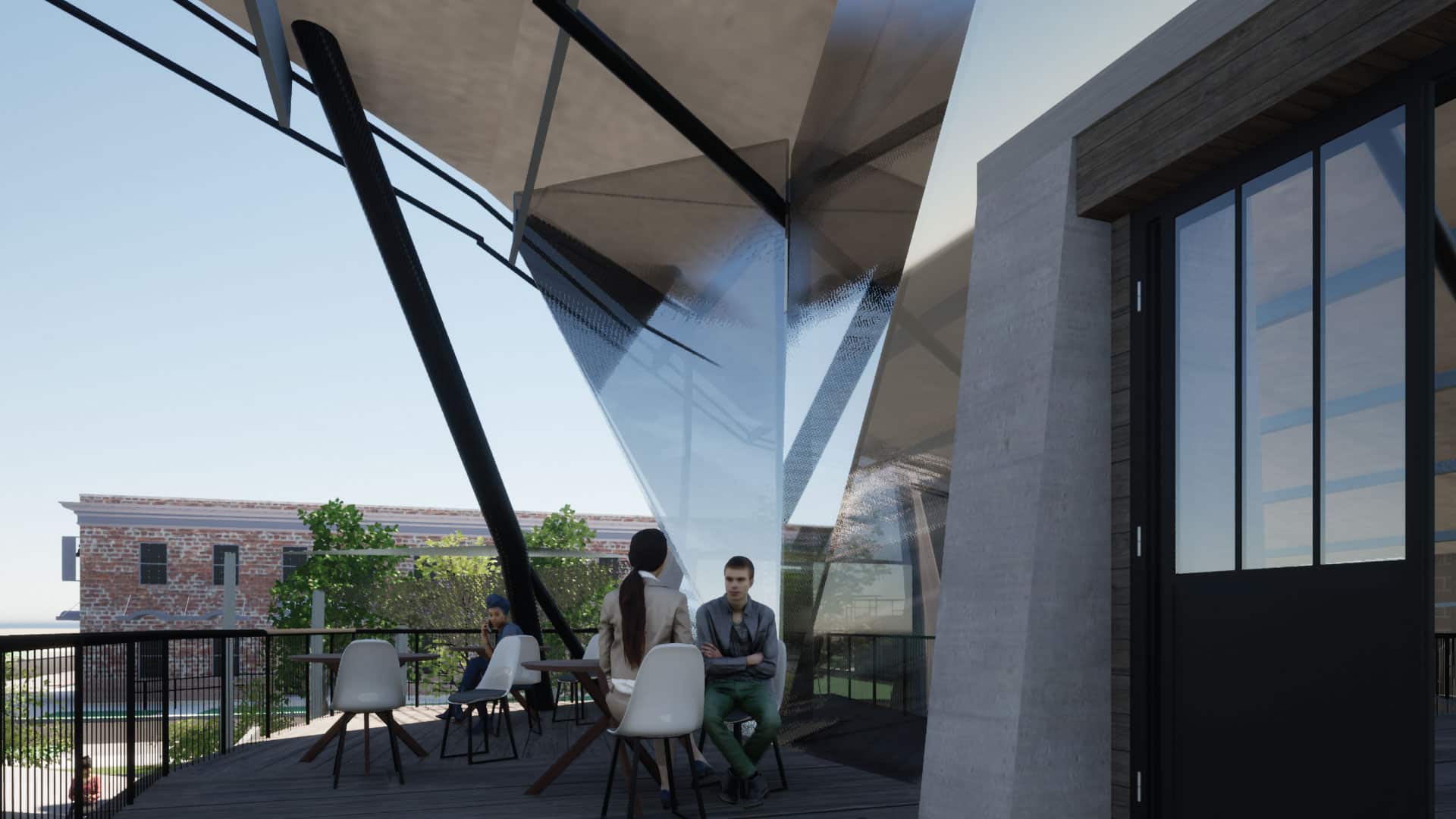
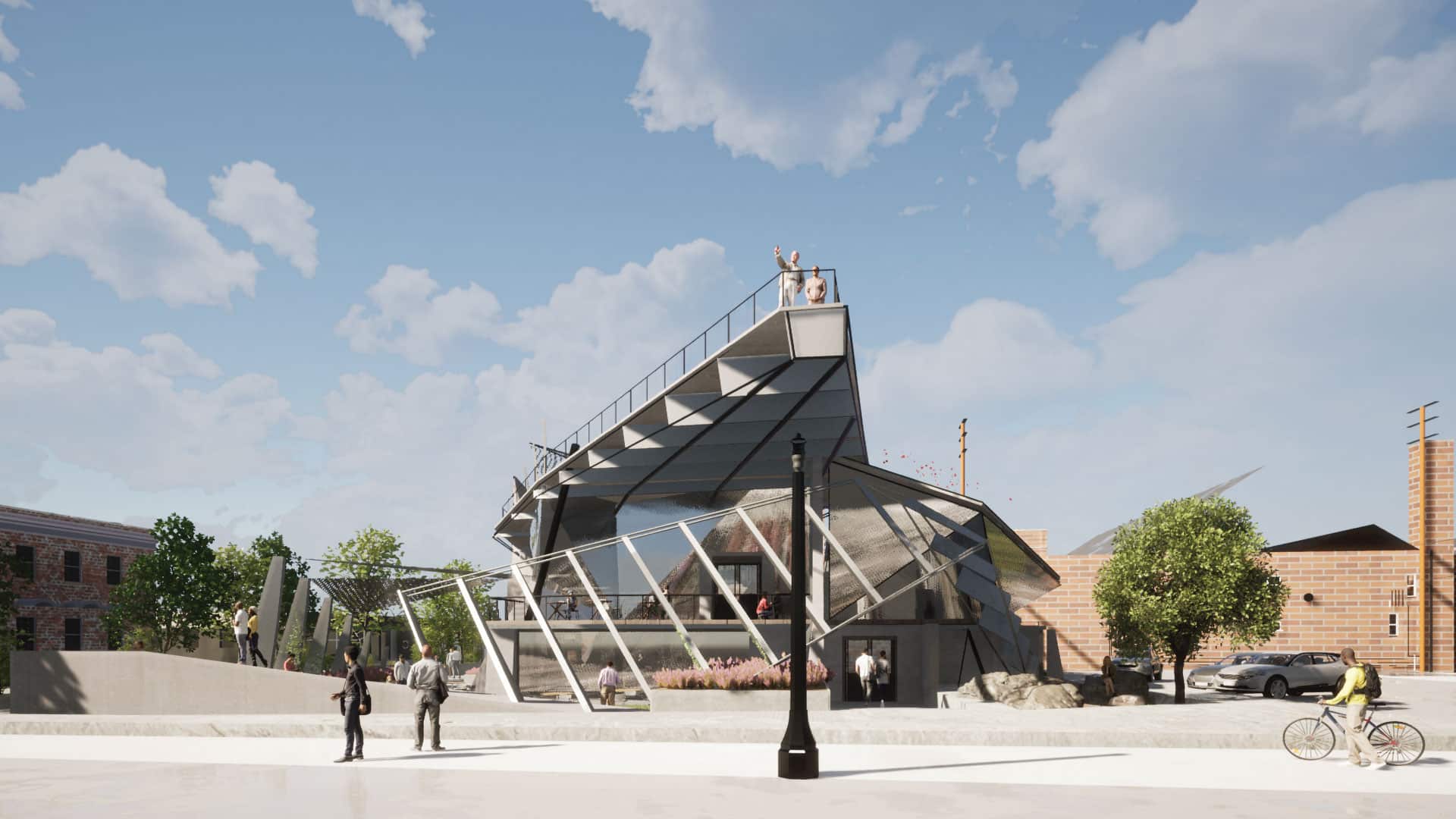
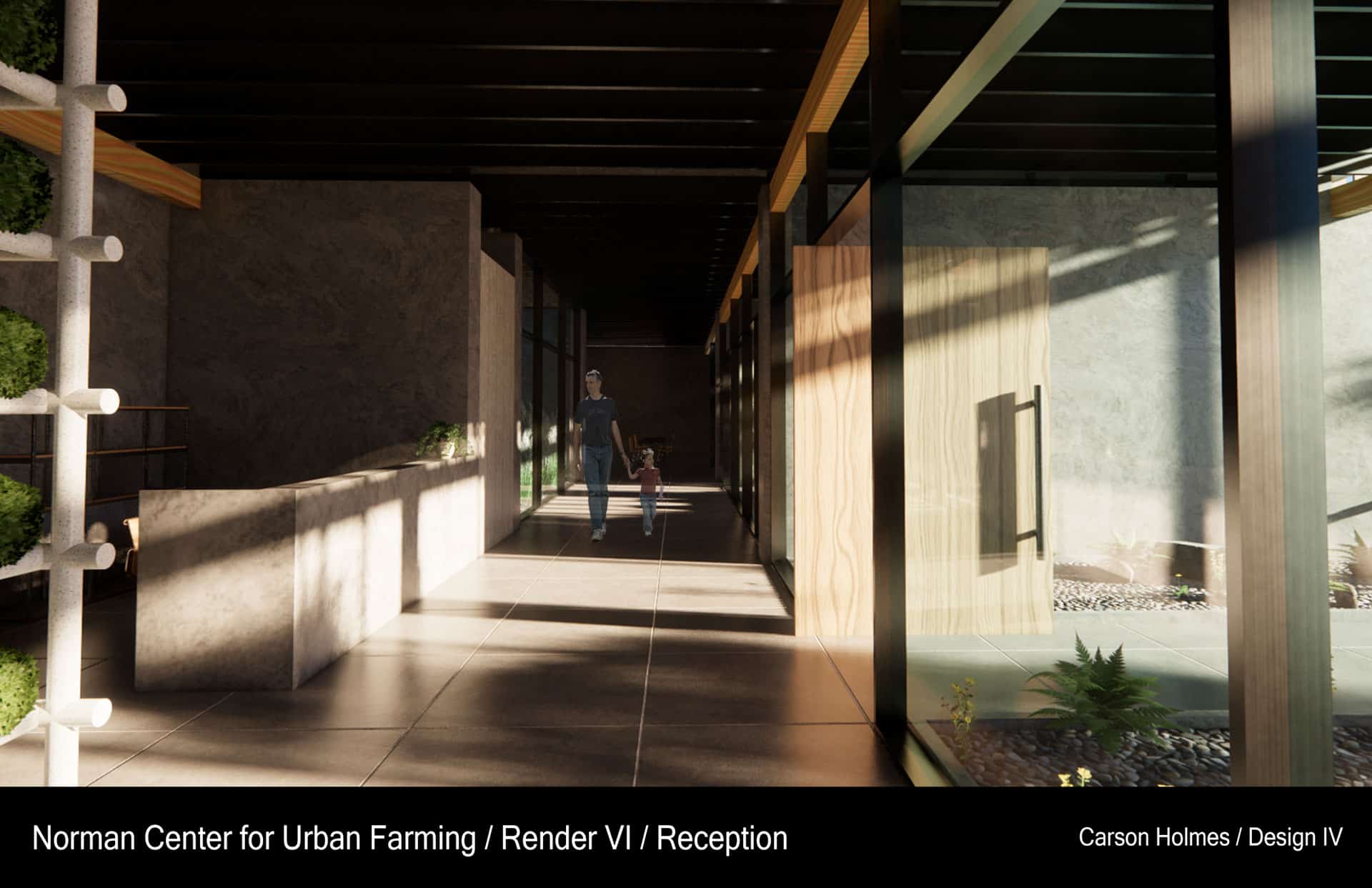
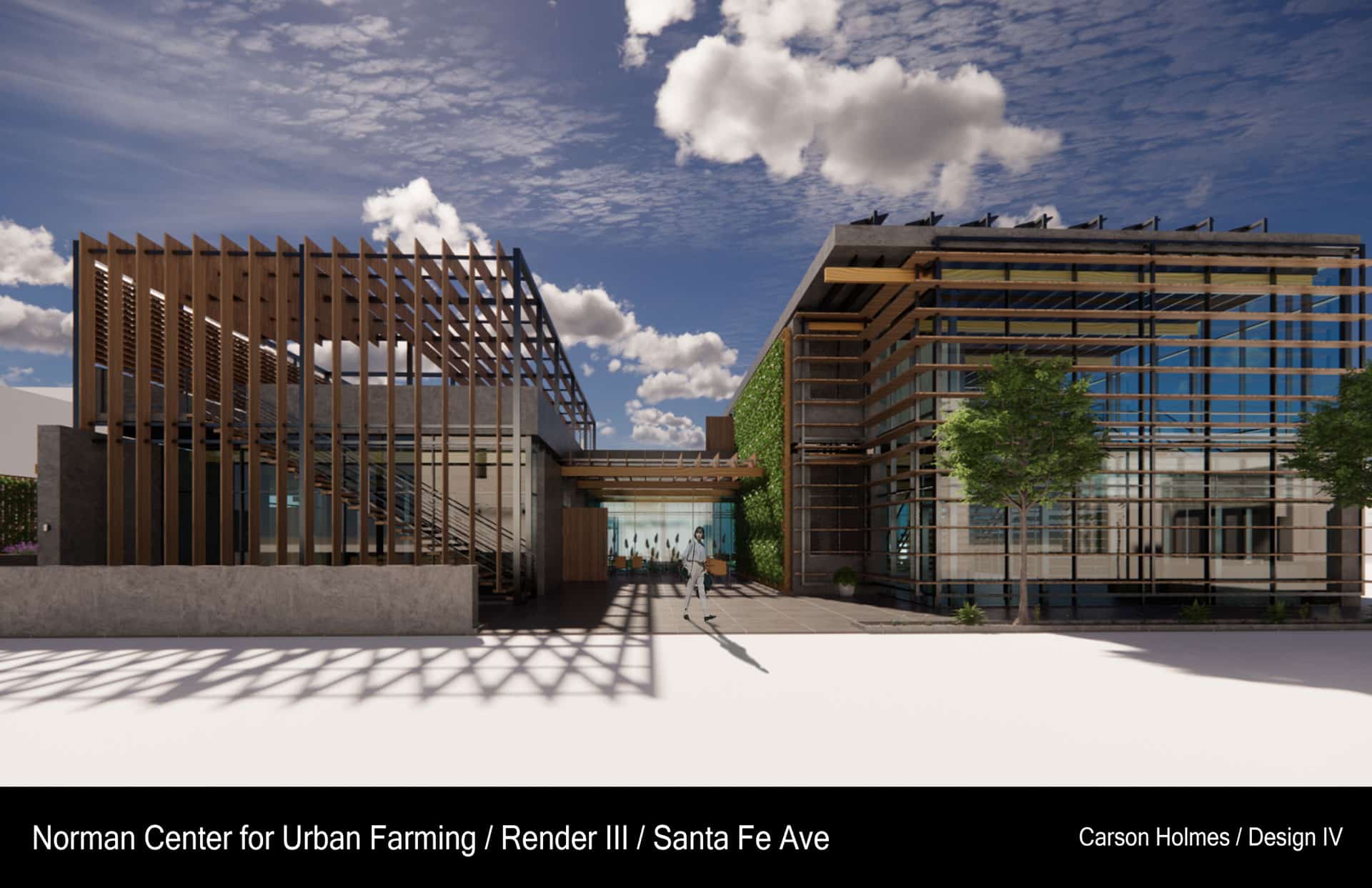
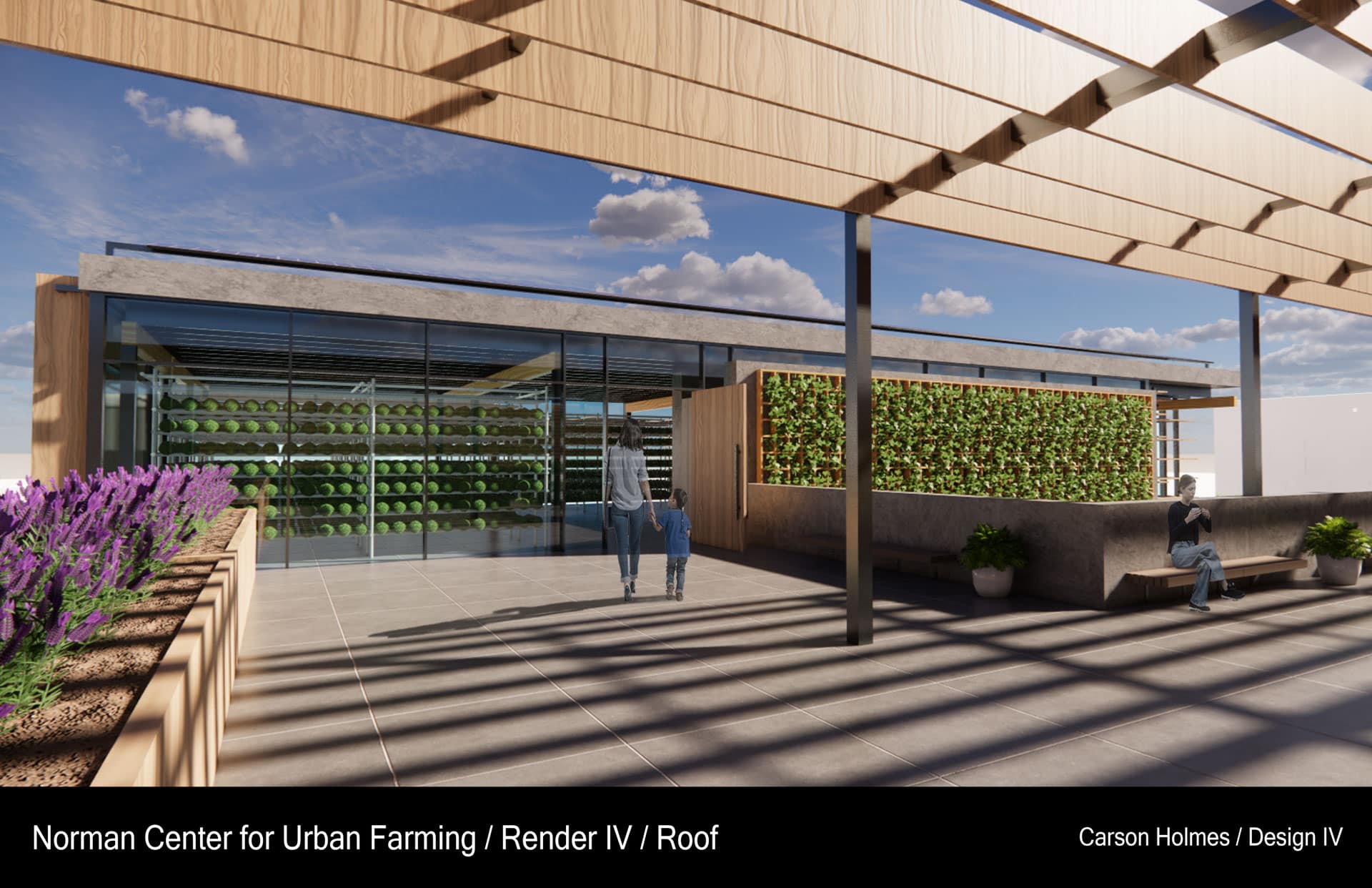
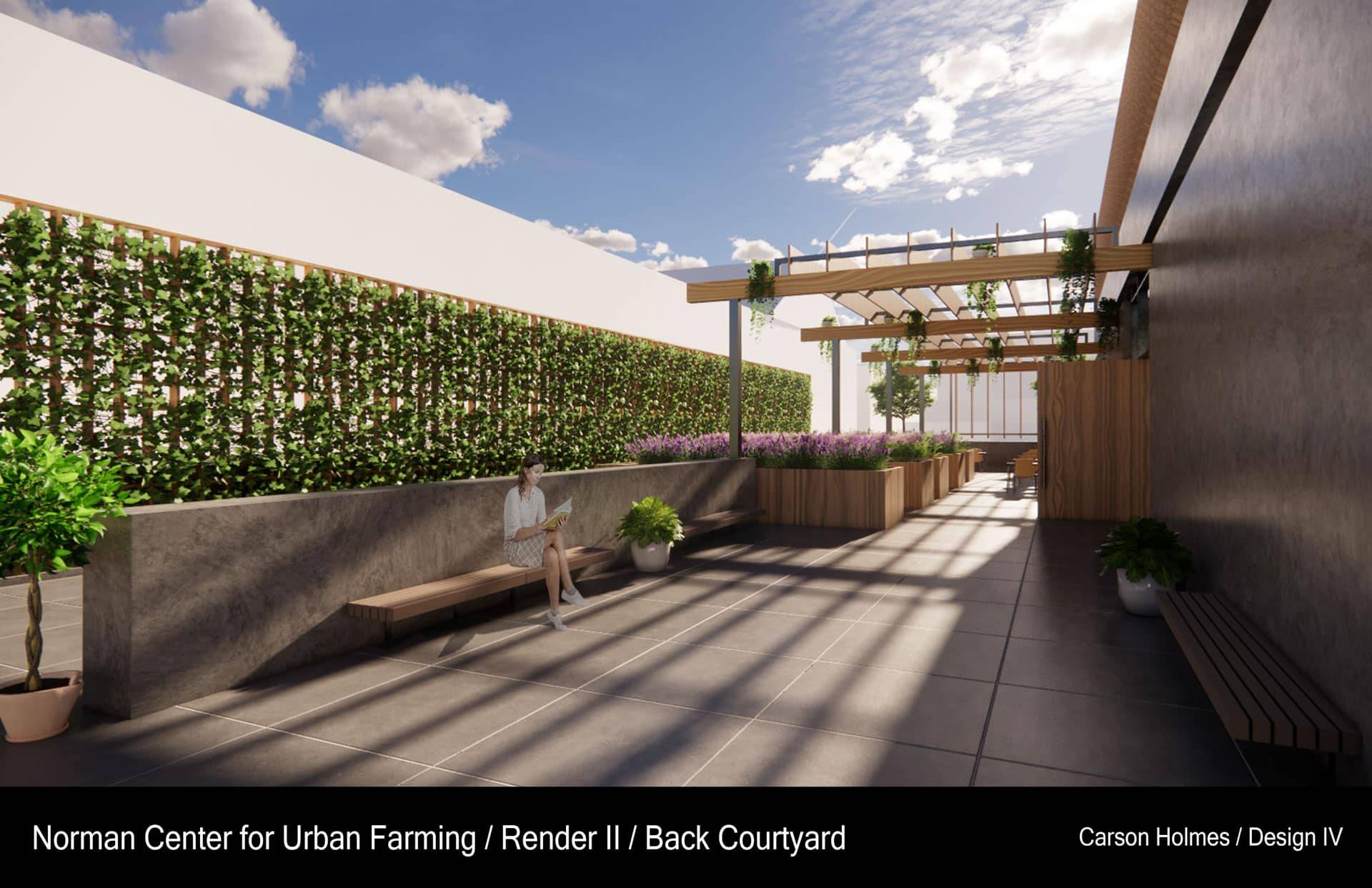
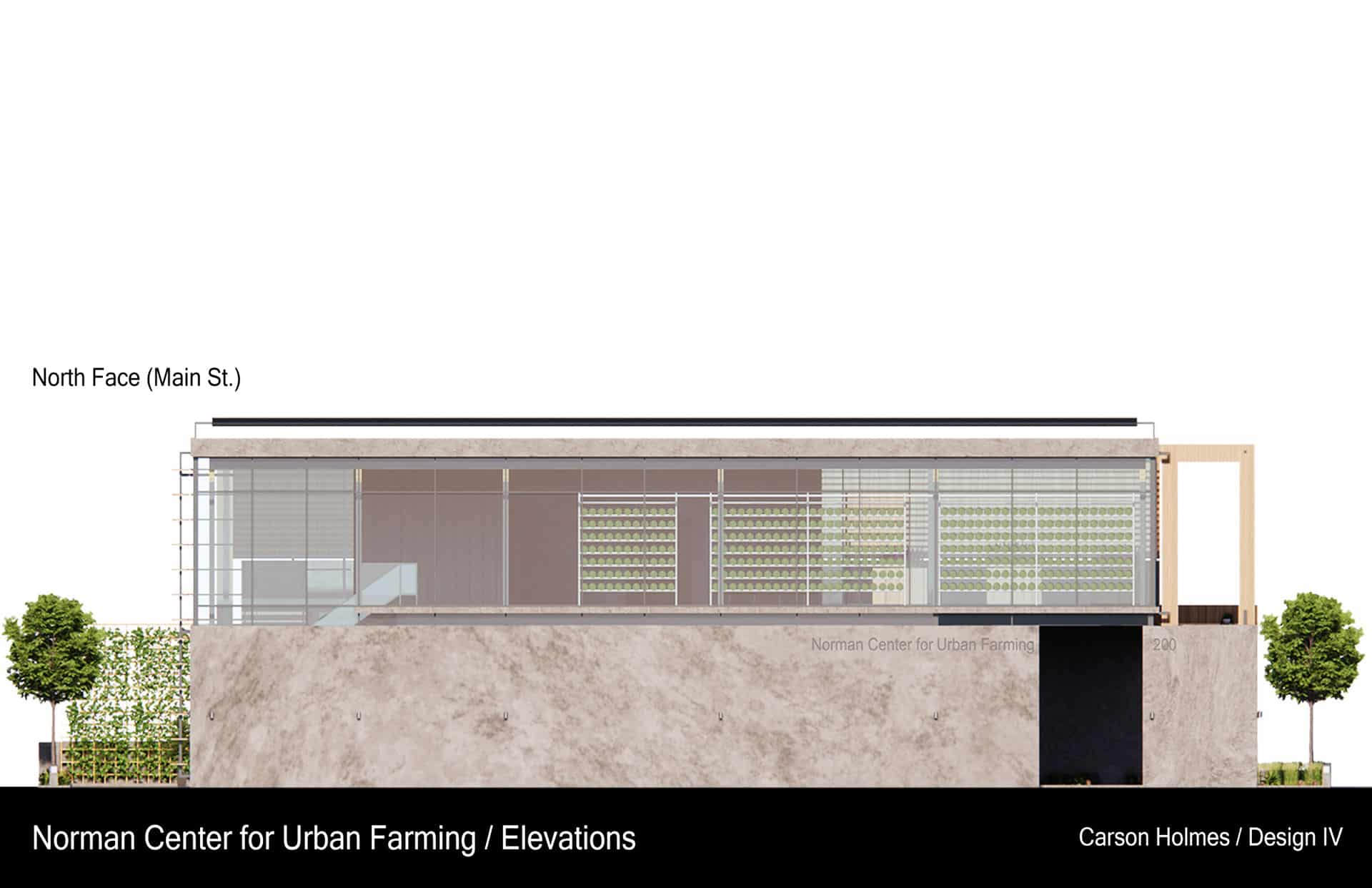
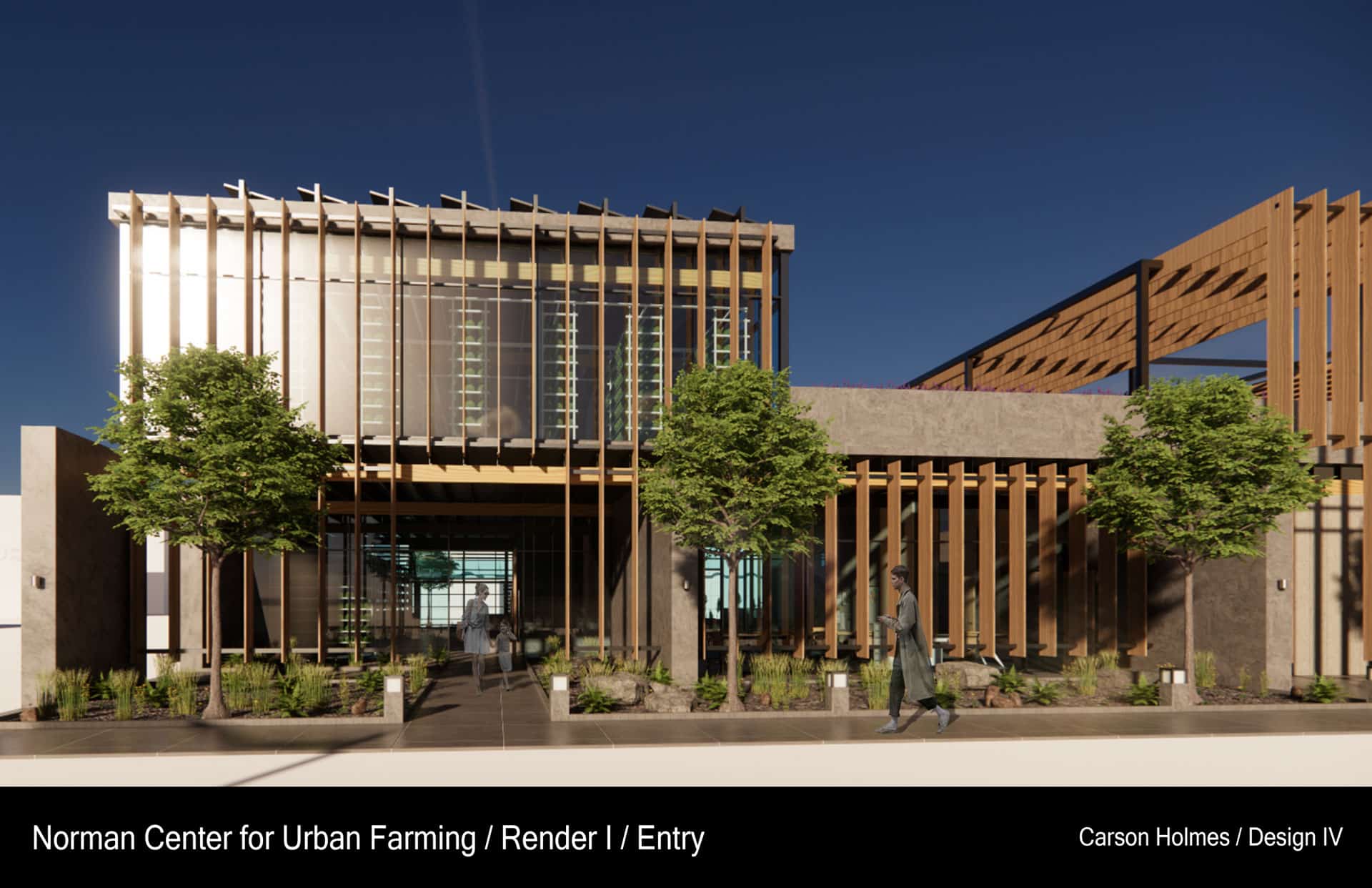
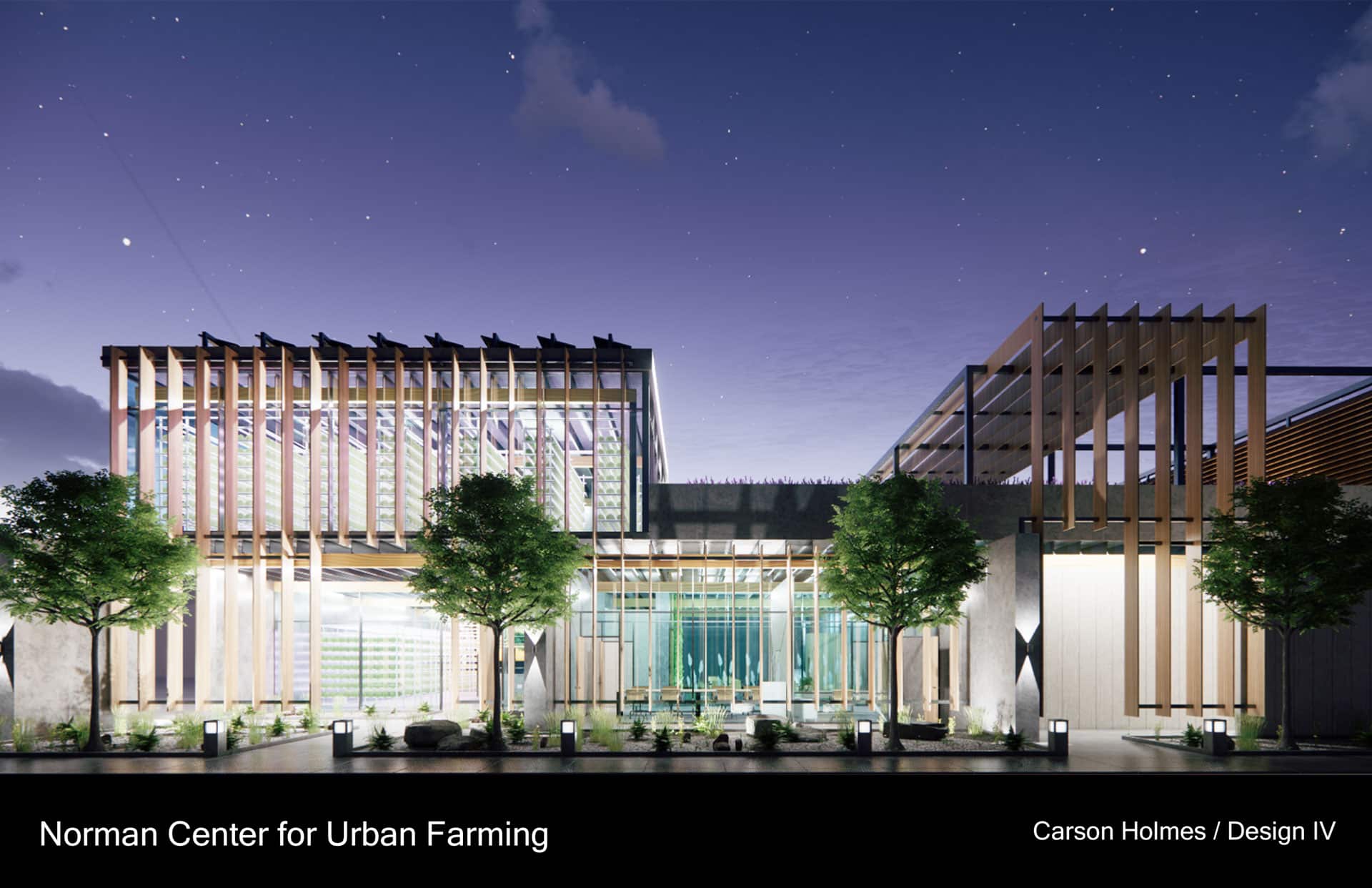
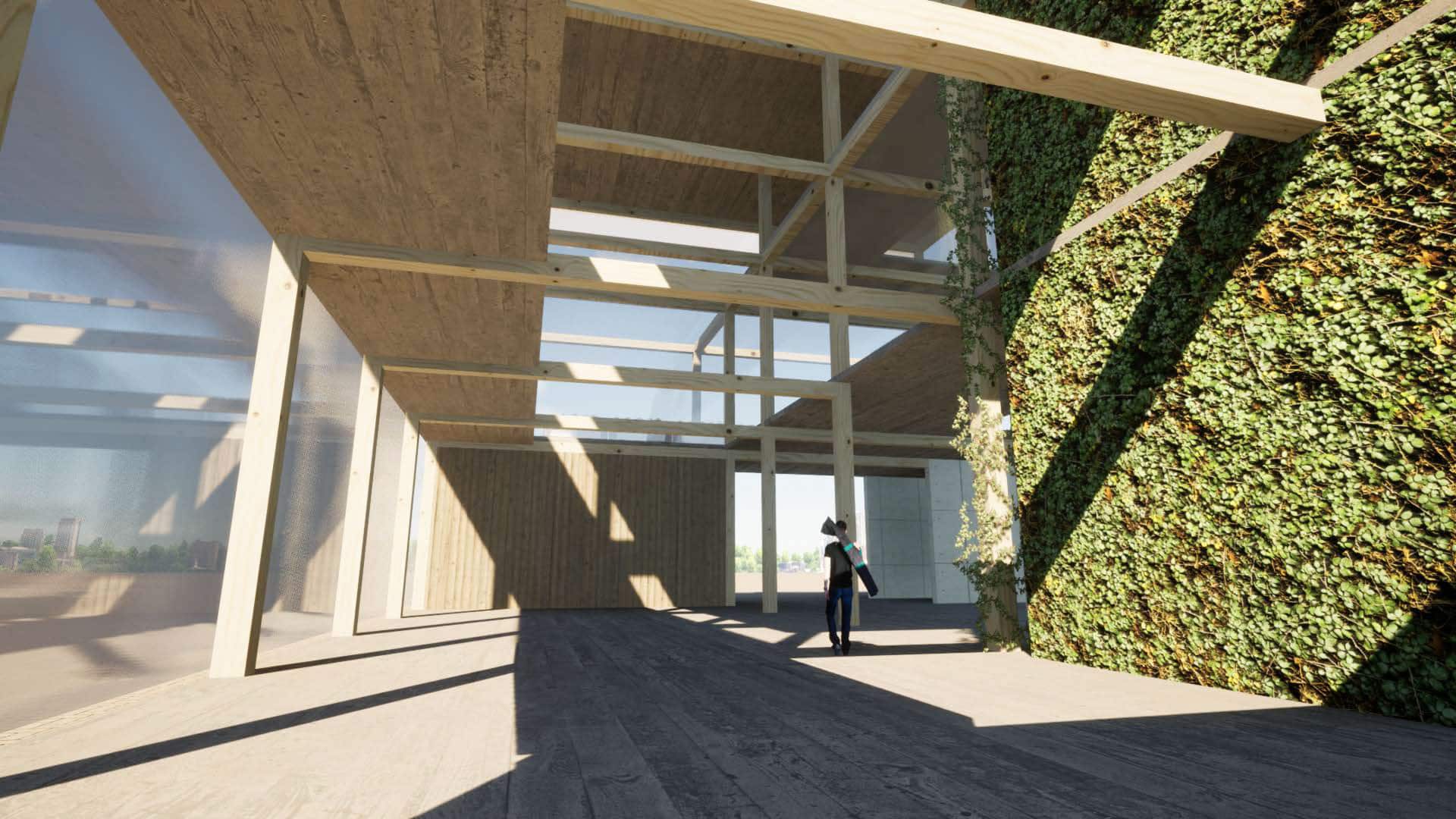
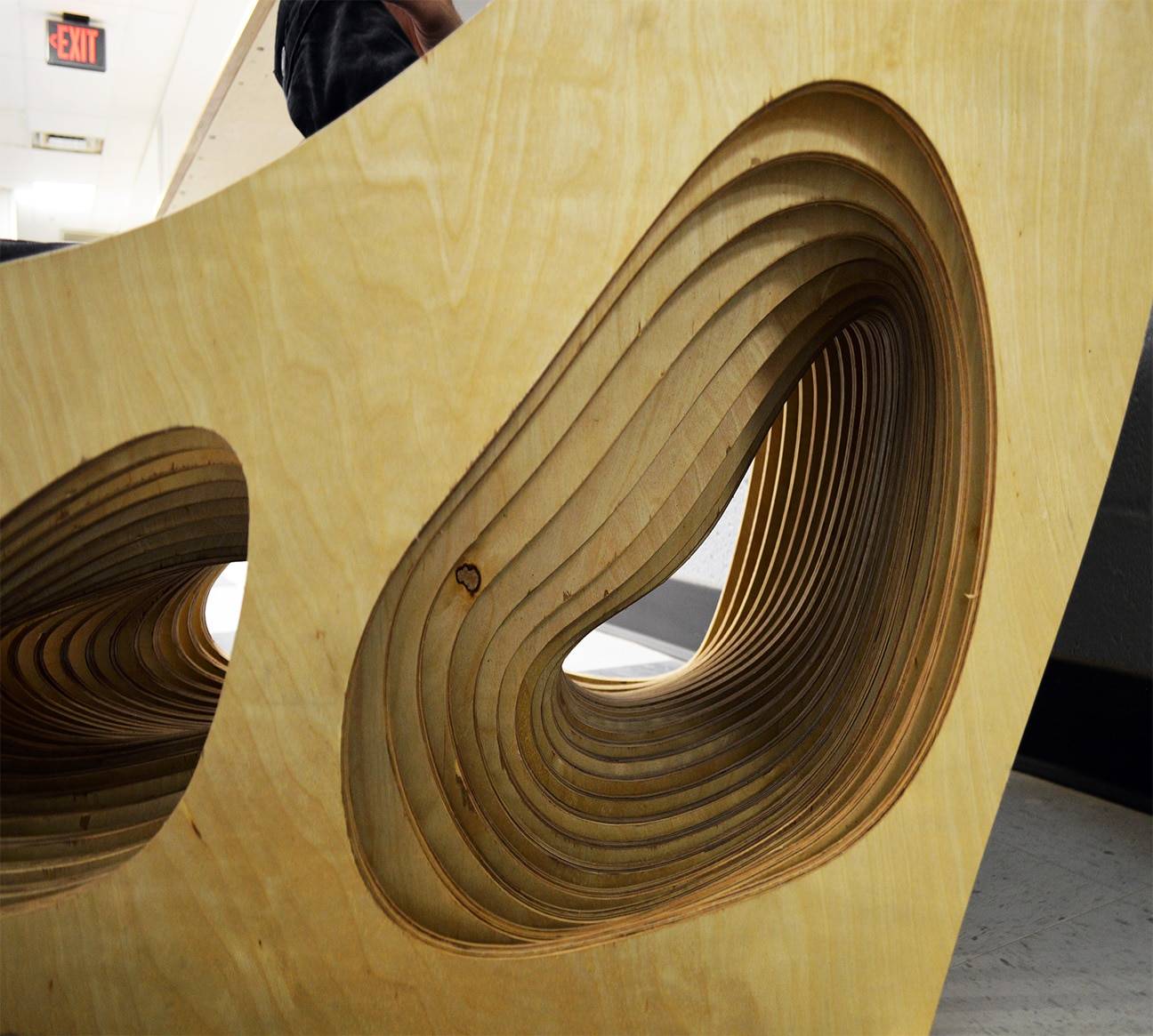
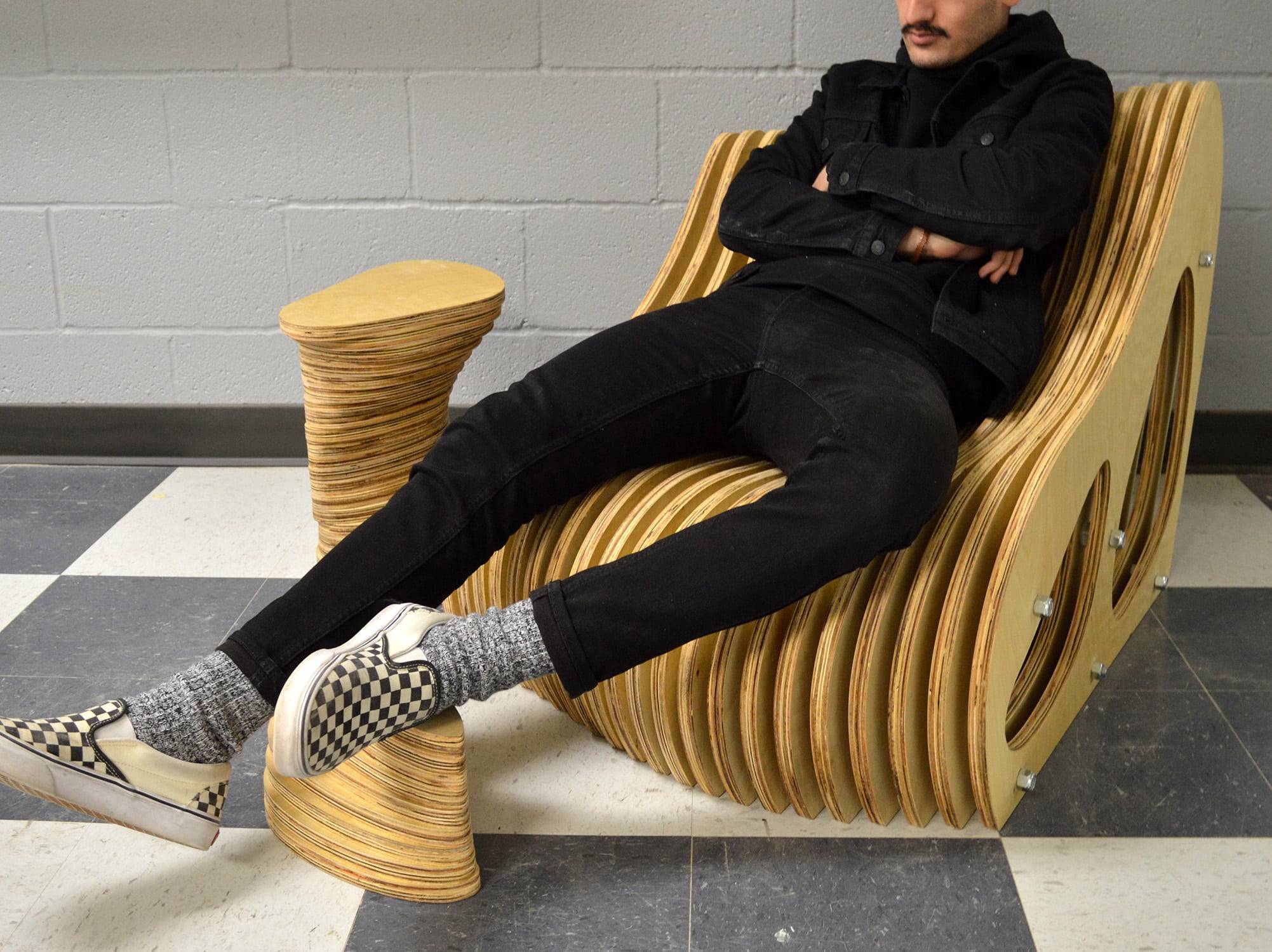
Representative projects include Material Systems Study, Spatial Frames Pavilion, and the Norman Center for Urban Farming. The Urban Farming Center asks students to design an 8,000-square-foot facility and 6,000 square feet of exterior growing space in downtown Norman. The program combines exhibition, education, and production spaces that celebrate sustainable urban agriculture. Students engage structural systems as both formal and spatial frameworks, using fabrication and environmental modeling to test their designs at multiple scales. Each project emphasizes structural expression, environmental response, and the experiential relationship between structure and space.
Intent

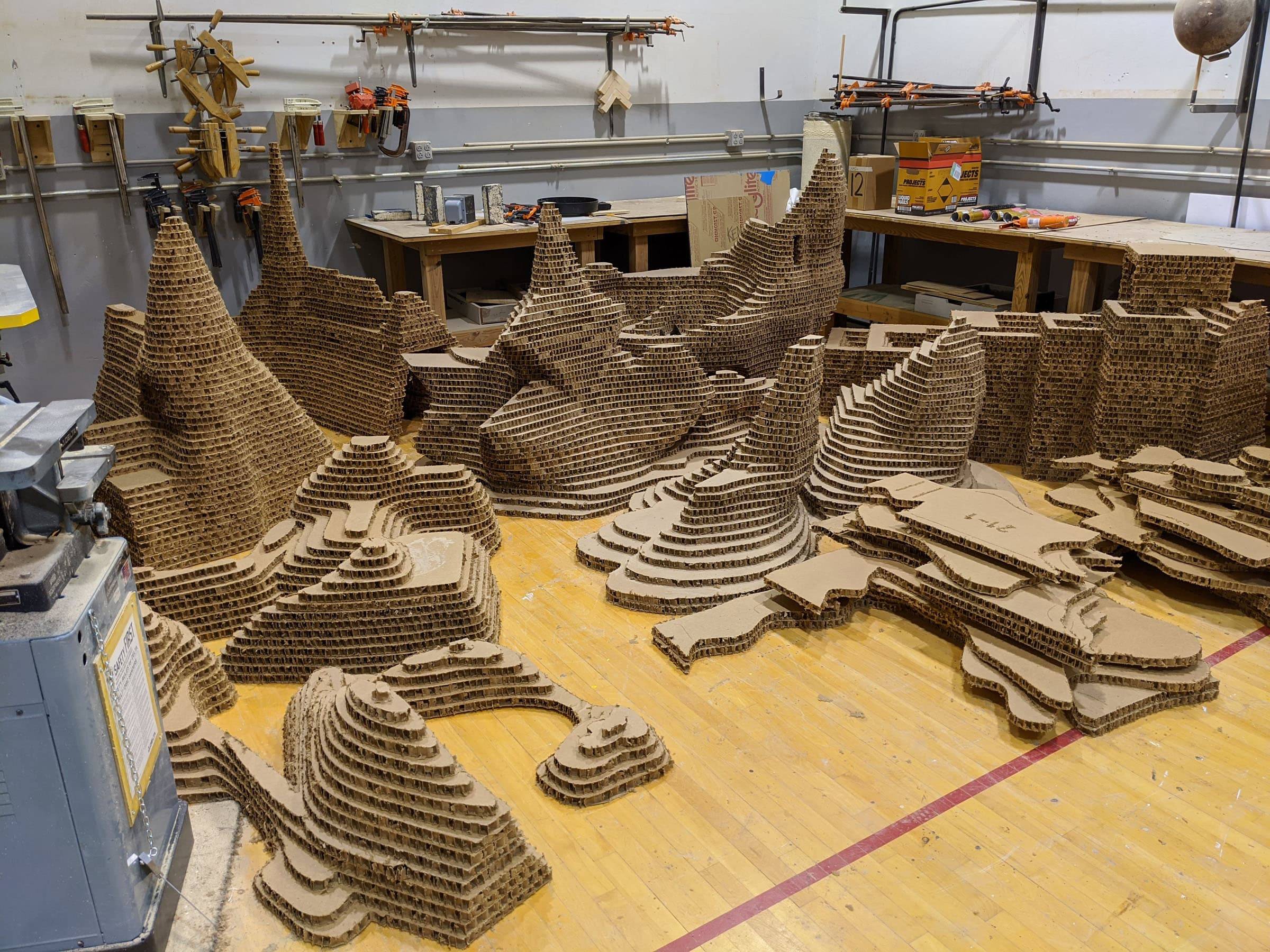
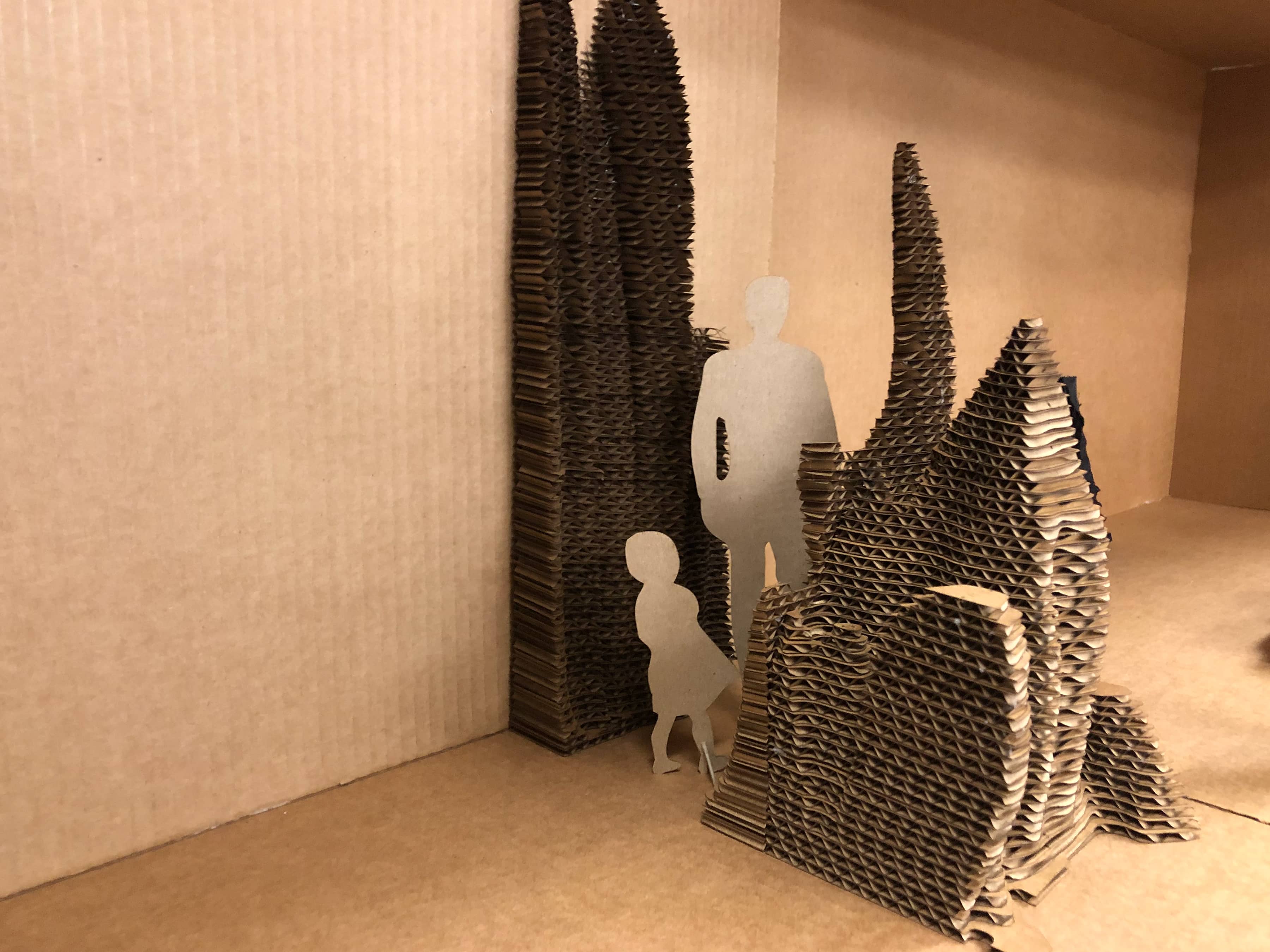
The intent of Design IV is to expand the student’s architectural vocabulary through a critical engagement with structure and material. The studio investigates construction not as an afterthought but as a generative process, where design emerges from the logic of assembly. Students learn to view architecture as a dialogue between concept and construction, exploring how detail and joinery can articulate broader spatial and environmental ambitions.

By engaging structural experimentation and iterative making, the course promotes a design sensibility grounded in observation, rigor, and craftsmanship. Students develop the ability to navigate between analytical precision and creative intuition, understanding how architecture embodies both structural necessity and expressive potential.
Pedagogy

The studio operates as a hybrid between a technical workshop and a conceptual laboratory. Instruction alternates between lectures, material investigations, and desk critiques, supported by reviews and peer discussion. Students work across multiple media—digital, analog, and fabricated—to develop ideas from conceptual sketch to structural model.

The studio emphasizes learning through making, encouraging students to test spatial and structural hypotheses through mockups and digital fabrication. Readings and case studies introduce students to precedents in tectonic and environmental design, situating their work within broader architectural discourse. Critiques focus on process and clarity of intent, reinforcing the importance of precision, representation, and iteration.
Tools and Methods

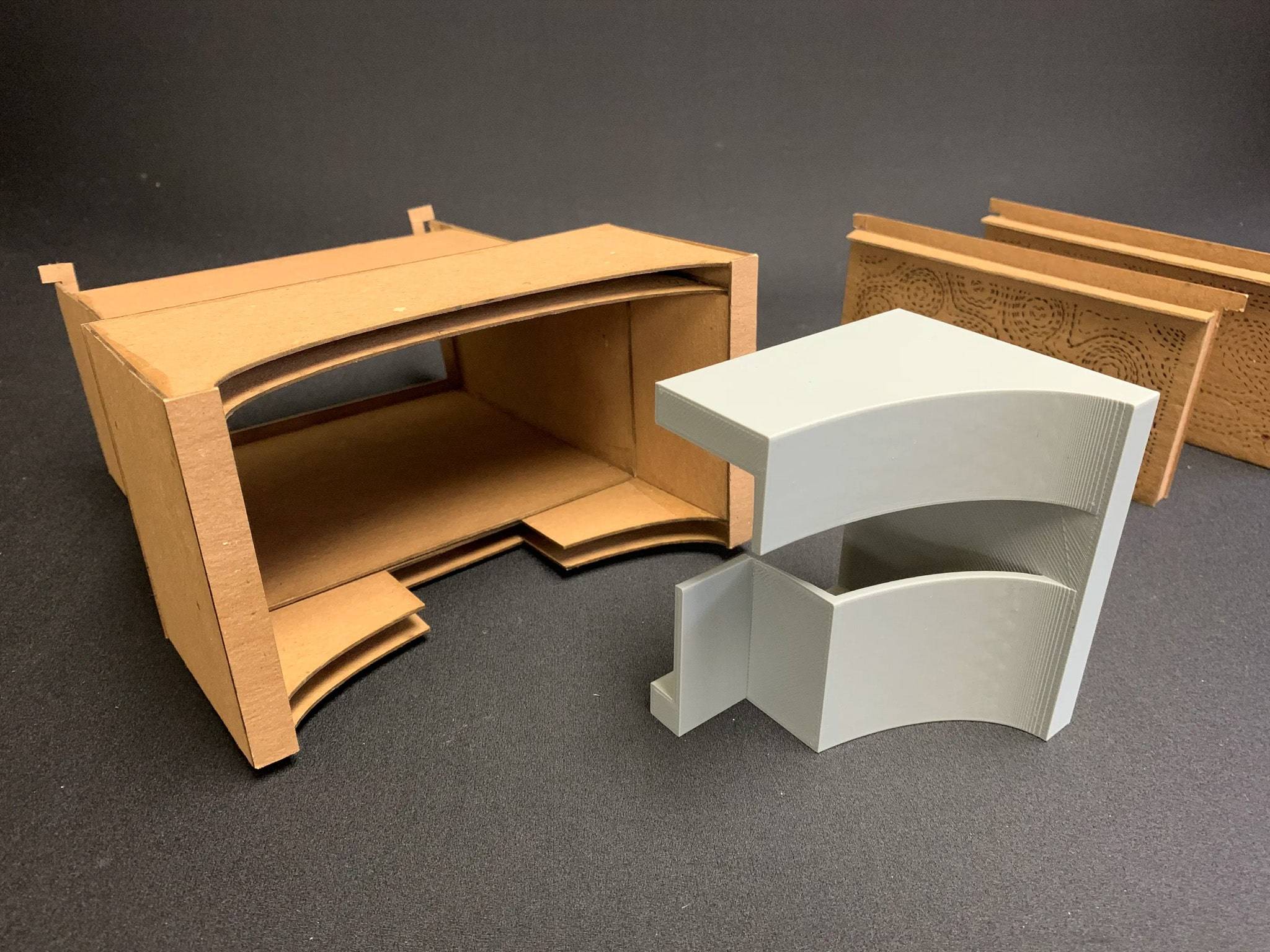
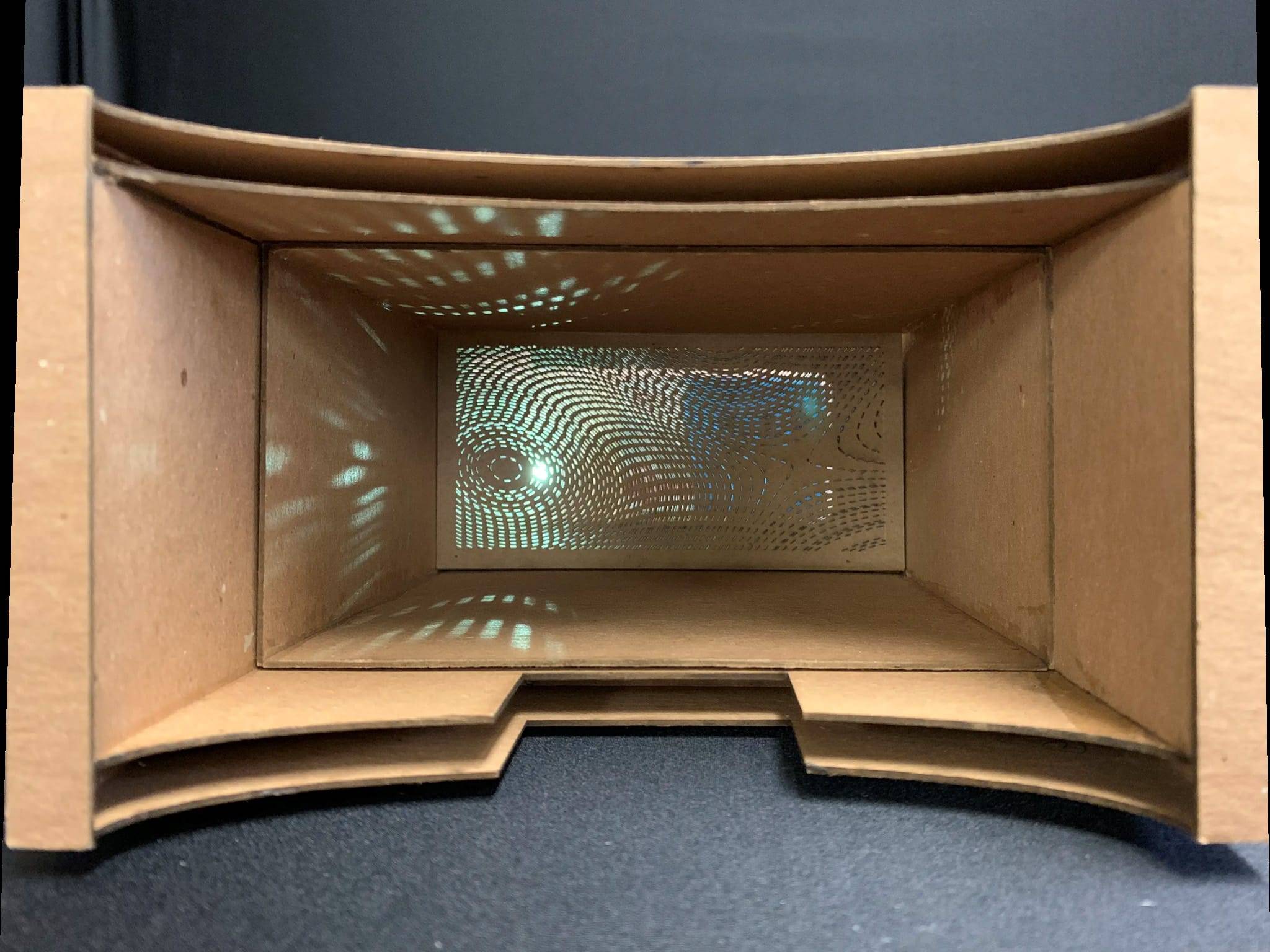
Students use both analog and digital tools to study structure, material behavior, and environmental performance. Rhino, Revit, and hand drafting are used for spatial and tectonic modeling, while CNC milling, laser cutting, and 3D printing enable physical prototyping. Students integrate structural analysis and diagrammatic studies into their design process, exploring how geometry, material, and force inform architectural expression.

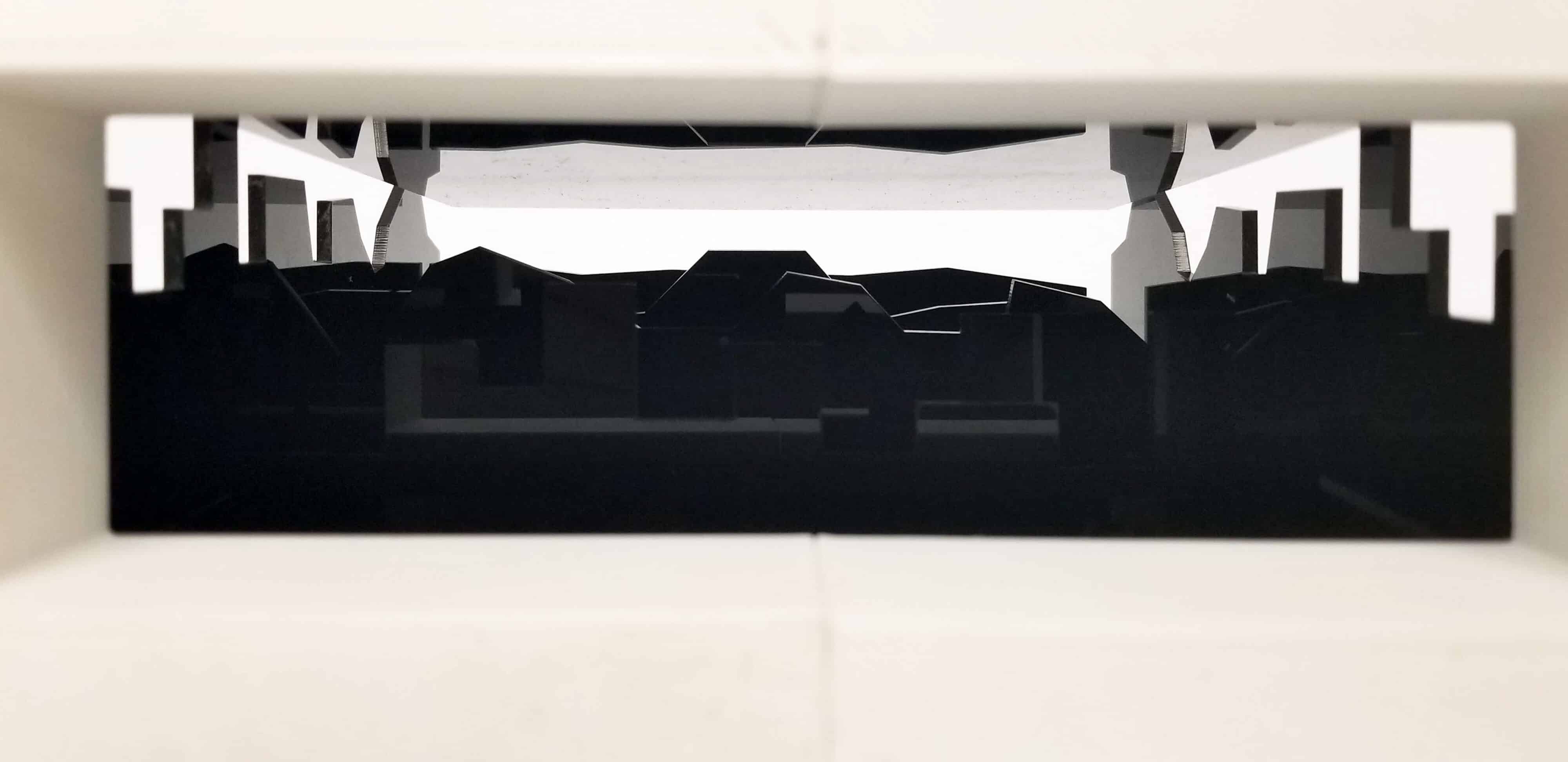
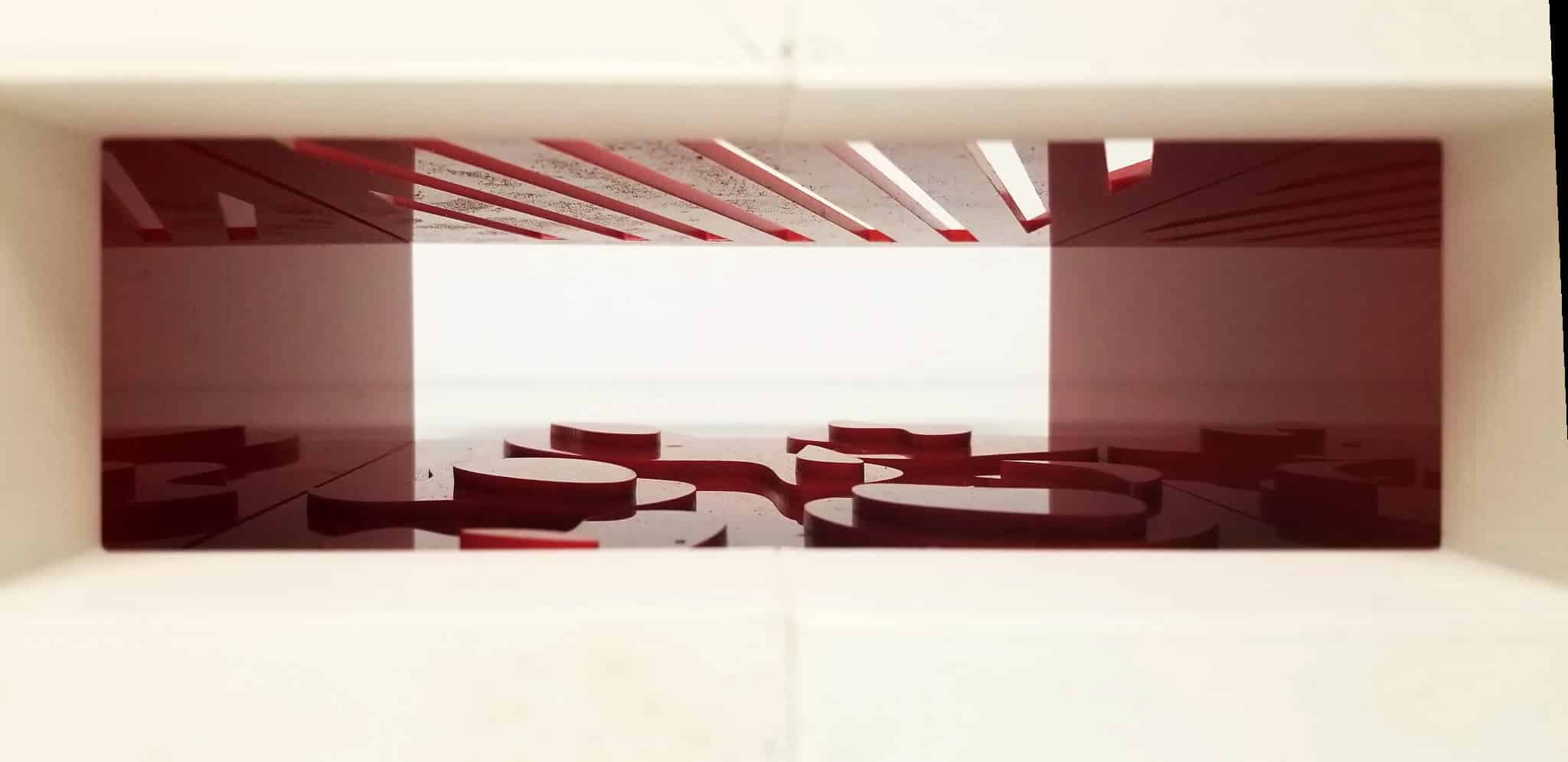
Hybrid drawing and modeling techniques are central to the studio. Students are encouraged to move fluidly between sketching, modeling, and simulation to test how materials perform under load and how light, structure, and space interact. Craft and representation are treated as inseparable from design thinking.
Outcomes

By the end of the course, students demonstrate the ability to synthesize structural reasoning, material performance, and design intent into coherent architectural proposals. They learn to articulate how construction systems contribute to spatial experience and to express the logic of their ideas through precise representation and fabrication.

Projects completed in Design IV exhibit an understanding of how architecture operates as both a physical system and a cultural artifact. Students develop the capacity to move fluidly between analysis and creation, transforming conceptual models into structurally resolved designs. The course prepares them for advanced studios by establishing a rigorous foundation in design integration—where form, function, and fabrication are inseparable from the act of making.
More Work


Architecture

Art + Code

Design + Fabrication

Courses + Student Work

© Ken Marold USA, Inc. All rights reserved.

Continue reading

Gibbs Collective Creating

Gibbs Collective Creating

ARCH 4970/5970 : Outré West

Oklahoma Contemporary Arts, Center, Oklahoma City, OK
Exhibited: Aug 22, 2024 – Jan 27, 2025

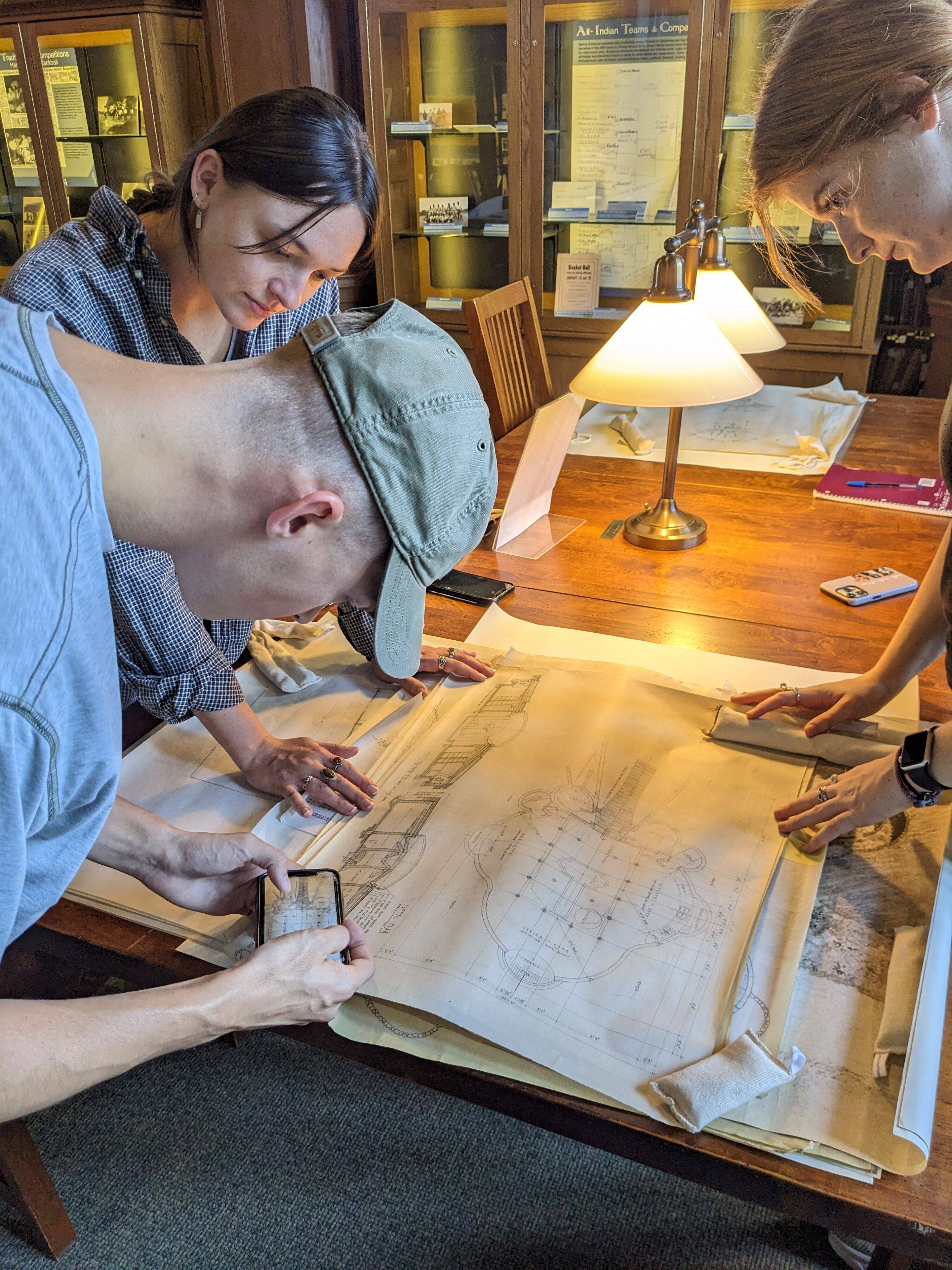
Outré West: The American School of Architecture from Oklahoma to California was a curated exhibition that examined the work of architects educated in the Midwest during the 1950s and 1960s who later developed experimental practices on the West Coast. As part of this larger show, a 3-credit undergraduate and graduate research and digital fabrication seminar contributed three full-scale installations that translated archival precedents into inhabitable exhibition experiences.

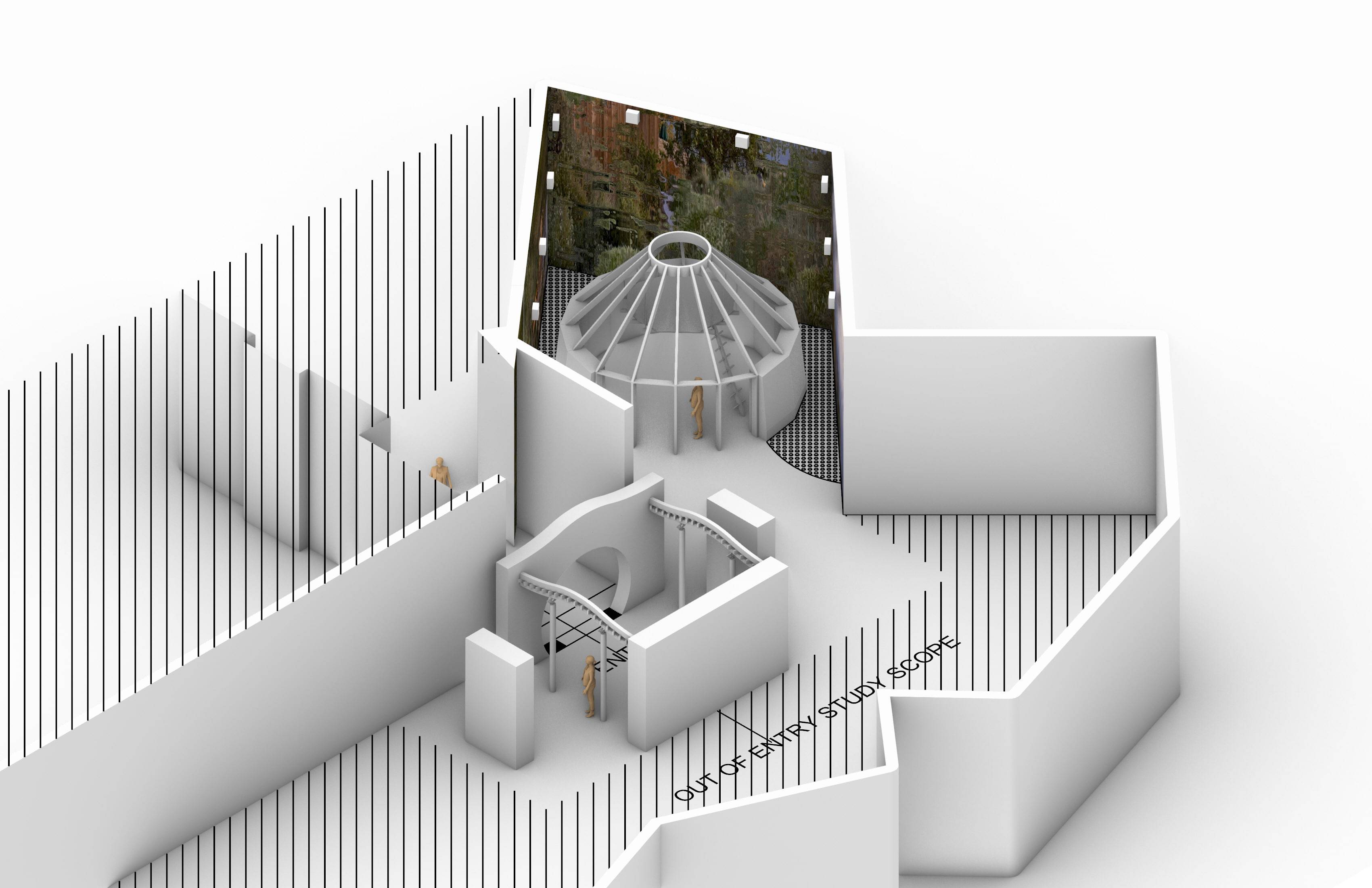
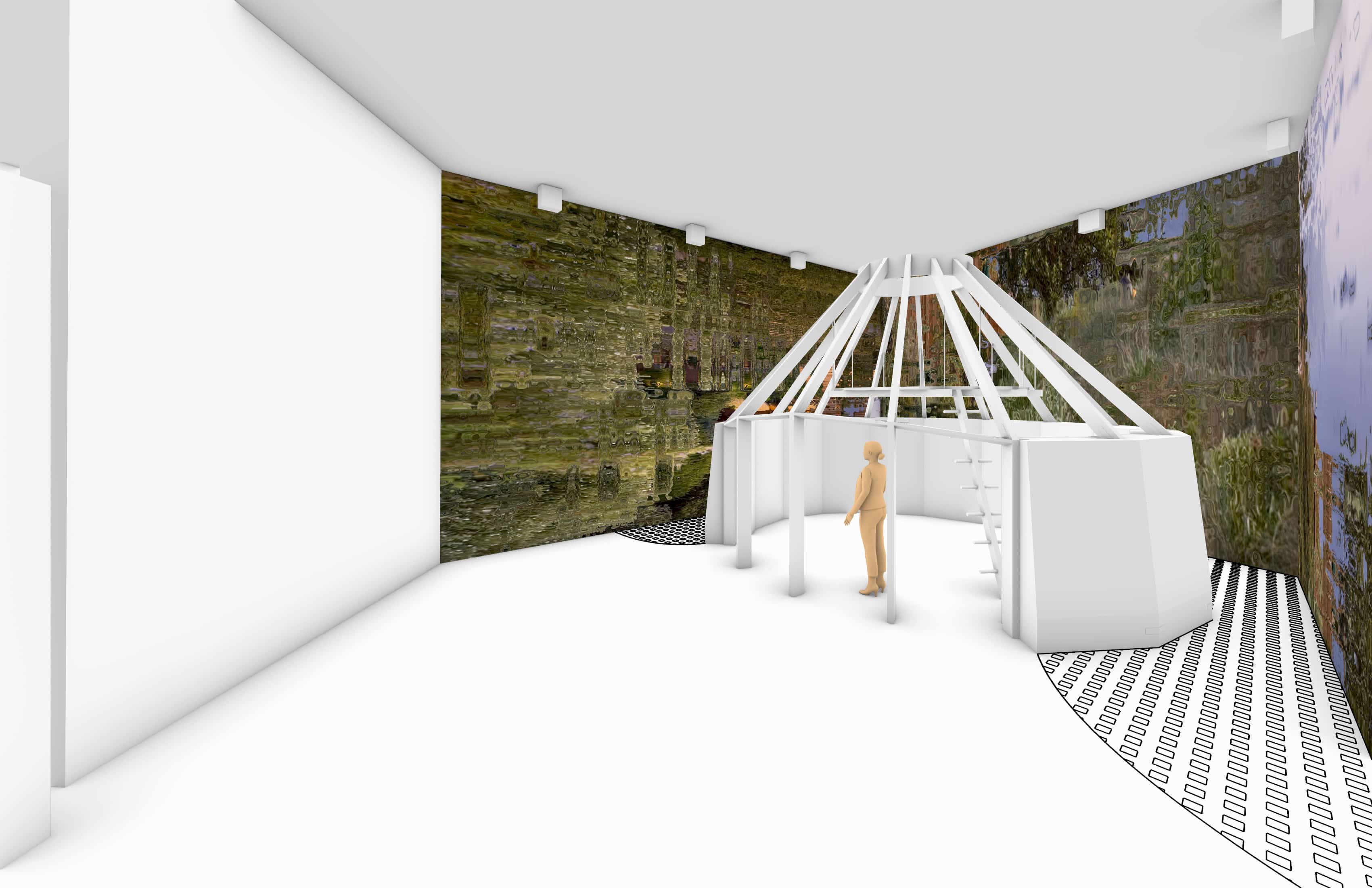
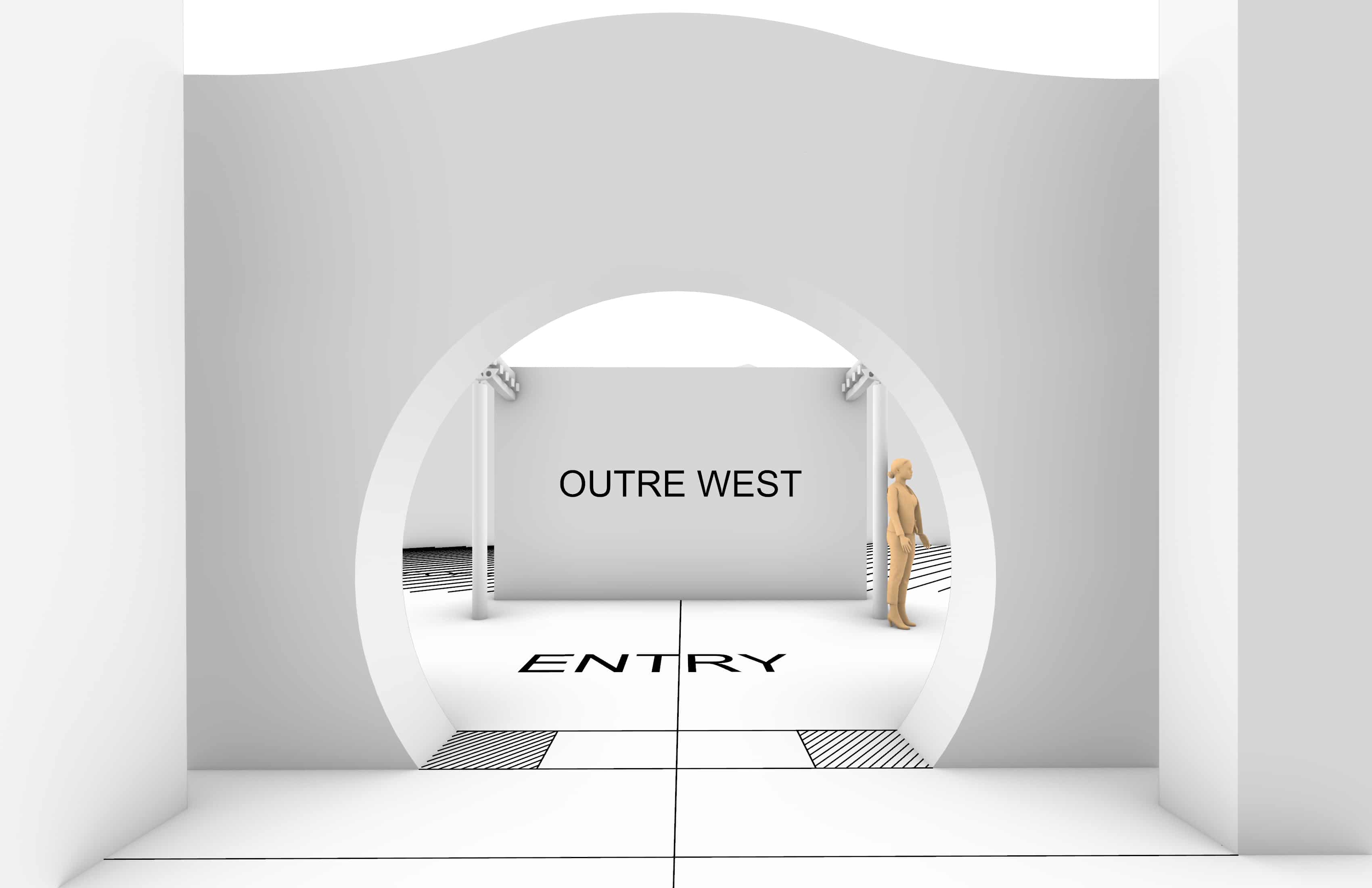
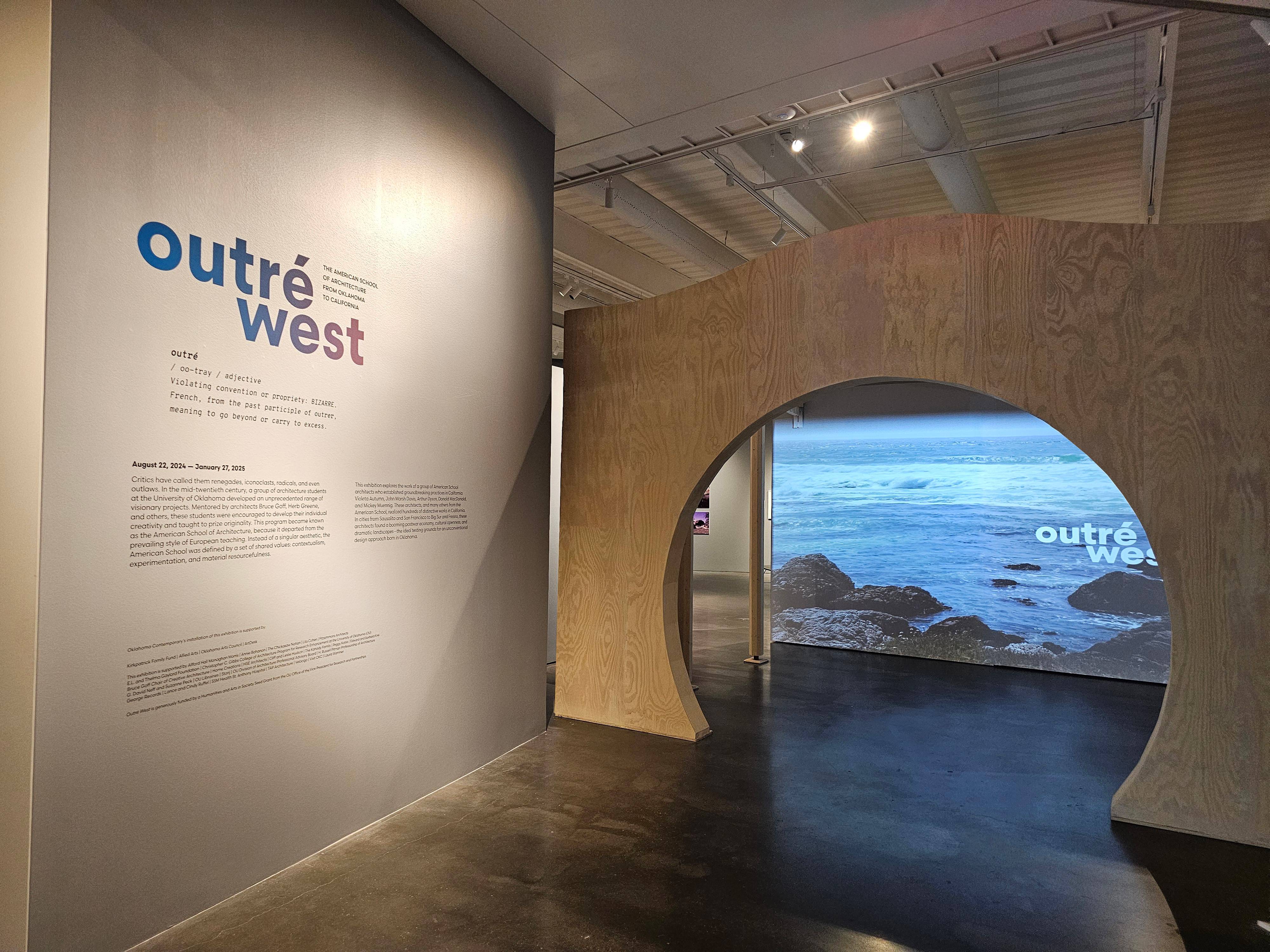
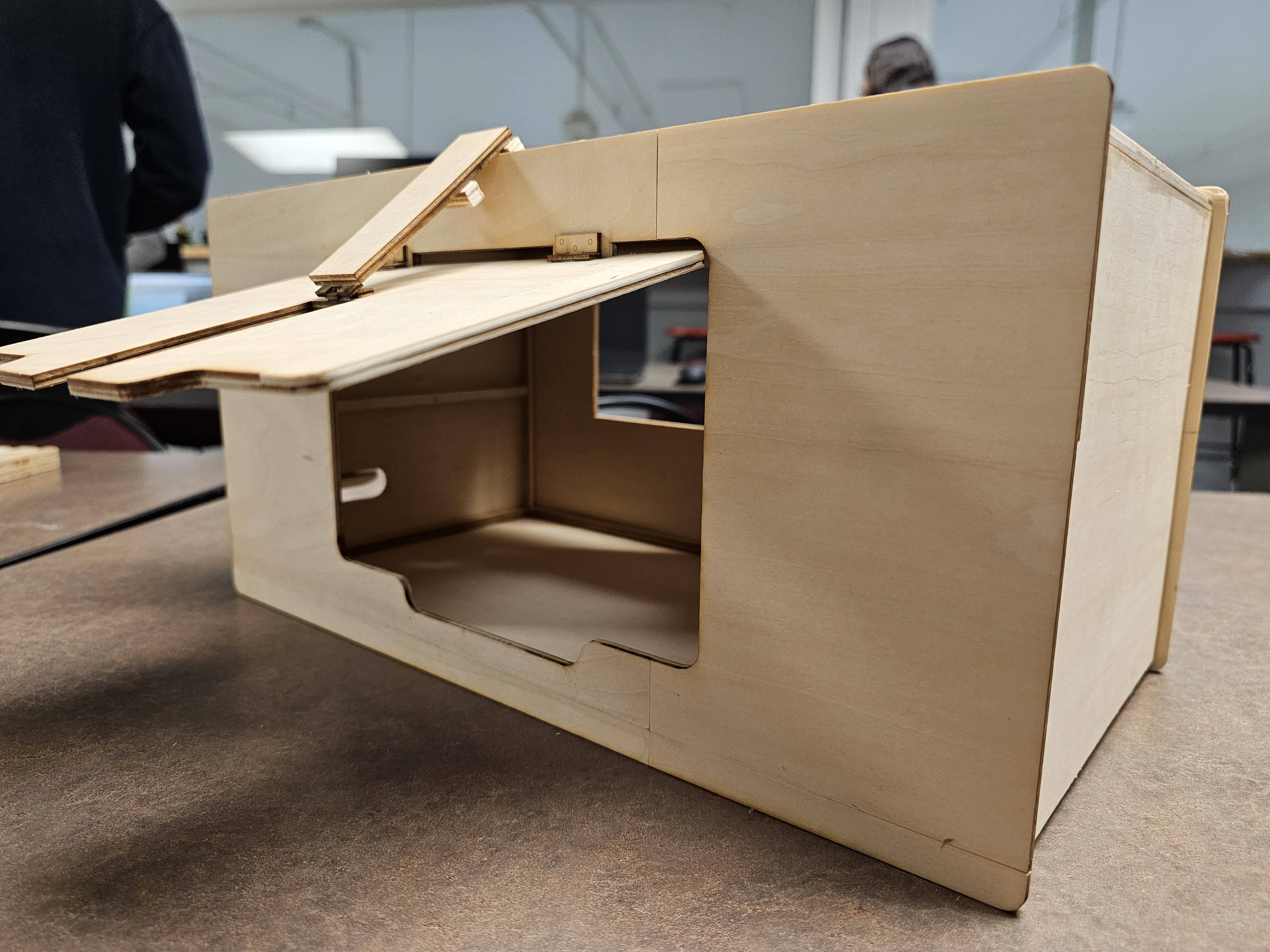
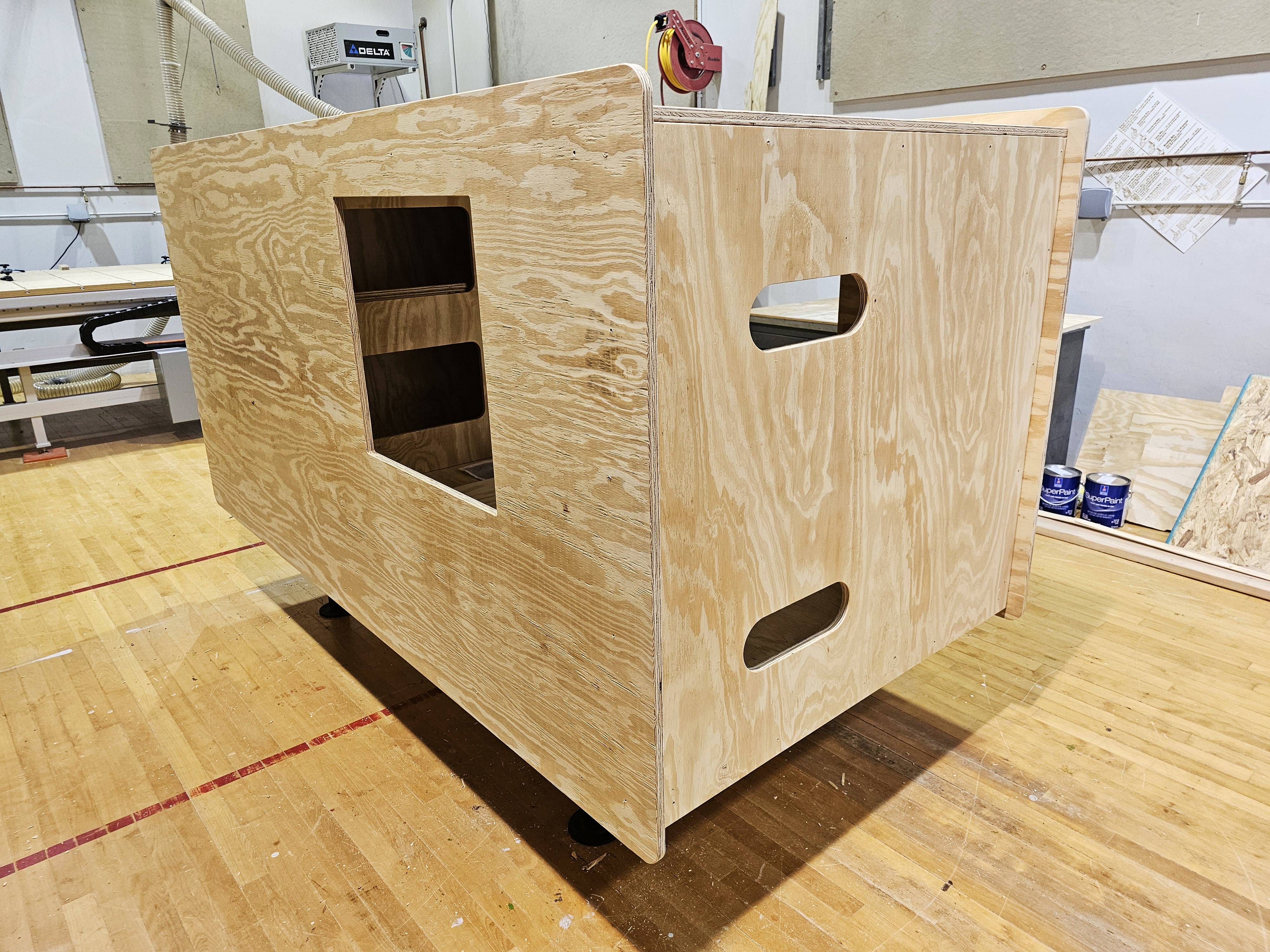
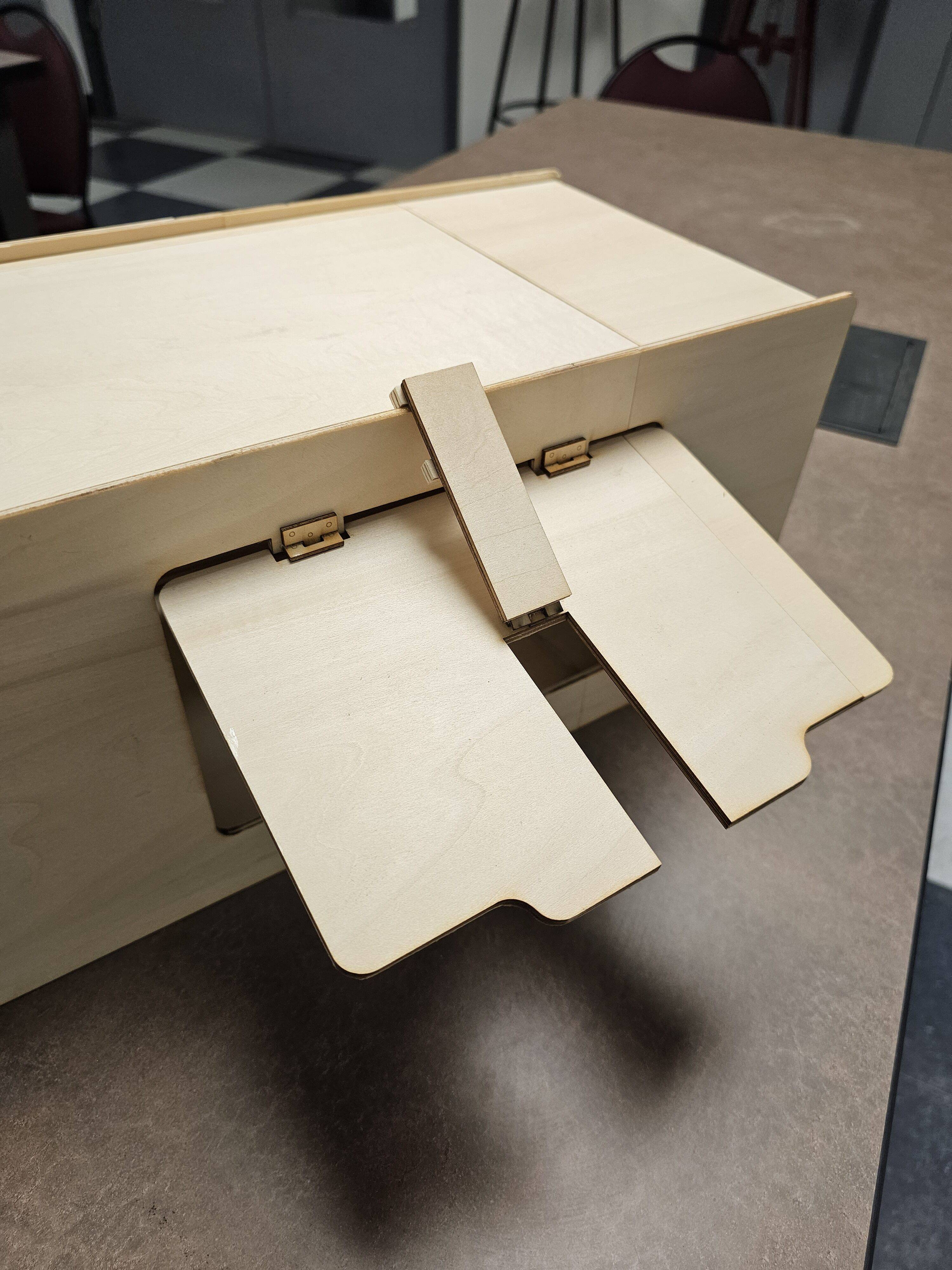
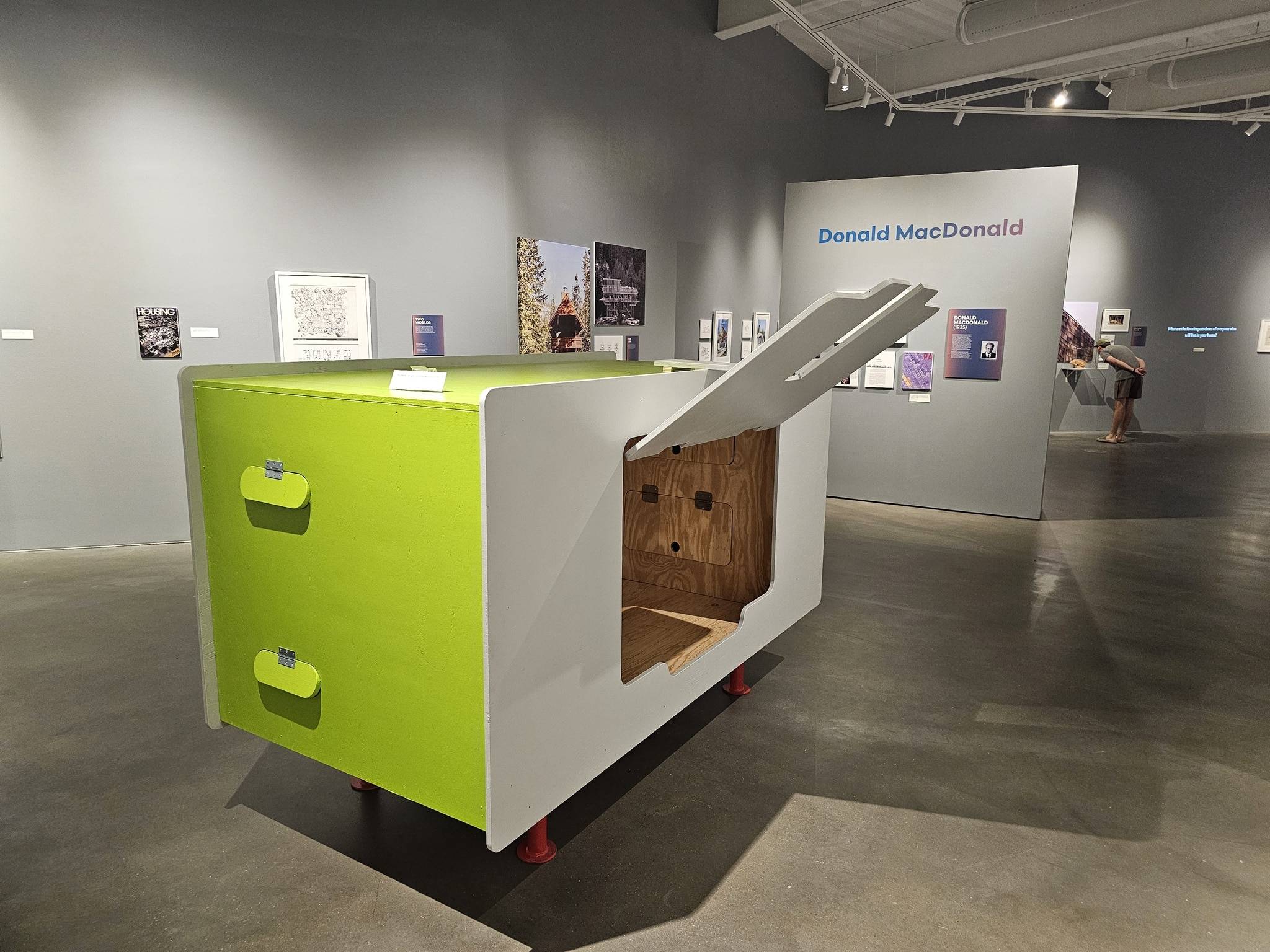
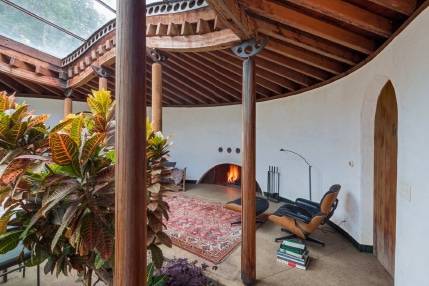
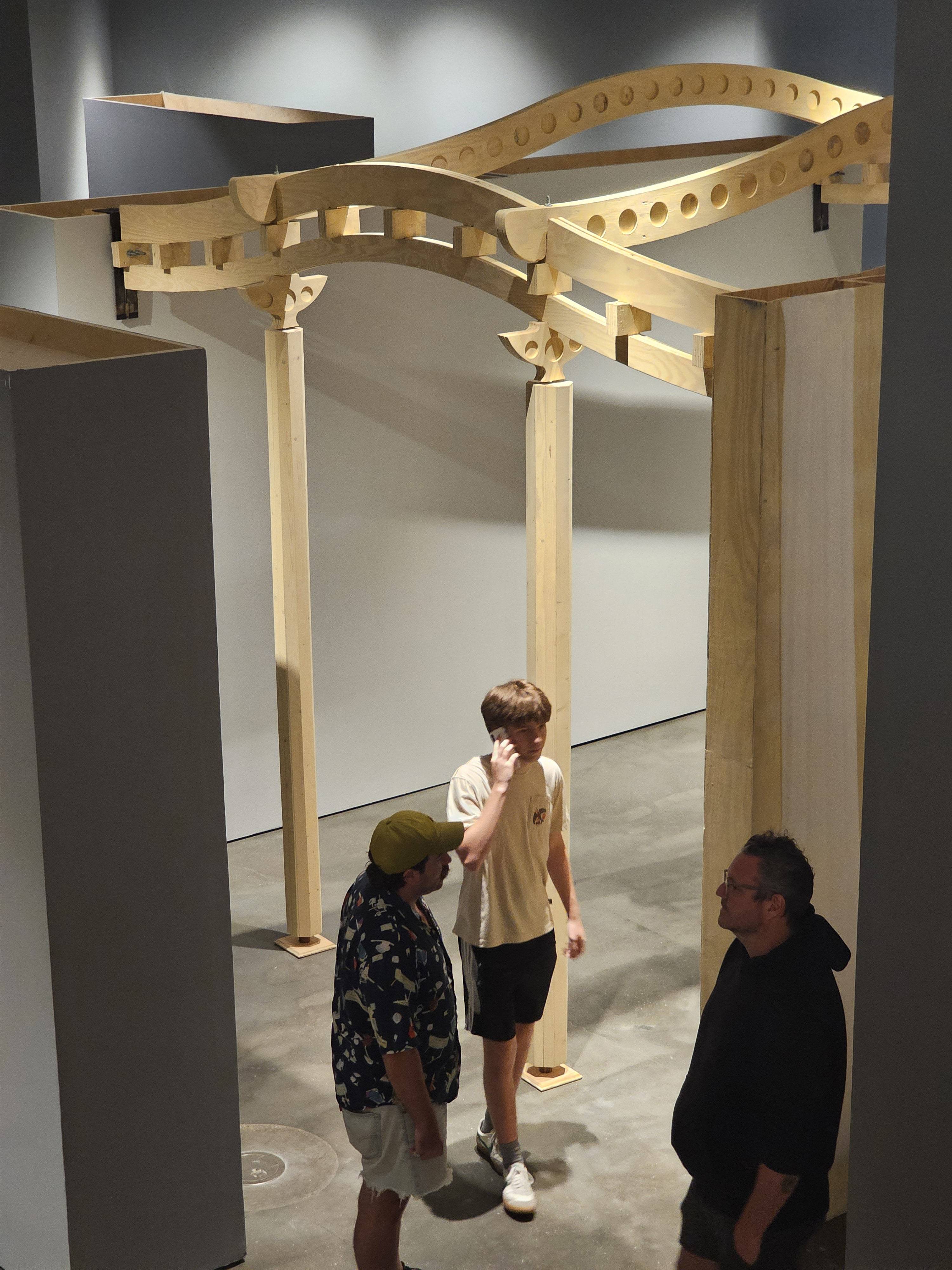
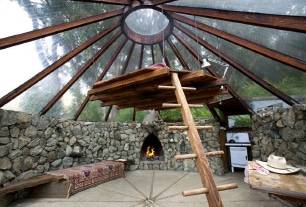
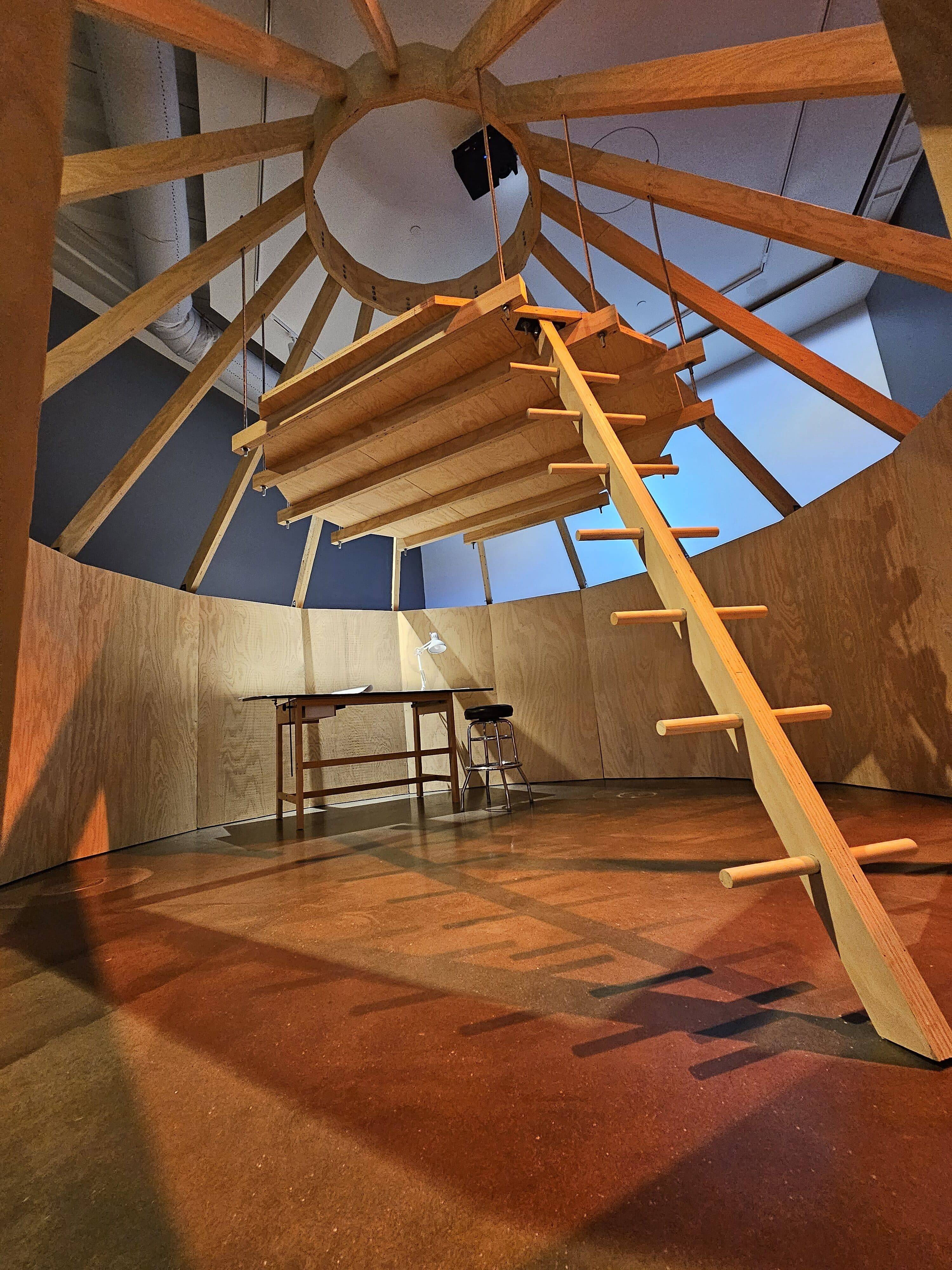
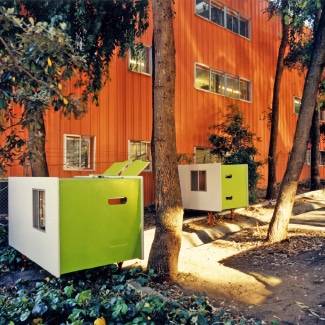
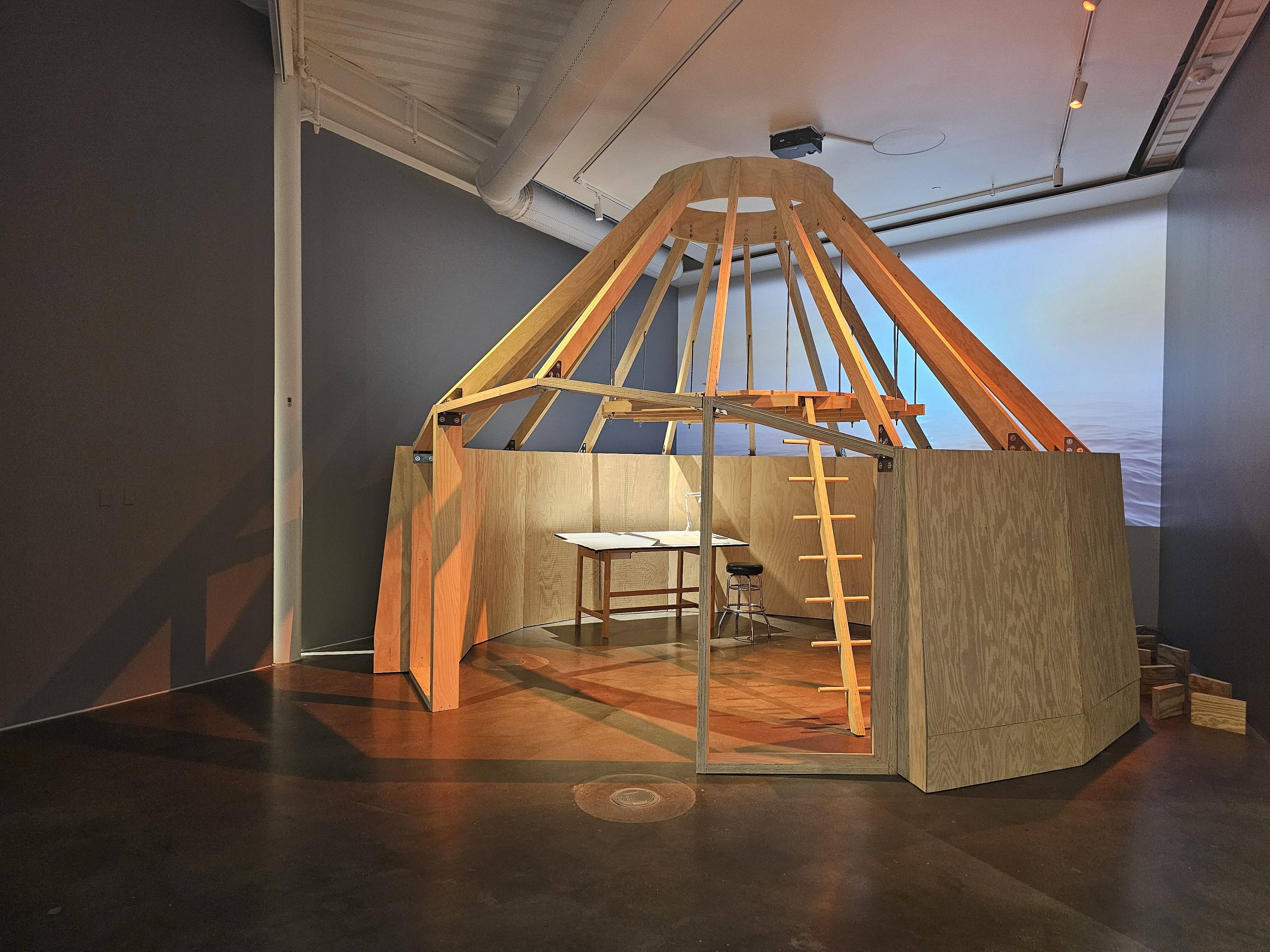
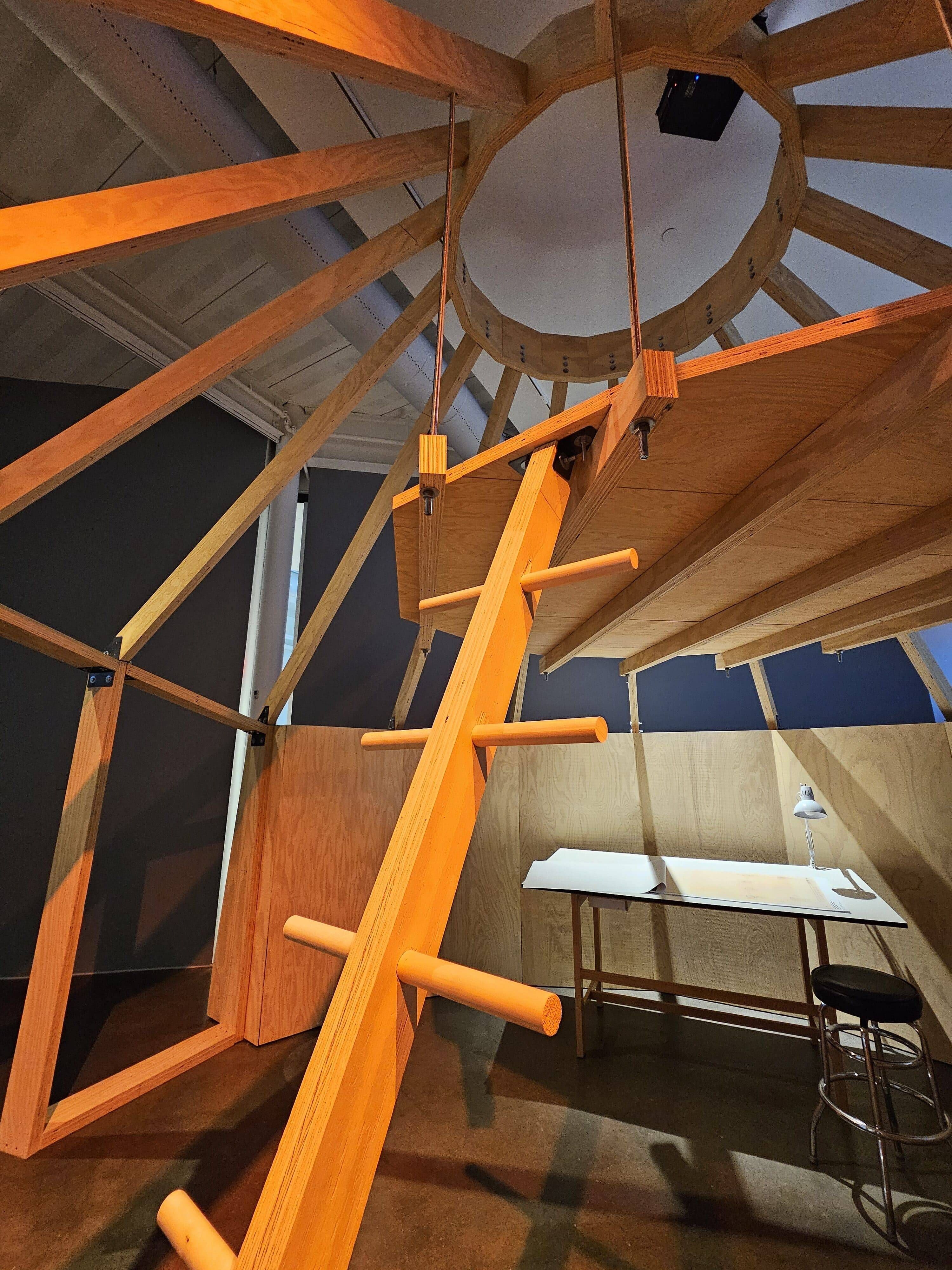
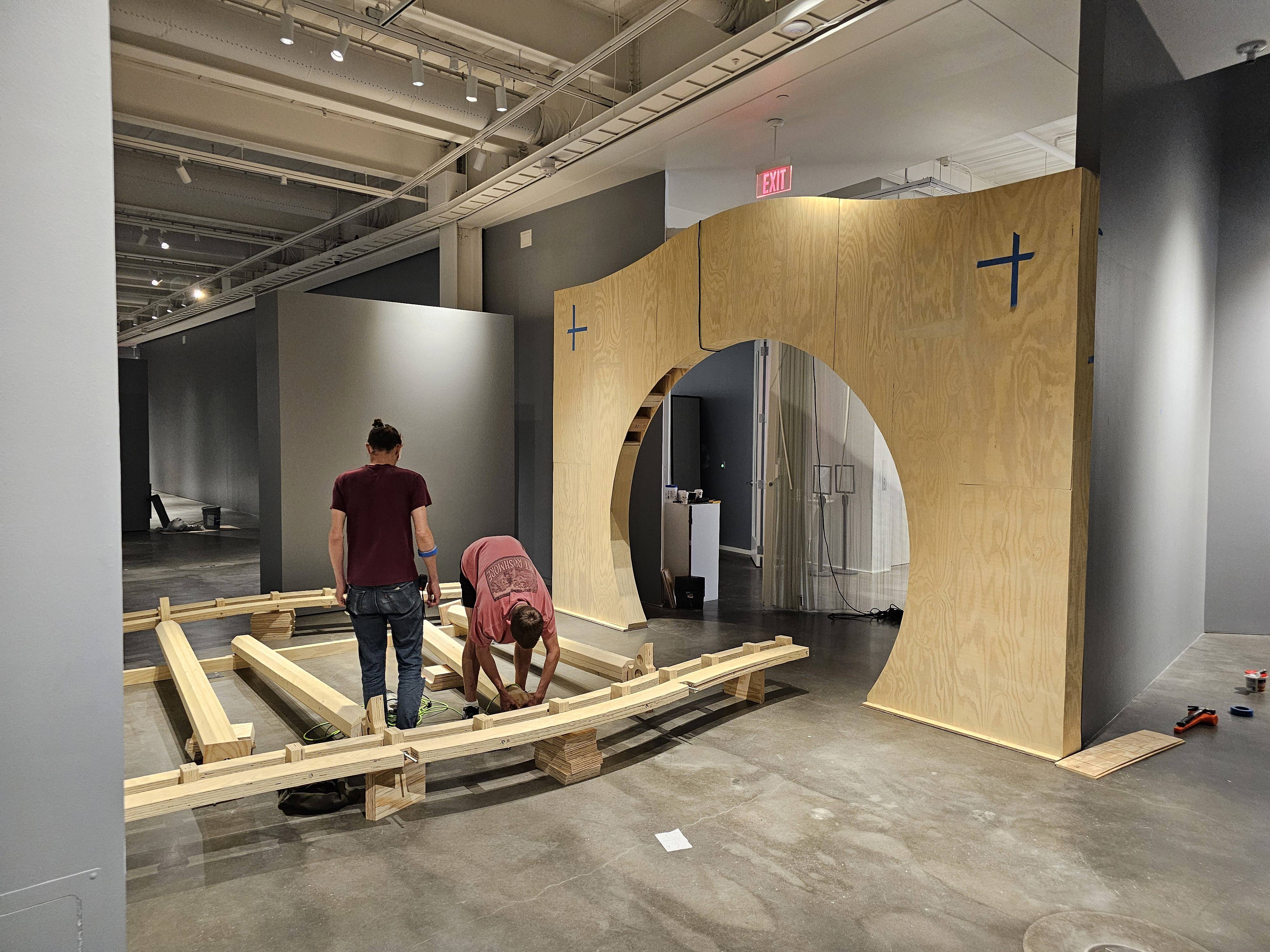
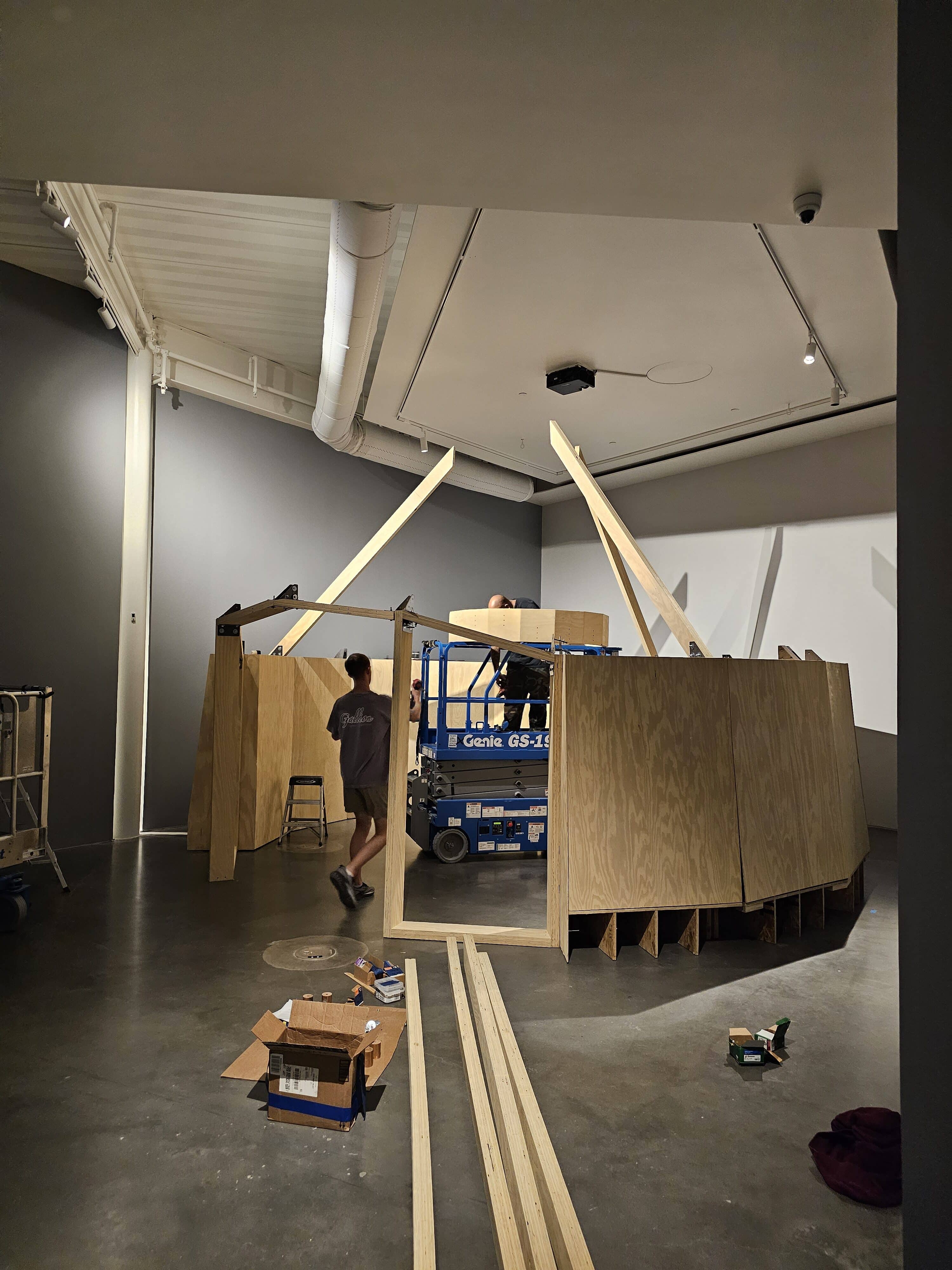
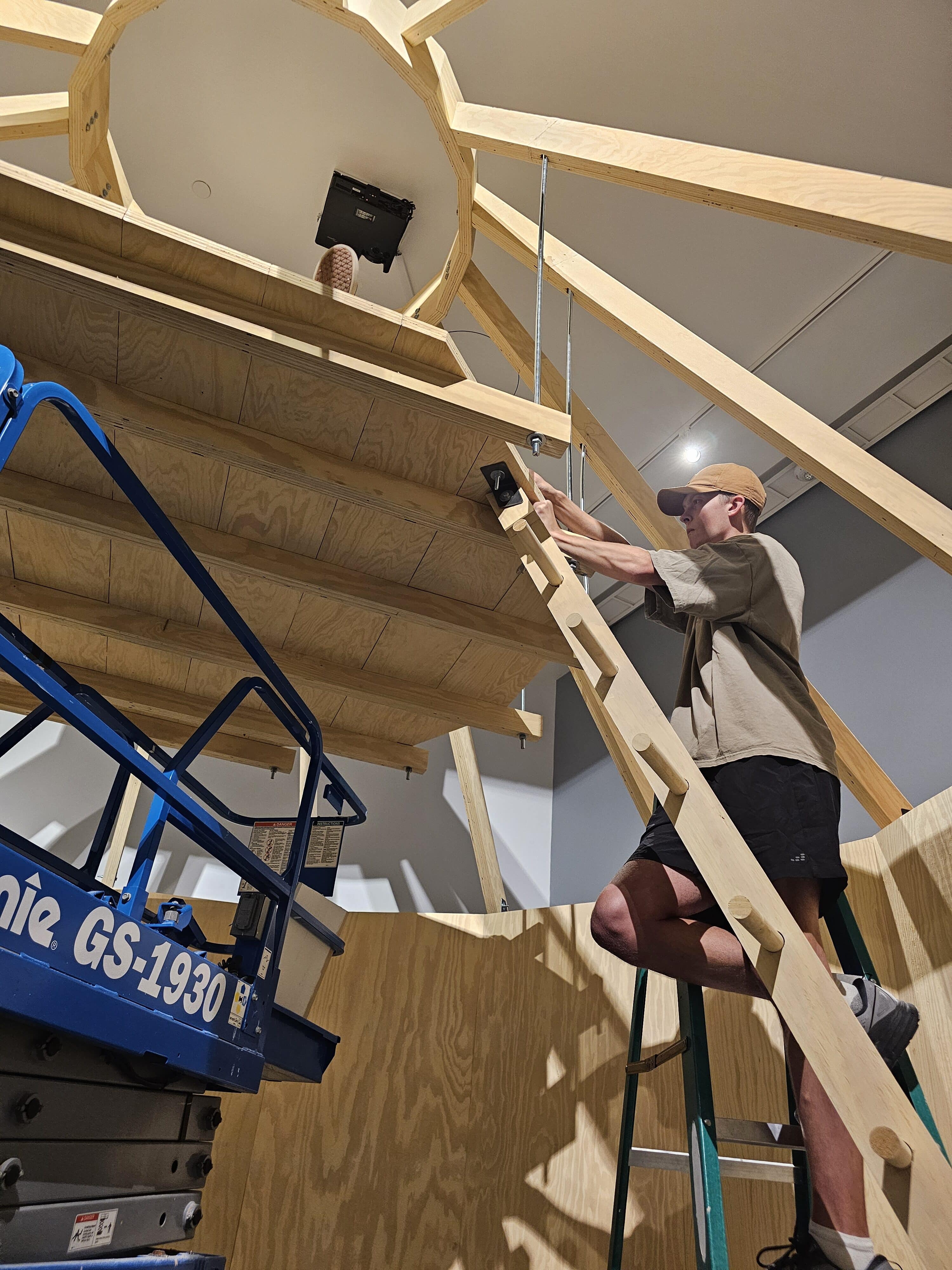
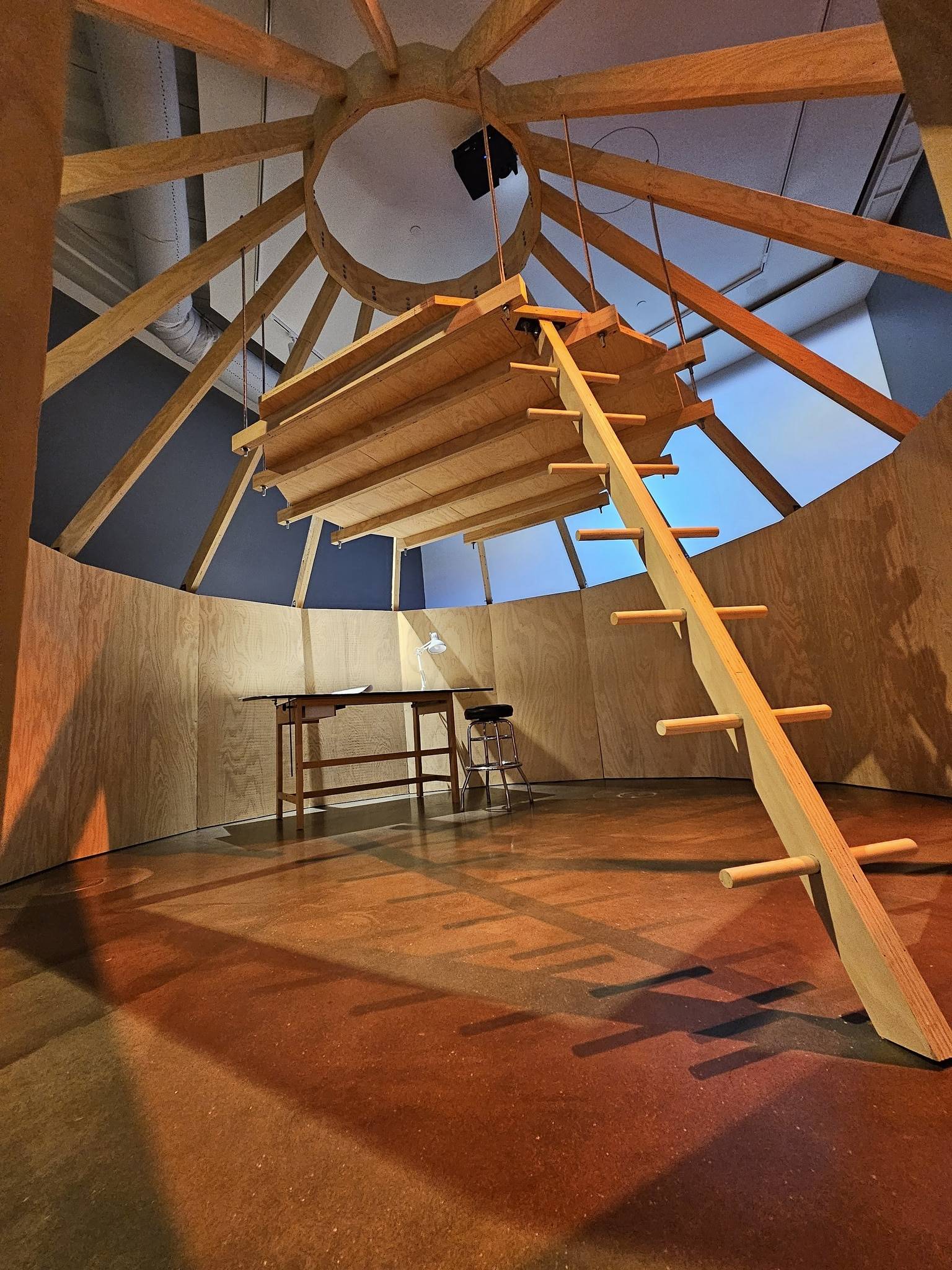
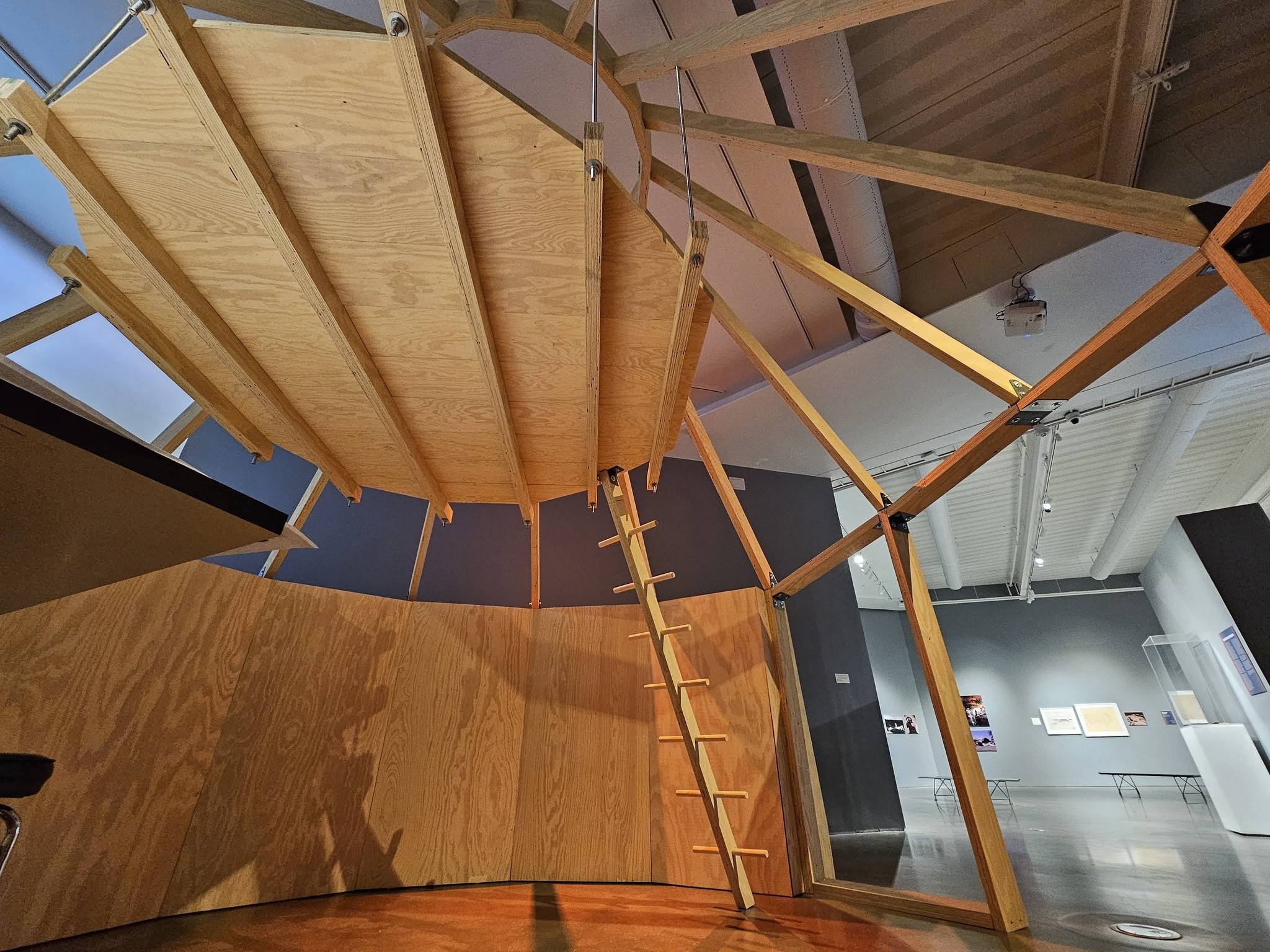
Working from original blueprints of Mickey Muennig and Donald MacDonald, students transformed drawings into contemporary tectonic systems through computational modeling and CNC fabrication. The seminar’s contributions formed a sequence within the exhibition. At the entry, students abstracted Muennig’s house, rationalizing its circular threshold and colonnaded interiors into CNC-milled plywood components that created a portal. At the midpoint, another team reconstructed MacDonald’s City Sleeper, a portable shelter designed for unhoused residents in San Francisco. Reimagined as a flat pack kit-of-parts, the installation preserved its humanitarian intent while testing prefabrication and assembly. The sequence concluded with a reinterpretation of Muennig’s studio, built as an inhabitable pavilion of CNC-milled ribs and lofted forms that immersed visitors in tectonic experimentation.


Gibbs Collective Creating

ARCH 4970/5970 : Outré West

Oklahoma Contemporary Arts, Center, Oklahoma City, OK
Exhibited: Aug 22, 2024 – Jan 27, 2025

Outré West: The American School of Architecture from Oklahoma to California was a curated exhibition that examined the work of architects educated in the Midwest during the 1950s and 1960s who later developed experimental practices on the West Coast. As part of this larger show, a 3-credit undergraduate and graduate research and digital fabrication seminar contributed three full-scale installations that translated archival precedents into inhabitable exhibition experiences.

Working from original blueprints of Mickey Muennig and Donald MacDonald, students transformed drawings into contemporary tectonic systems through computational modeling and CNC fabrication. The seminar’s contributions formed a sequence within the exhibition. At the entry, students abstracted Muennig’s house, rationalizing its circular threshold and colonnaded interiors into CNC-milled plywood components that created a portal. At the midpoint, another team reconstructed MacDonald’s City Sleeper, a portable shelter designed for unhoused residents in San Francisco. Reimagined as a flat pack kit-of-parts, the installation preserved its humanitarian intent while testing prefabrication and assembly. The sequence concluded with a reinterpretation of Muennig’s studio, built as an inhabitable pavilion of CNC-milled ribs and lofted forms that immersed visitors in tectonic experimentation.

The seminar framed exhibition making as both pedagogy and public contribution. By rationalizing curves into flat stock, designing joinery for repeatable assembly, and treating archival drawings as living design material, students confronted material limits, structural realities, and visitor safety. They left with technical fluency in digital fabrication, a resilient approach to iteration, and the collaborative habits required to deliver work that could stand alongside professional and academic contributions in a cultural setting.

Pedagogical Highlights

  • Invited contribution to a larger curated academic exhibition.
  • Worked directly from original historic blueprints of Muennig and MacDonald.
  • Contributed three full-scale installations as inhabitable experiences within the exhibition.
  • Balanced archival research, computational modeling, fabrication, and public engagement.


Project Data

Project Title: Outré West
Location: Oklahoma City, Oklahoma
Semester/Year: Fall 2023 – Spring 2024
Completion Date: August 2024
Exhibition Dates: August 22, 2024 – January 27, 2025

Collaborators & Funding

Primary sponsor: $12,000. Faculty and administrators supported curricular alignment, project consultation, and exhibition curation; community partners advised on accessibility and program needs.

Student Participation

11 undergraduate and graduate students in a 3-credit research and digital fabrication seminar, plus 5 independent studies. All students received academic credit; no unpaid labor.

Project Type: Full-scale exhibition installation, research and digital fabrication pedagogy, CNC-milled plywood assemblies

Duration: Two semesters, including archival research, parametric modeling, prototyping, fabrication, and on-site installation under institutional deadlines.


Learning Outcomes

The seminar established clear objectives centered on technical fluency, conceptual depth, and public engagement through research and digital fabrication:

  • Translate archival precedents into contemporary prototypes by working directly from the original blueprints of Mickey Muennig and Donald MacDonald.
  • Develop computational literacy through parametric modeling, unfolding complex geometries, and sequencing assemblies for CNC milling.
  • Advance material intelligence by investigating plywood’s renewable and expressive potential through joinery, efficiency, and tolerance testing.
  • Engage exhibition-making as pedagogy, designing for public audiences while meeting professional institutional standards.
  • Foster collaboration across academic levels, integrating digital research, material experimentation, and fabrication into cohesive, full-scale installations.
  • Explore equity and humanitarian design, using Donald MacDonald’s City Sleeper as a platform to connect digital fabrication to social and cultural responsibility.


Learning Outcomes

The seminar established clear objectives centered on technical fluency, conceptual depth, and public engagement through research and digital fabrication:

  • Translate archival precedents into contemporary prototypes by working directly from the original blueprints of Mickey Muennig and Donald MacDonald.
  • Develop computational literacy through parametric modeling, unfolding complex geometries, and sequencing assemblies for CNC milling.
  • Advance material intelligence by investigating plywood’s renewable and expressive potential through joinery, efficiency, and tolerance testing.
  • Engage exhibition-making as pedagogy, designing for public audiences while meeting professional institutional standards.
  • Foster collaboration across academic levels, integrating digital research, material experimentation, and fabrication into cohesive, full-scale installations.
  • Explore equity and humanitarian design, using Donald MacDonald’s City Sleeper as a platform to connect digital fabrication to social and cultural responsibility.


Precision and Fit
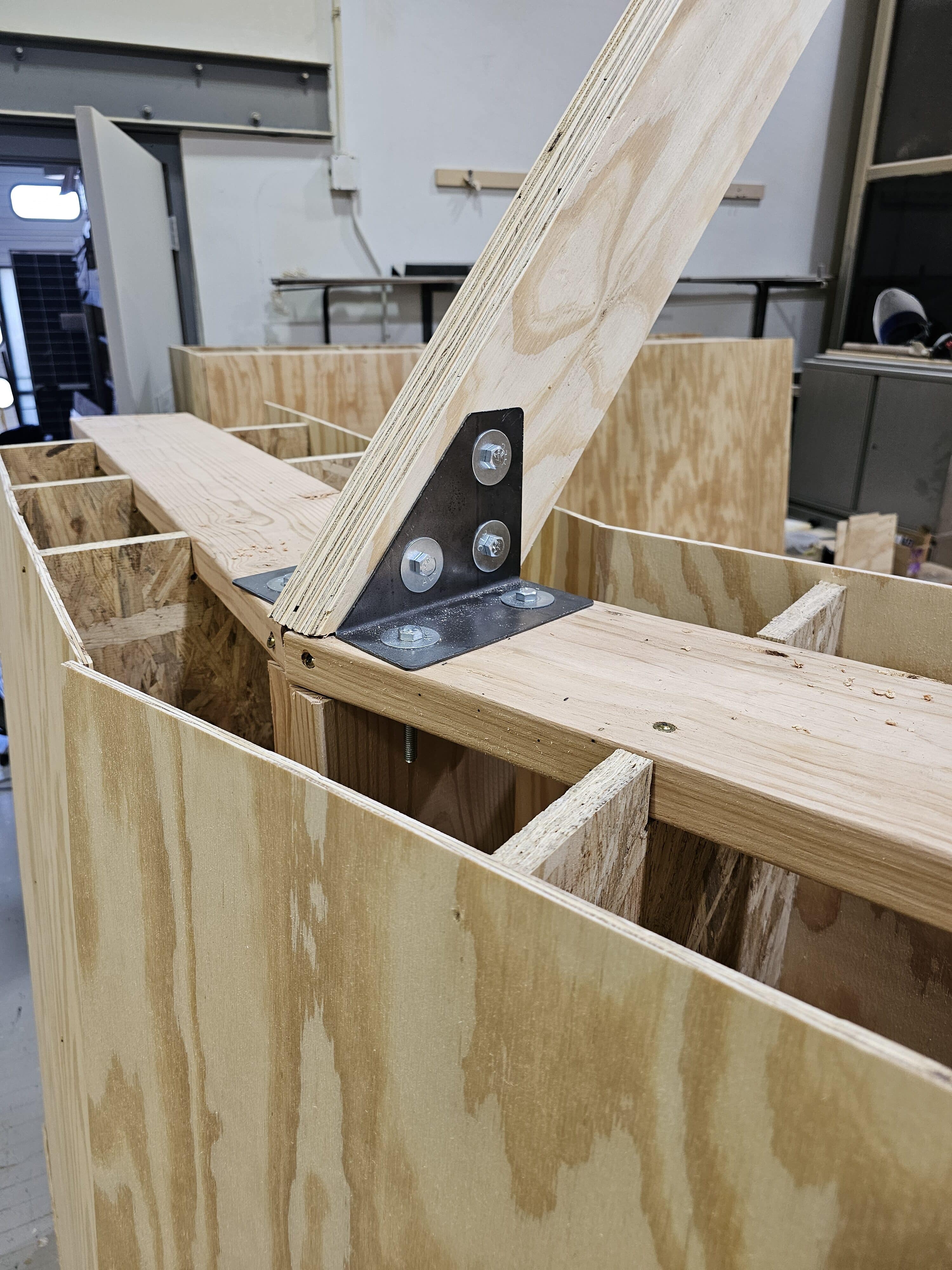
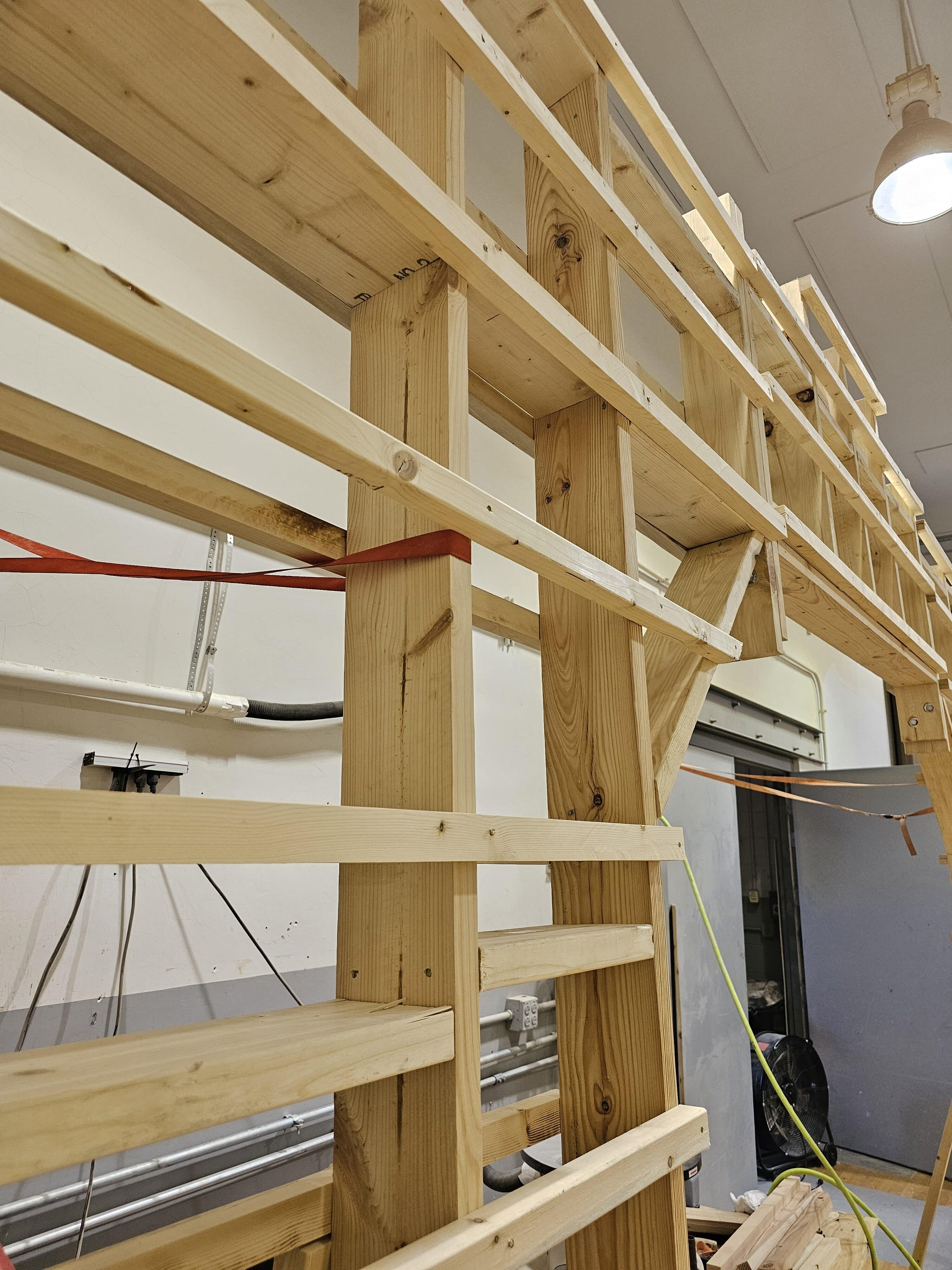
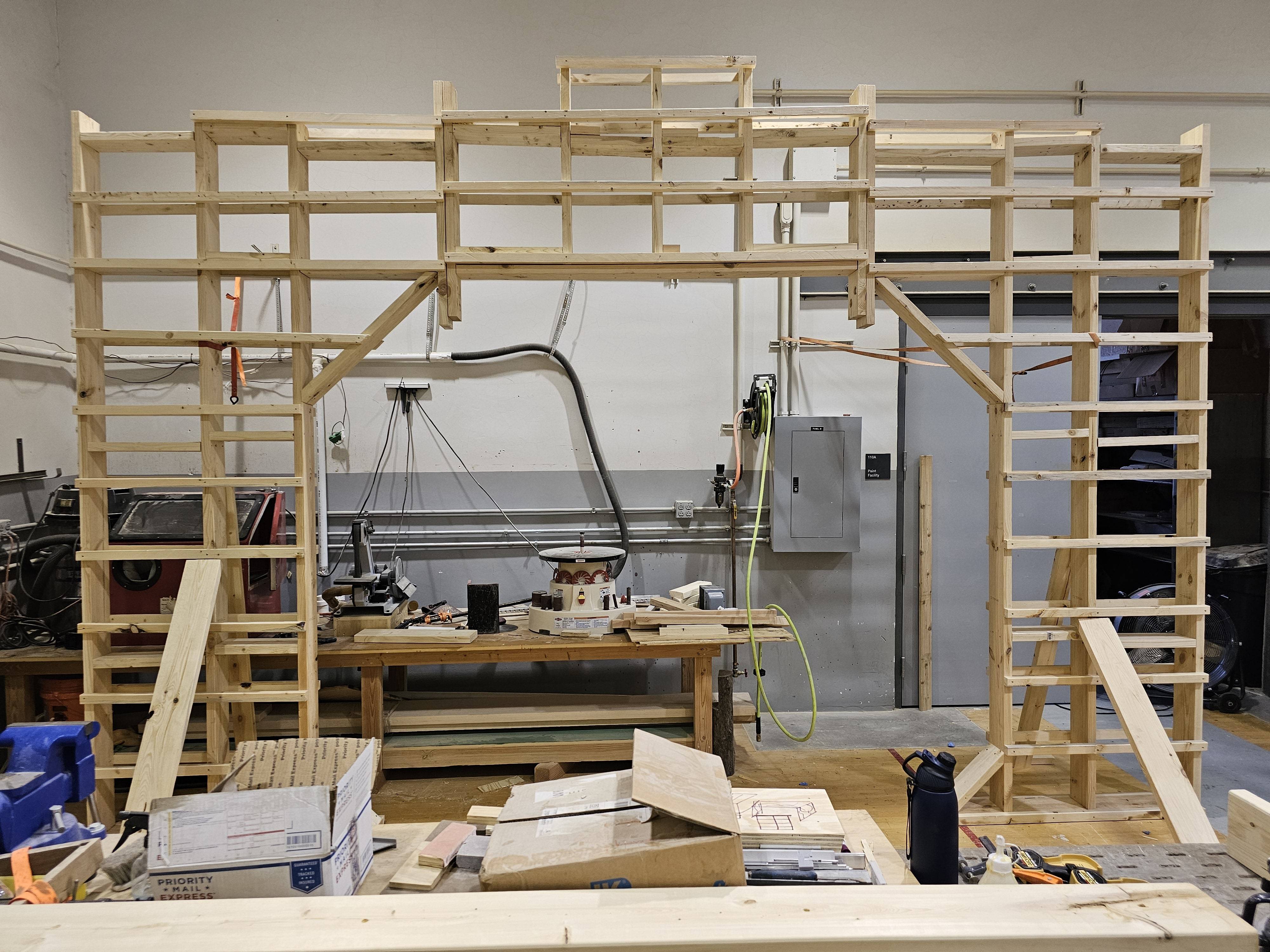
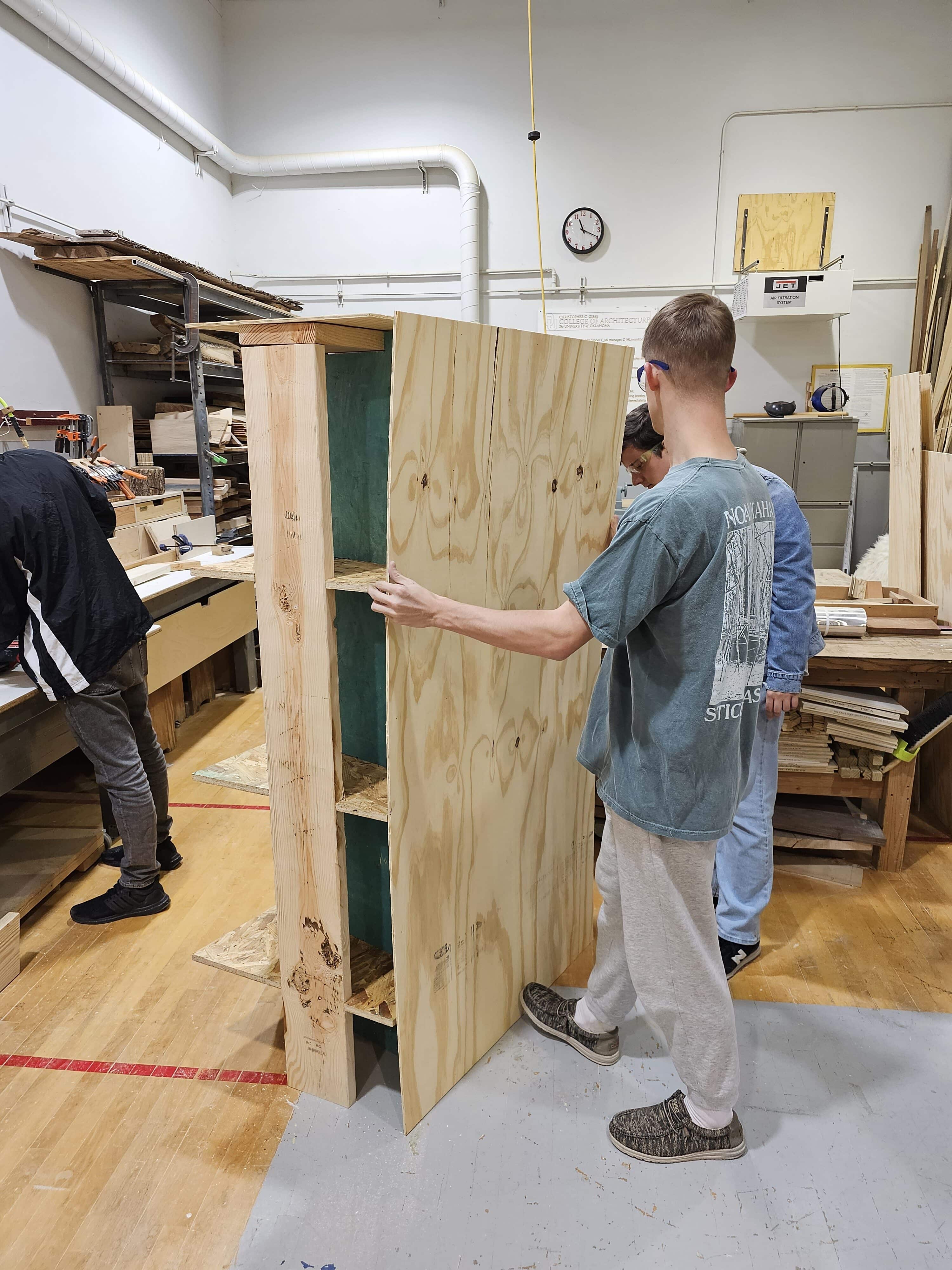
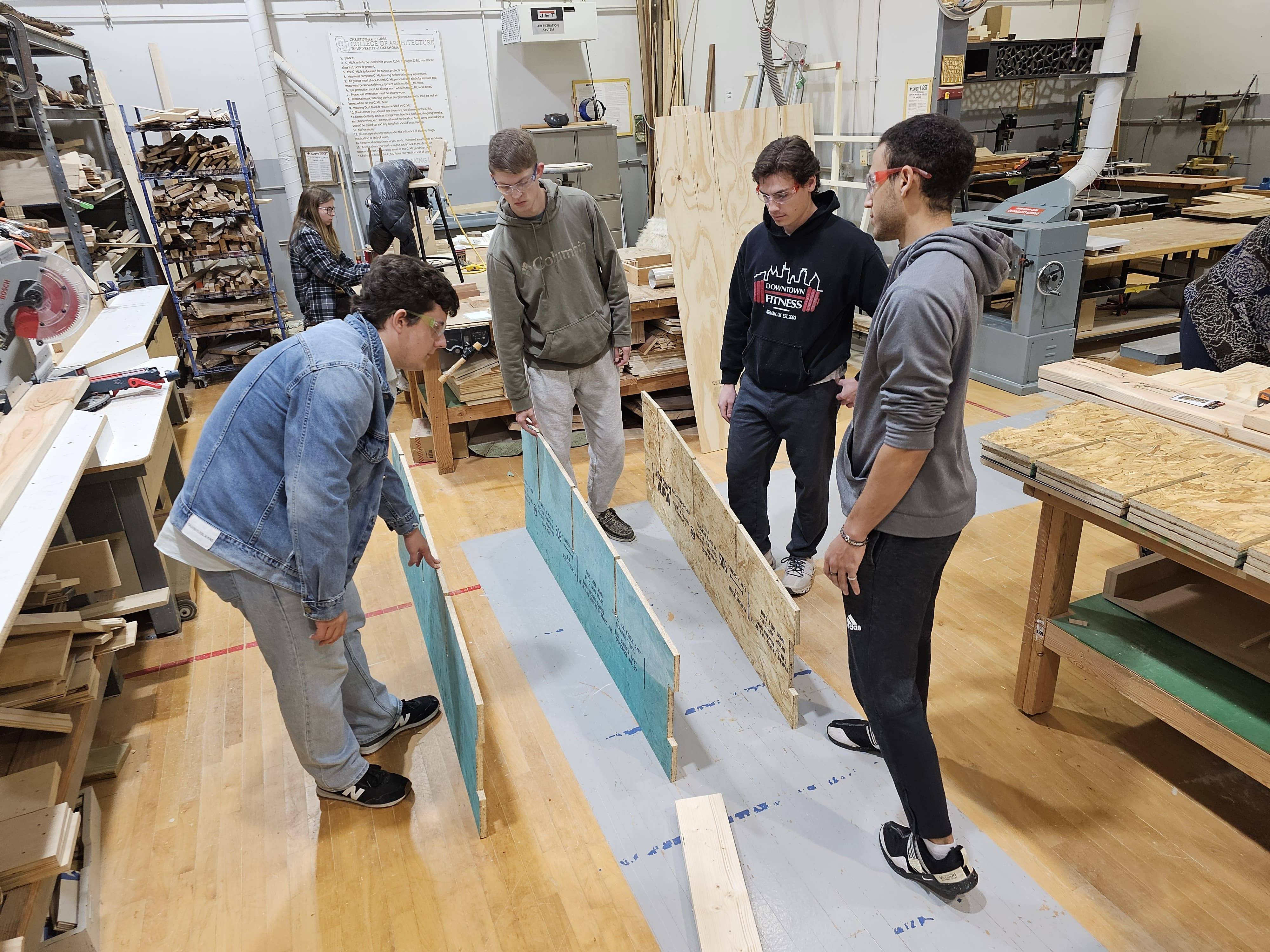
Workshop images document joinery refinement and assembly sequencing. Assembly simulation and prototypes enabled students to evaluate fabrication tolerances and test construction outcomes before museum installation.


Exhibition as Pedagogy

The design-build and digital fabrication seminar’s participation in Outré West demonstrated how academic work can operate simultaneously as precedent study, material research, and public scholarship. Unlike site-based projects, this effort required students to situate their work within a curated exhibition, meeting expectations of durability, clarity, and interpretive strength. Inclusion in a professional museum context extended the reach of academic making, positioning design-build pedagogy as research through making—a framework where design inquiry, construction, and cultural engagement intersected through integration of design and construction.

Making as Inquiry
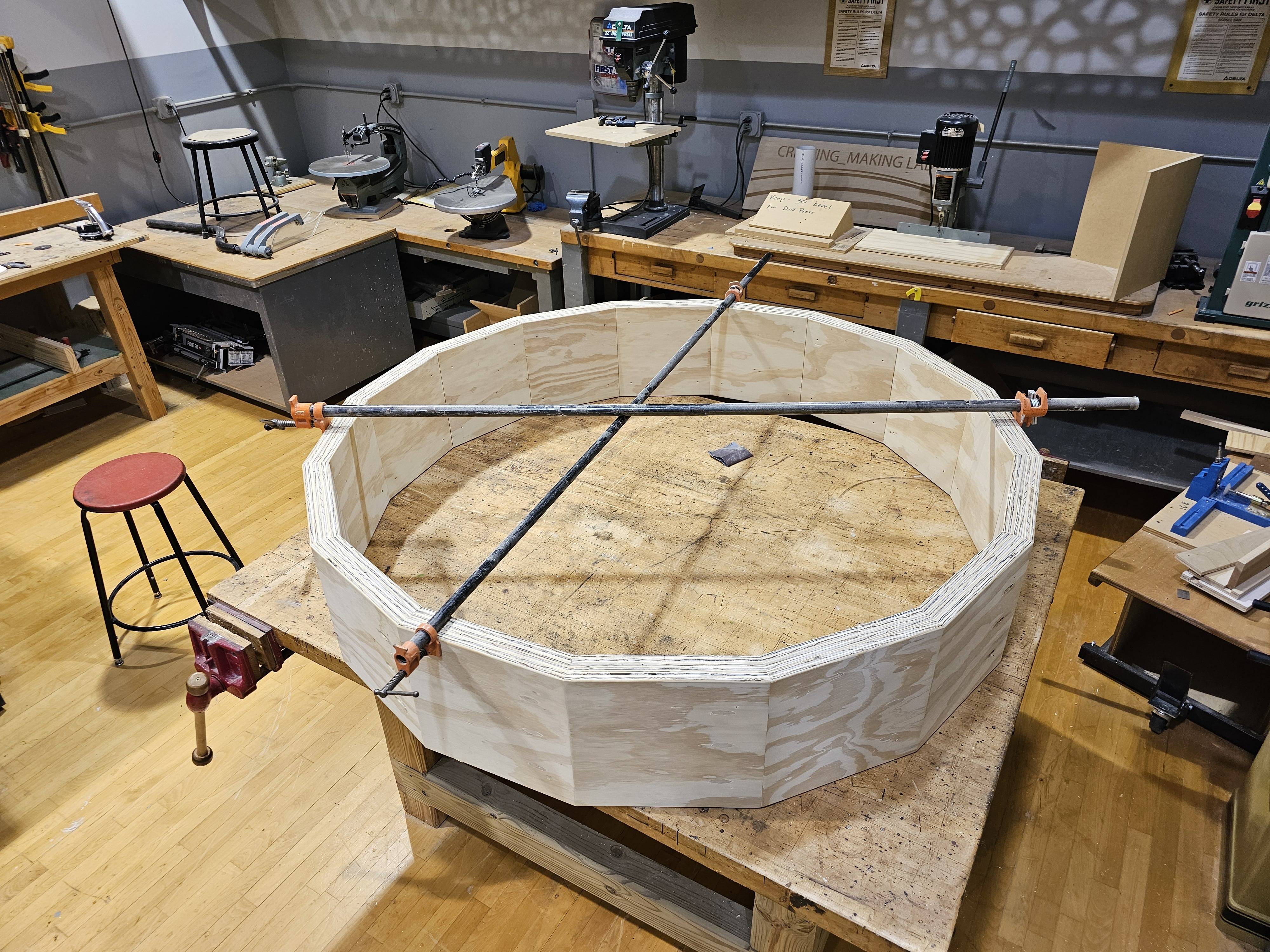
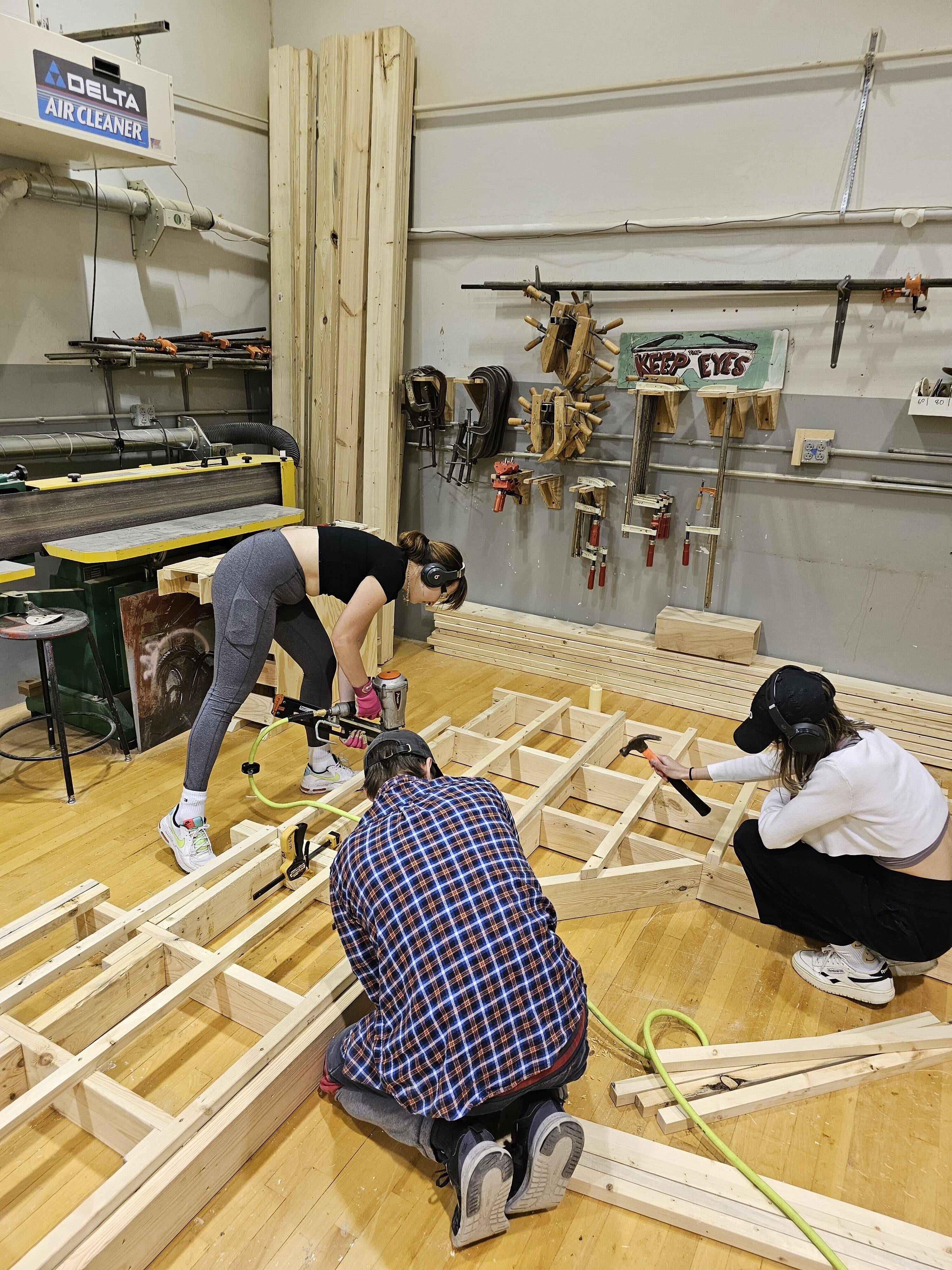
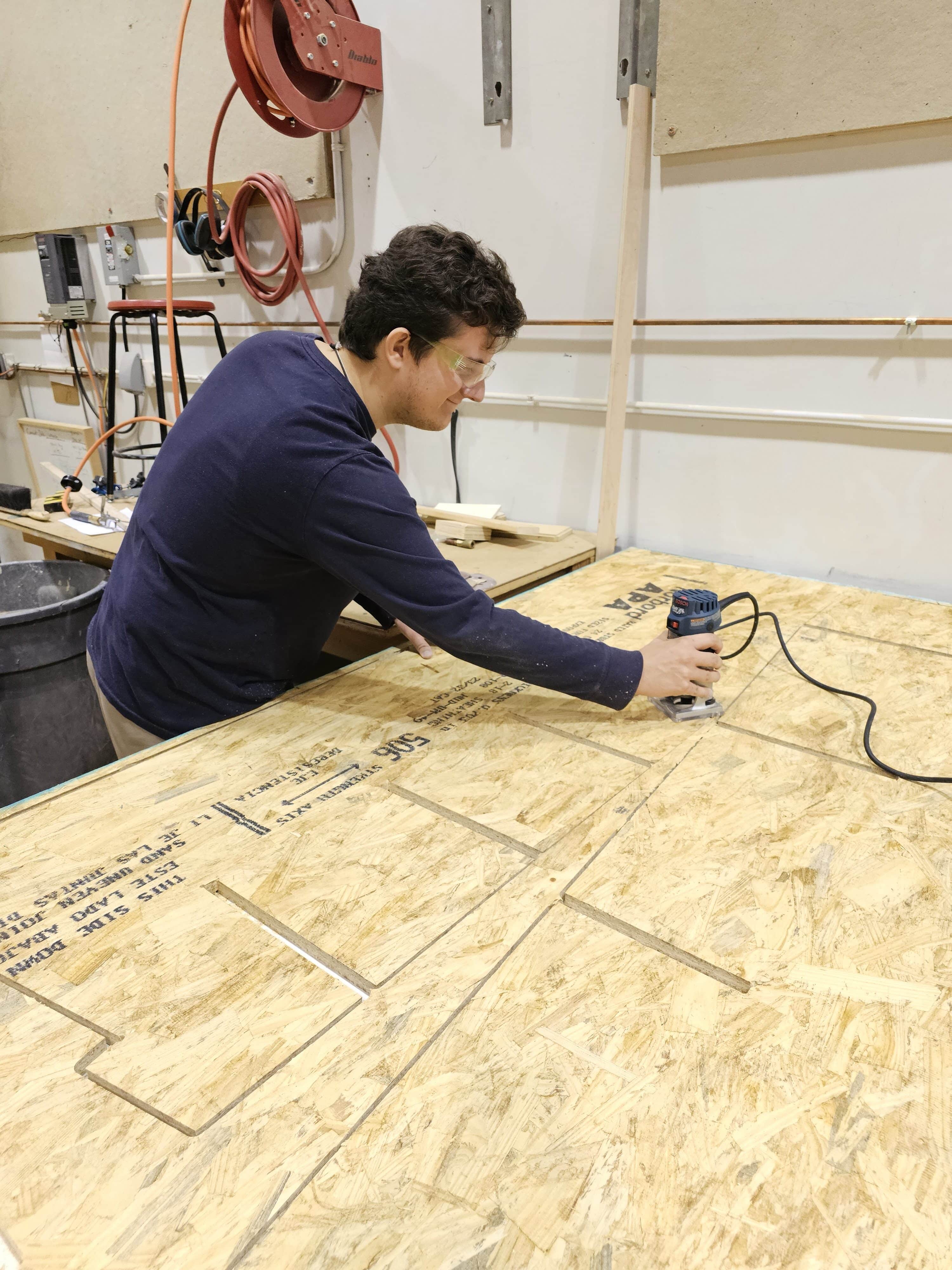
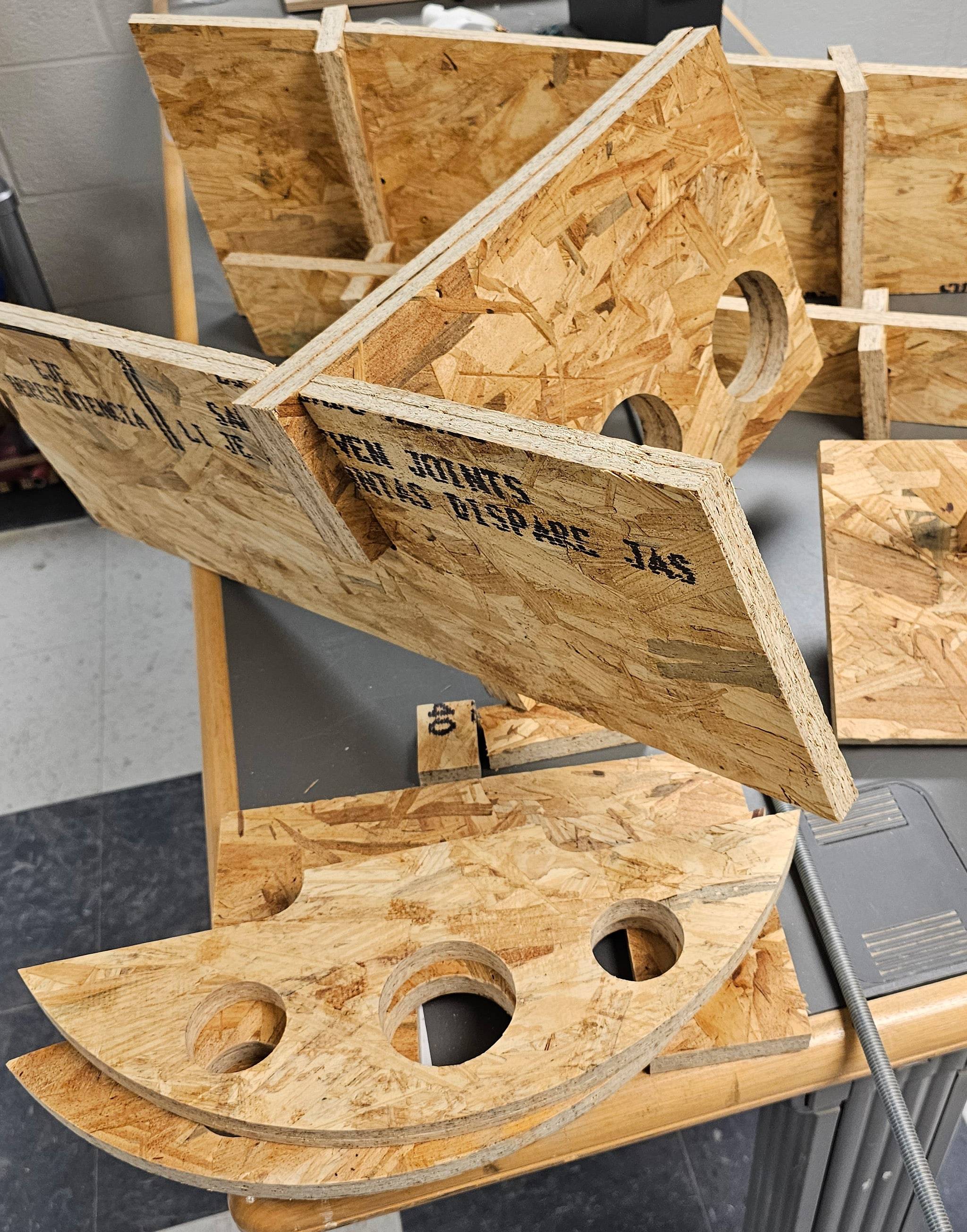
Students fabricate wall modules in the workshop, transforming research into material experimentation. The process framed making as a form of inquiry, testing how design-build pedagogy operates within exhibition contexts.


Design-Build Threshold
The CNC-milled portal inspired by Muennig’s house introduces the exhibition. Its circular geometry and vertical rhythm reinterpret historic precedent as contemporary craft and computational precision.


Full-Scale Design-Build Installations: From Archive to Experience

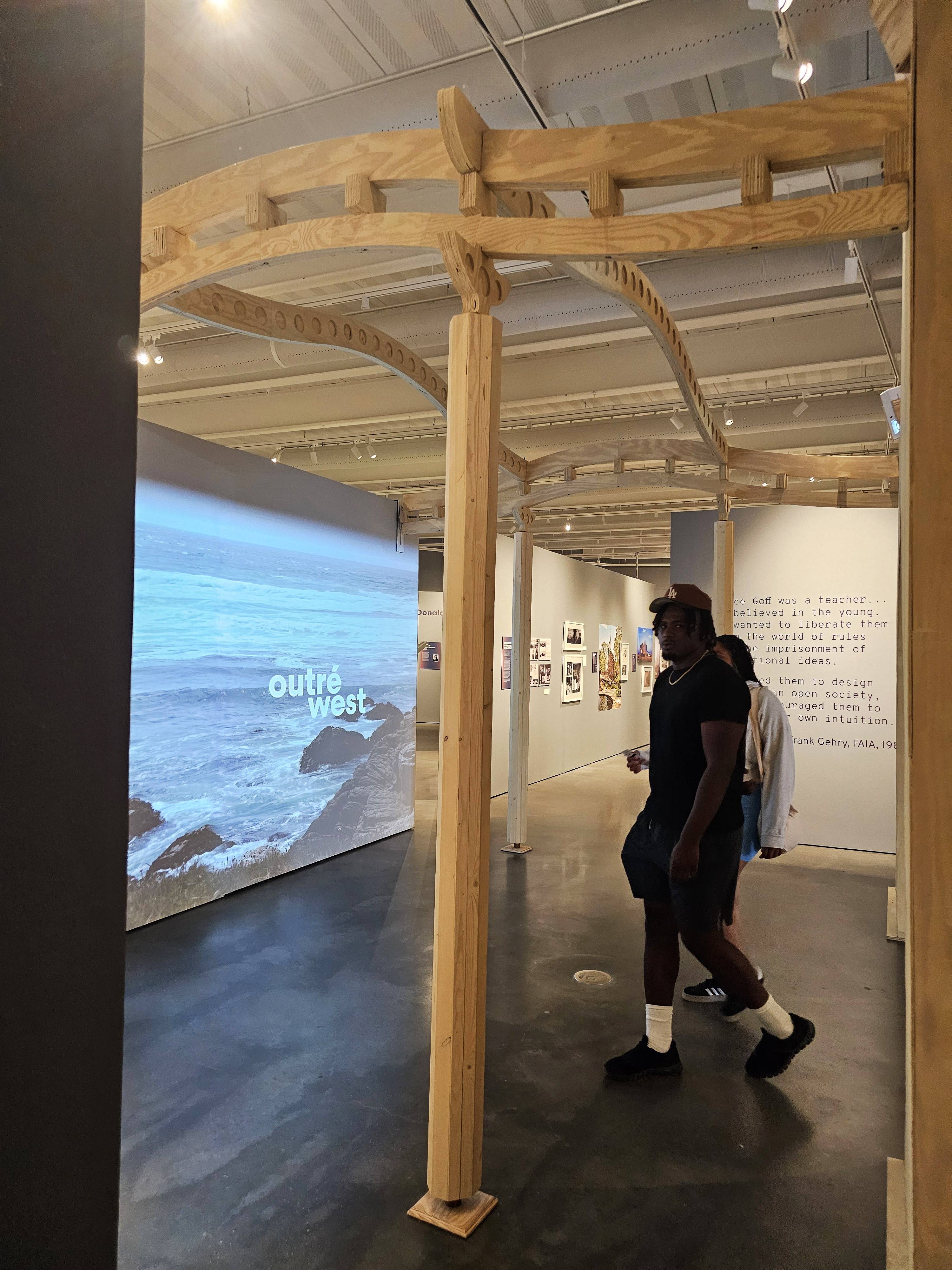
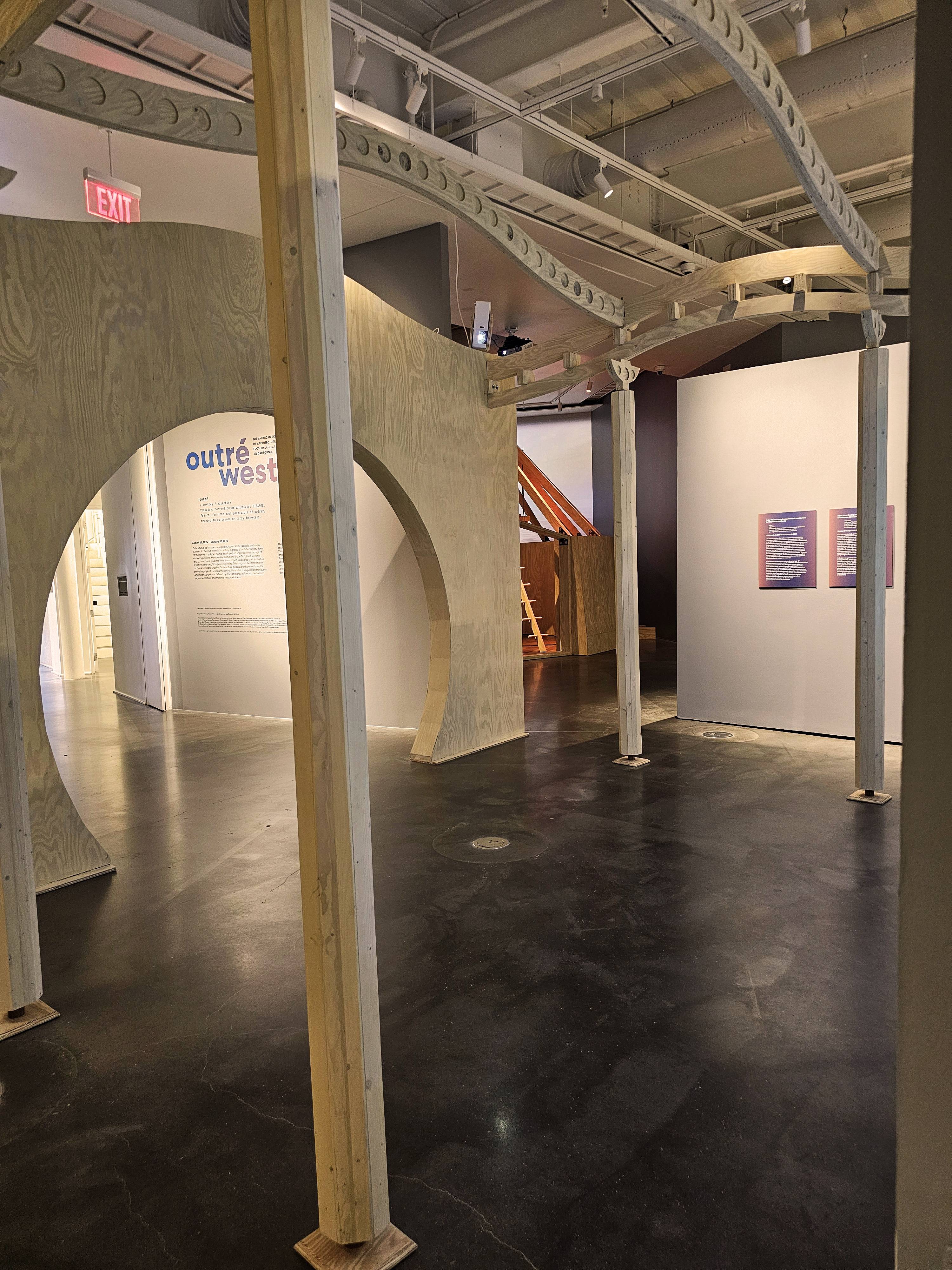
The seminar’s contributions unfolded as a spatial sequence within the exhibition. At the entry, students reinterpreted Muennig’s house, condensing its circular threshold and colonnaded spaces into CNC-milled plywood components that formed a welcoming portal. At the midpoint, another team reconstructed MacDonald’s City Sleeper, originally designed as a portable plywood shelter for the unhoused. Reimagined as a flat-pack kit-of-parts, the installation retained its humanitarian intent while testing prefabrication, rapid assembly, and construction precision. The sequence culminated in a reinterpretation of Muennig’s studio, fabricated as an inhabitable pavilion of lofted ribs and interlocking joints. This immersive space provided the exhibition’s finale, enveloping visitors in a demonstration of digital fabrication, material experimentation, and full-scale realization.

Each installation translated archival research into tactile experience, forming a continuum of investigation—archival data modeled computationally, tested through iterative prototyping, and realized through design-build workflows.


Threshold to Colonnade
After passing through the circular entry, visitors enter a field of CNC-milled columns. The installation transforms compression into openness, echoing Muennig’s spatial language through rhythm and light.


Collective Construction
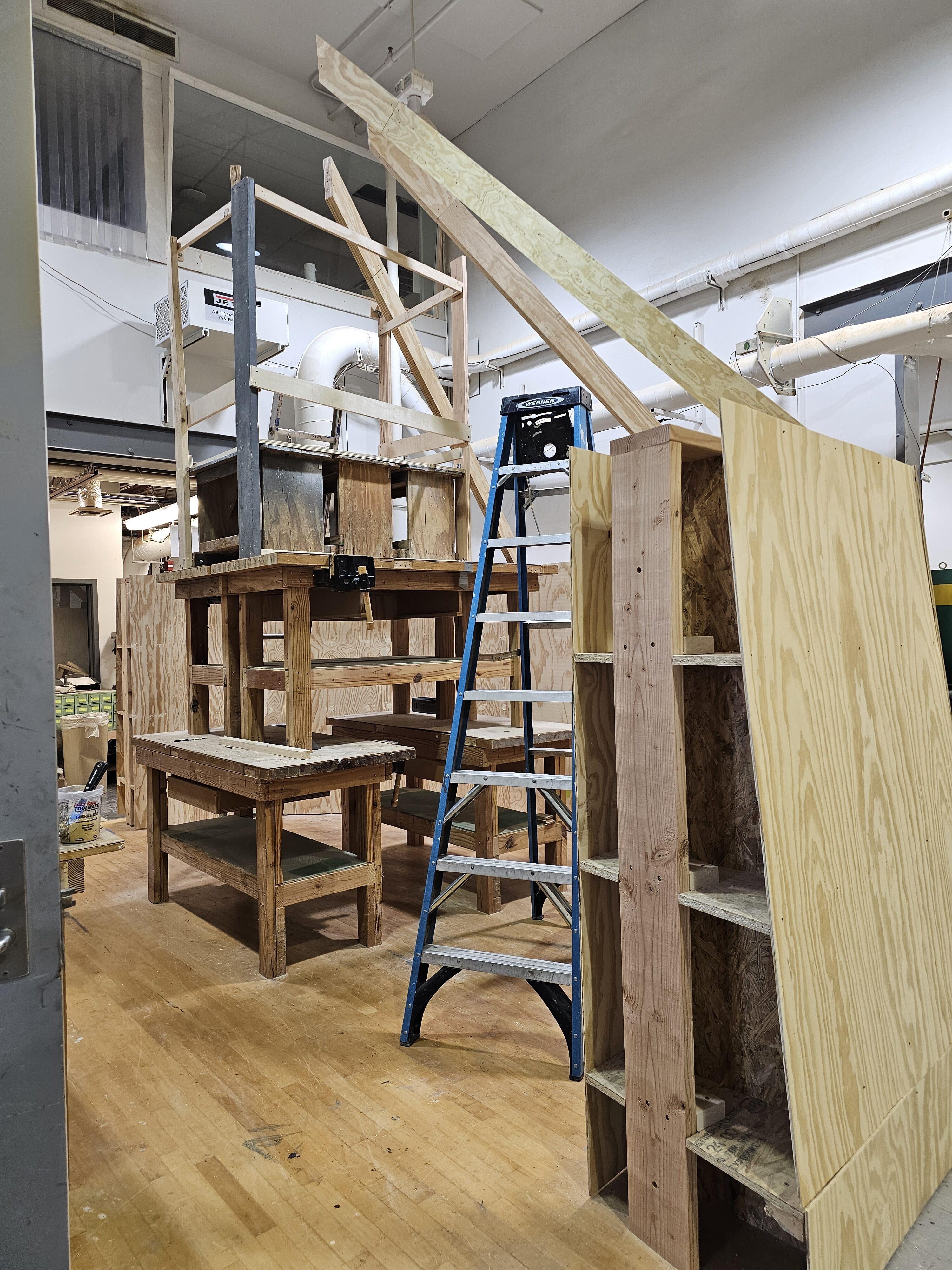
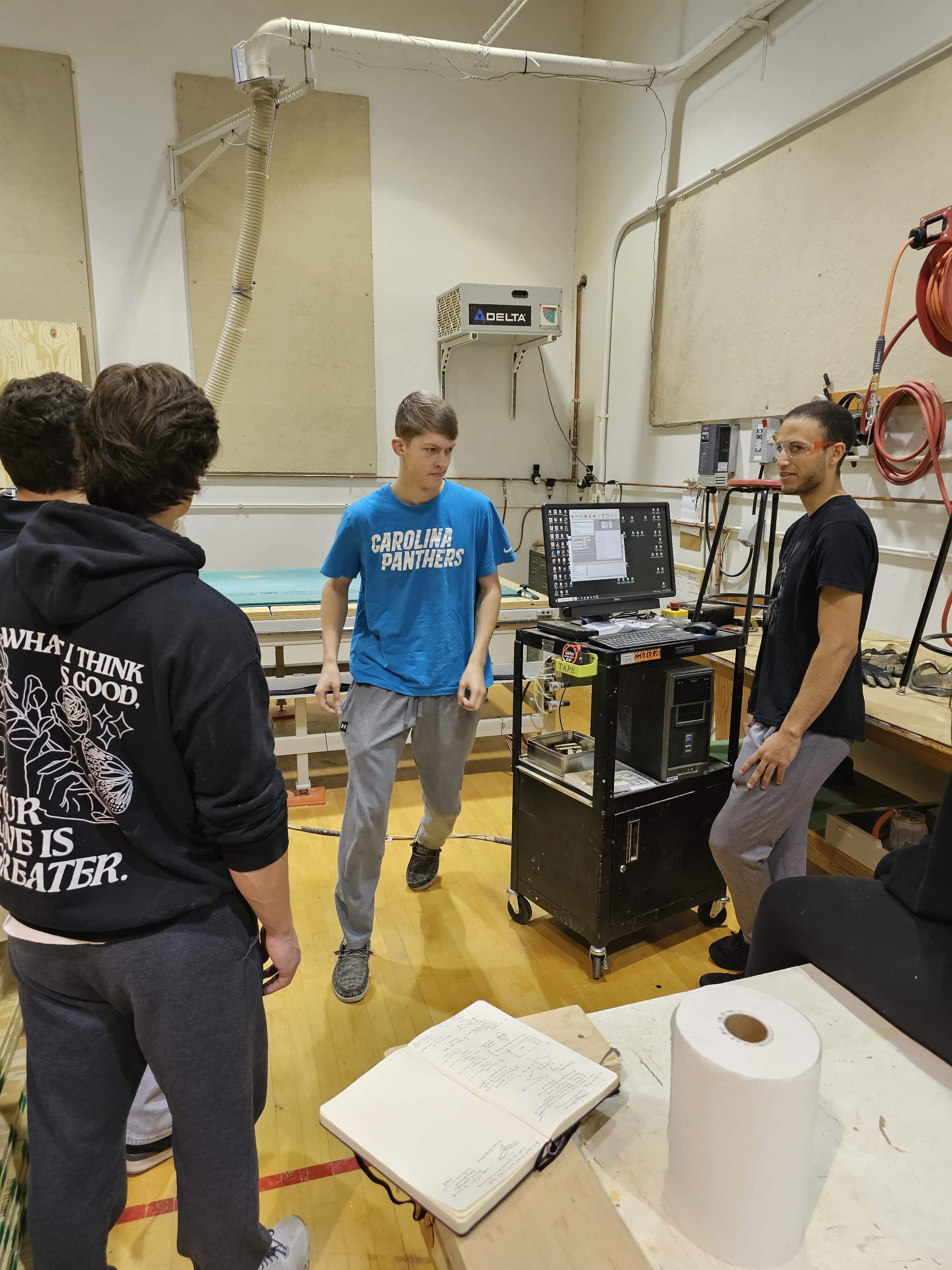
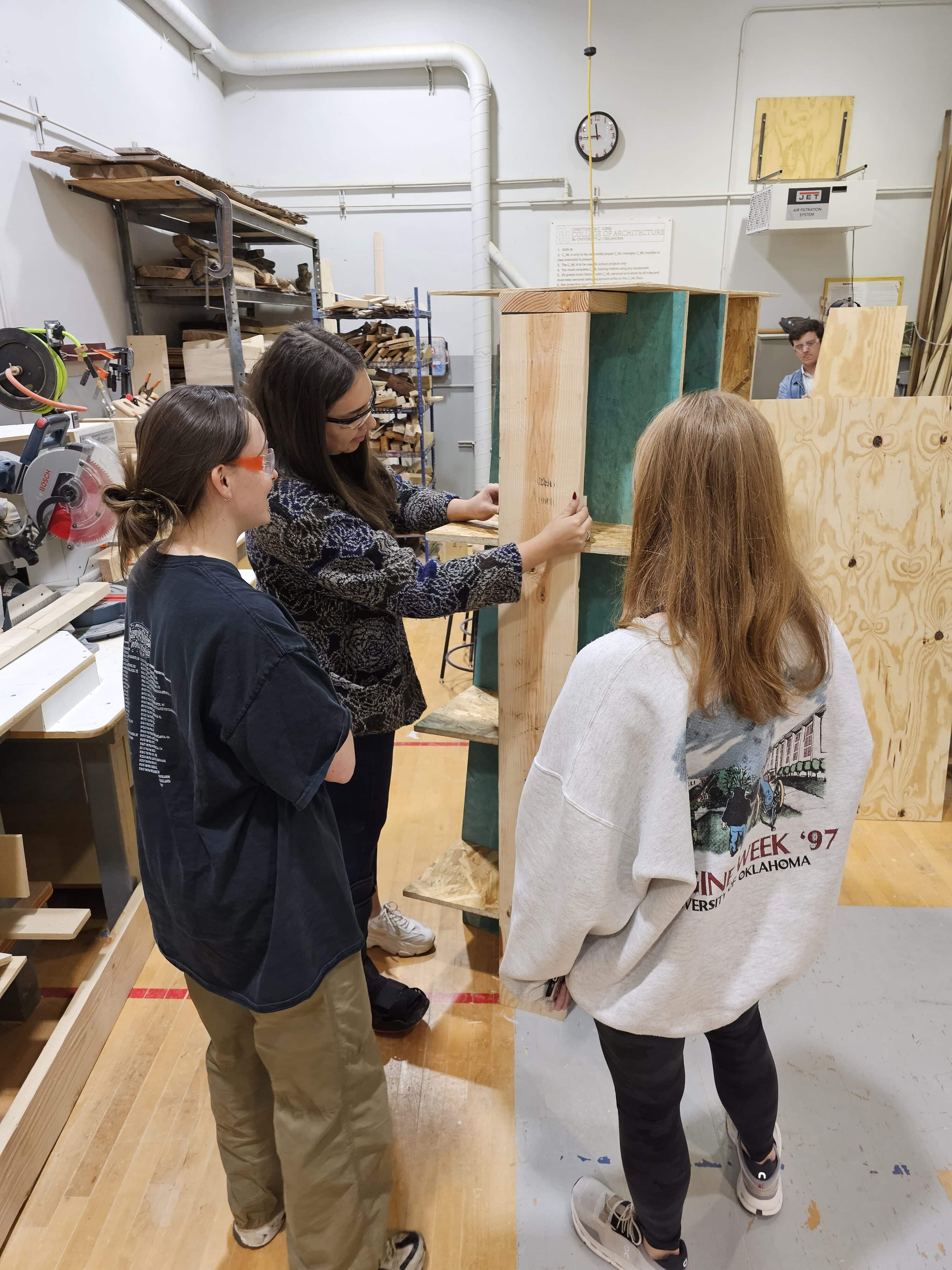
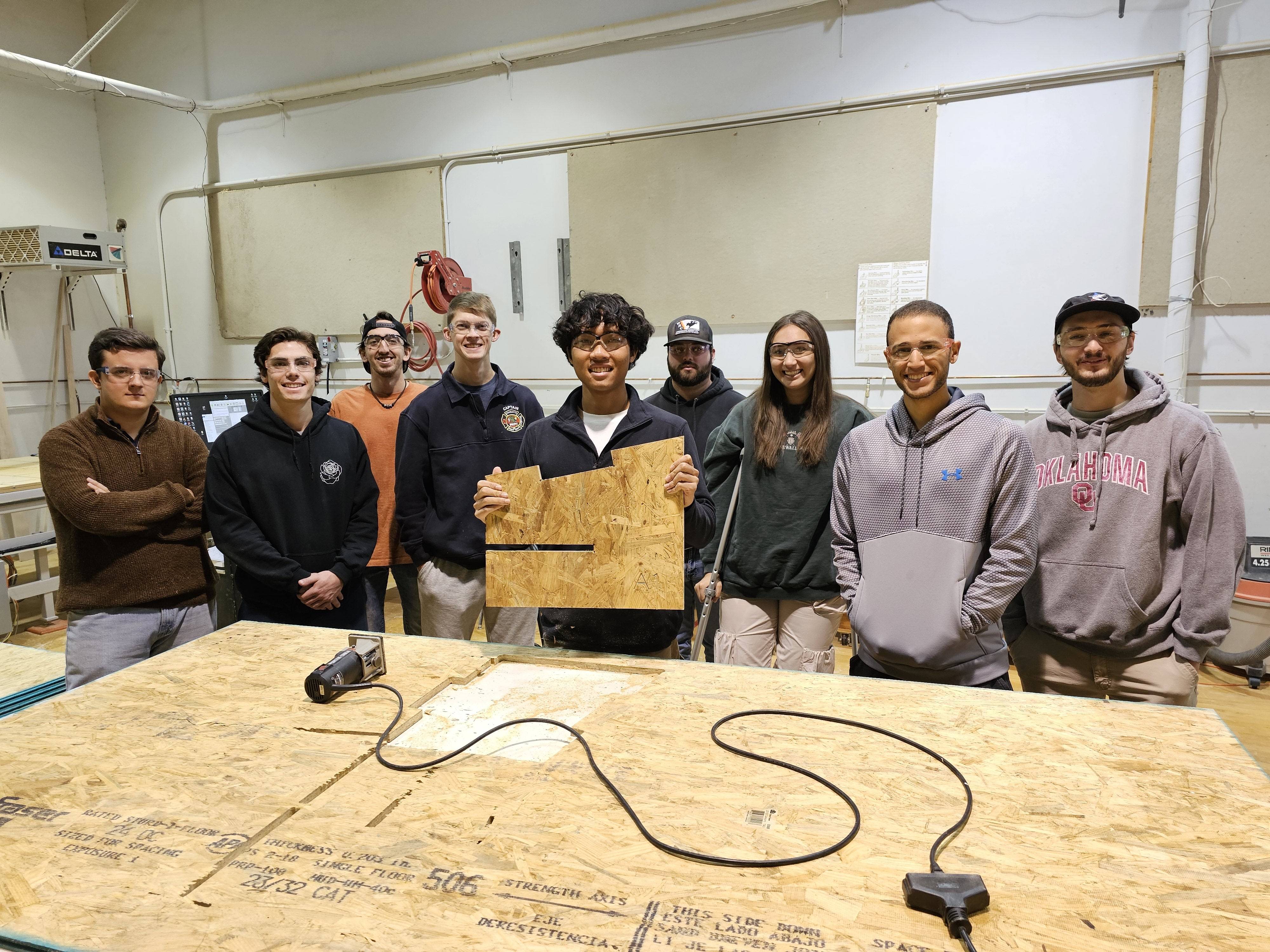
Students collaborate on cutting, fastening, and assembling structural components. The shared workflow modeled professional coordination between design, fabrication, and installation teams.


Building as Research

The seminar emphasized building as a mode of research. Students cycled between archival drawings, computational models, study models, and full-scale prototypes, testing translations from blueprint to digital file to CNC-milled part. Small-scale simulations provided a low-stakes environment for exploring toolpaths and sequencing, enabling feedback between digital design and physical construction. Full-scale fabrication underscored the unforgiving nature of material, demanding precision, resilience, and adaptability.

Students treated plywood as both structure and language—its surface, grain, and modularity becoming tools for expressive, sustainable construction. Through precision joinery and nested assemblies, they explored tectonic detail as both technical and cultural inquiry. To professionalize their work, students produced assembly manuals for each project, ensuring museum staff could reassemble components as needed. Exhibition-making thus extended beyond fabrication into documentation, accountability, and institutional collaboration—a synthesis of design, research, and public communication.


From Model to Mock-Up
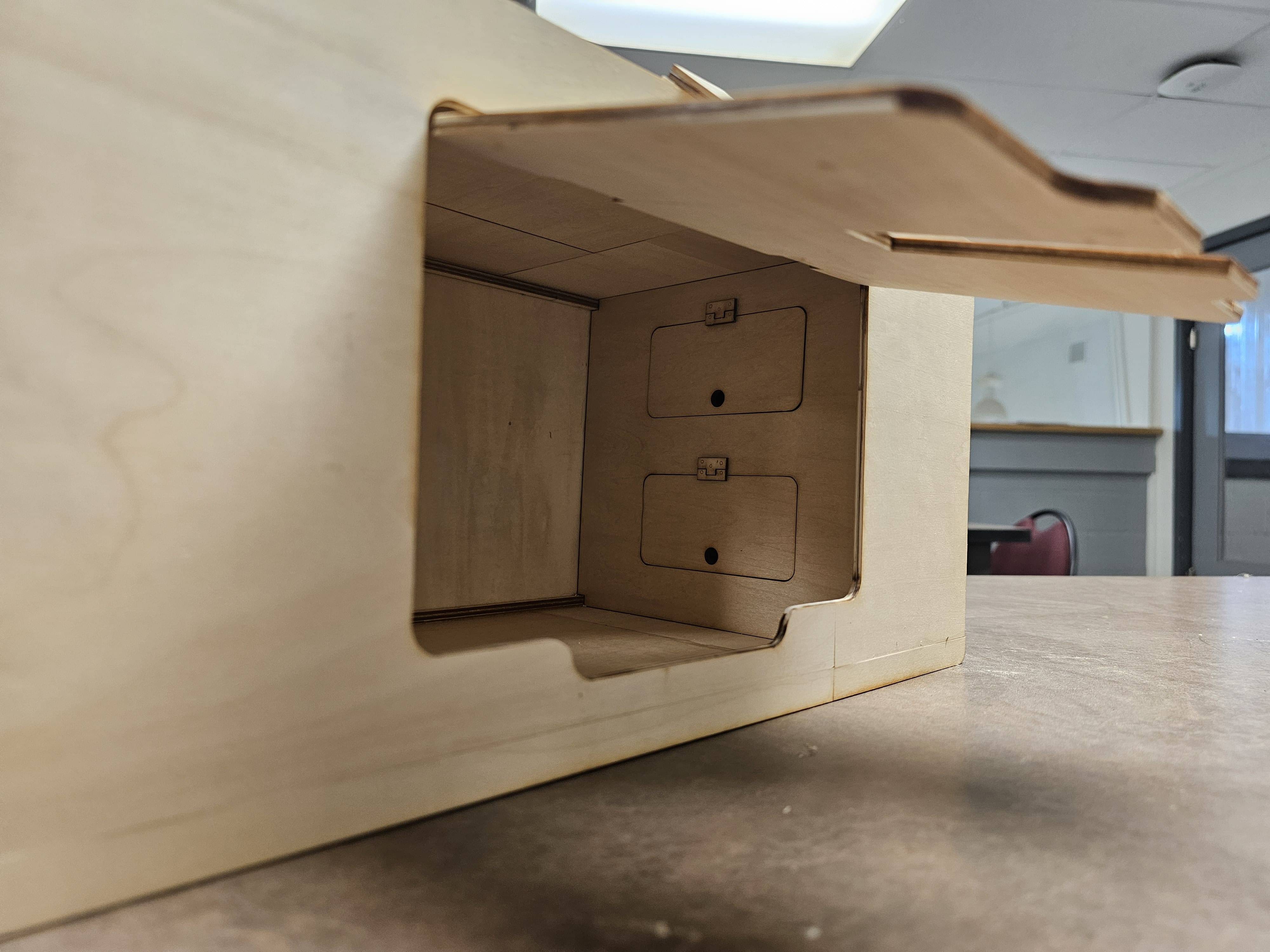
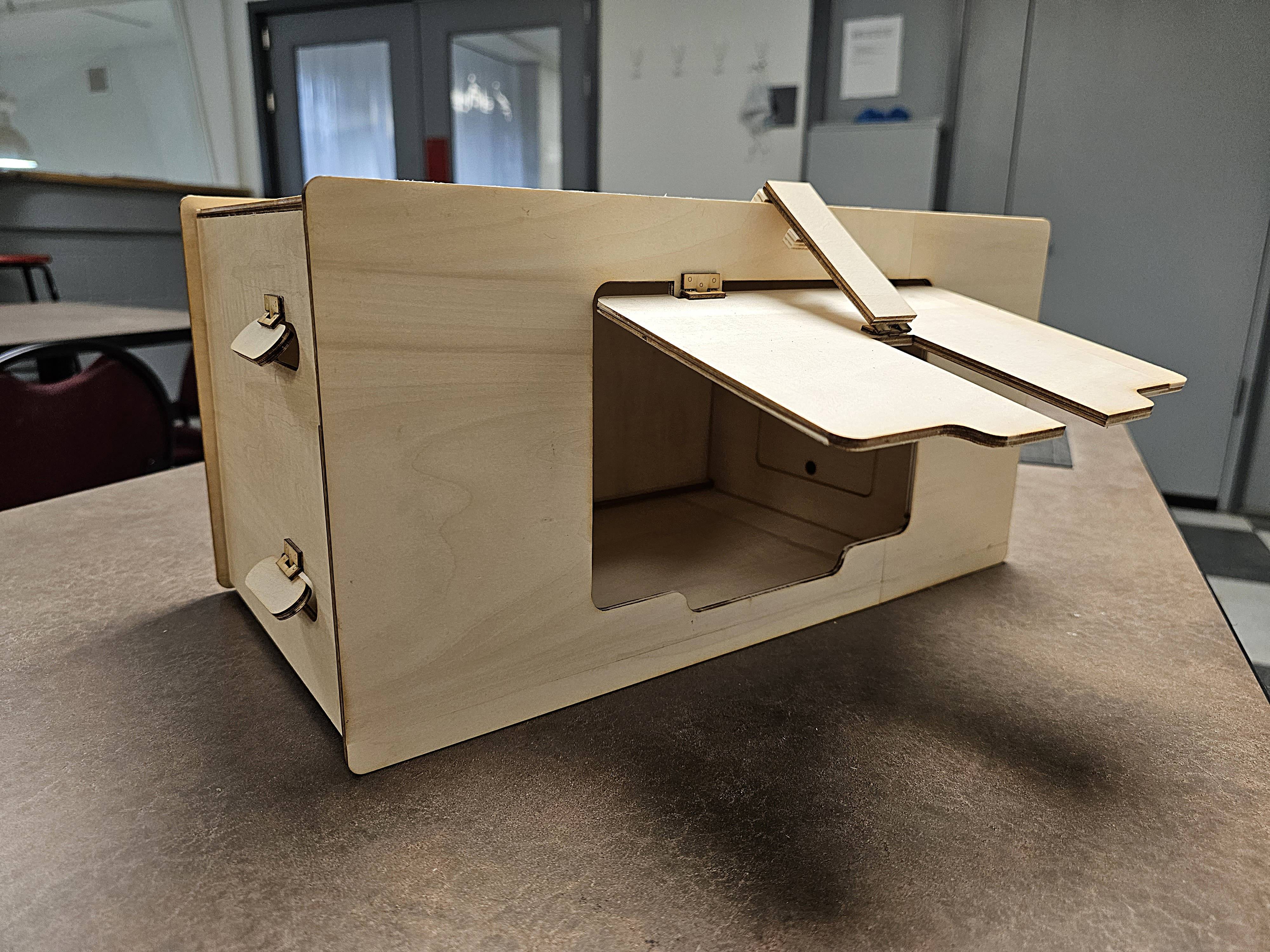
Students refined City Sleeper through study models and a full-scale plywood prototype. The iterative process tested fabrication tolerances, structural logic, and material efficiency prior to exhibition installation.

Threshold to Colonnade
After passing through the circular entry, visitors enter a field of CNC-milled columns. The installation transforms compression into openness, echoing Muennig’s spatial language through rhythm and light.


Collective Authorship

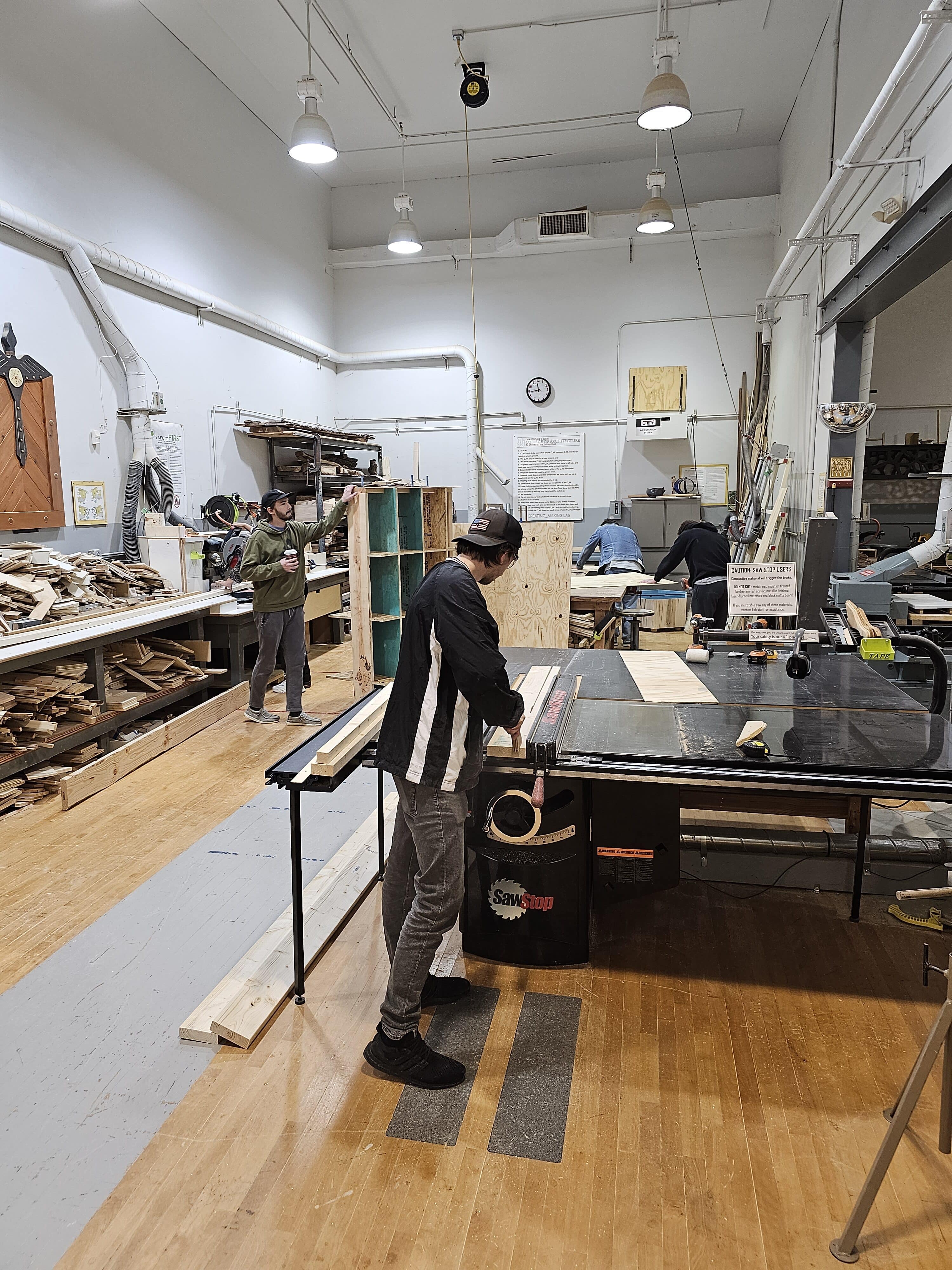
Collaboration defined the seminar. Undergraduate and graduate students worked side by side, guided by faculty and exhibition curators. Faculty provided instruction in digital-to-physical workflows, while curators advised on sequencing, audience engagement, and interpretive framing. Students coordinated fabrication and installation schedules, negotiated between curatorial expectations and architectural intentions, and engaged in collective authorship that blurred distinctions between designer, builder, and researcher.

Student reflections described the experience as transformative—“the moment when research became physical space.” This multi-layered collaboration fostered interdisciplinary learning and modeled a replicable framework for design-build partnerships between academic programs and cultural institutions.

Collective Authorship in Action
Undergraduate and graduate students collaborate in fabrication and assembly, guided by faculty and curators. The process exemplifies shared responsibility and interdisciplinary teamwork within the design-build seminar.


Collective Authorship

Collaboration defined the seminar. Undergraduate and graduate students worked side by side, guided by faculty and exhibition curators. Faculty provided instruction in digital-to-physical workflows, while curators advised on sequencing, audience engagement, and interpretive framing. Students coordinated fabrication and installation schedules, negotiated between curatorial expectations and architectural intentions, and engaged in collective authorship that blurred distinctions between designer, builder, and researcher.

Student reflections described the experience as transformative—“the moment when research became physical space.” This multi-layered collaboration fostered interdisciplinary learning and modeled a replicable framework for design-build partnerships between academic programs and cultural institutions.


Installation in Progress
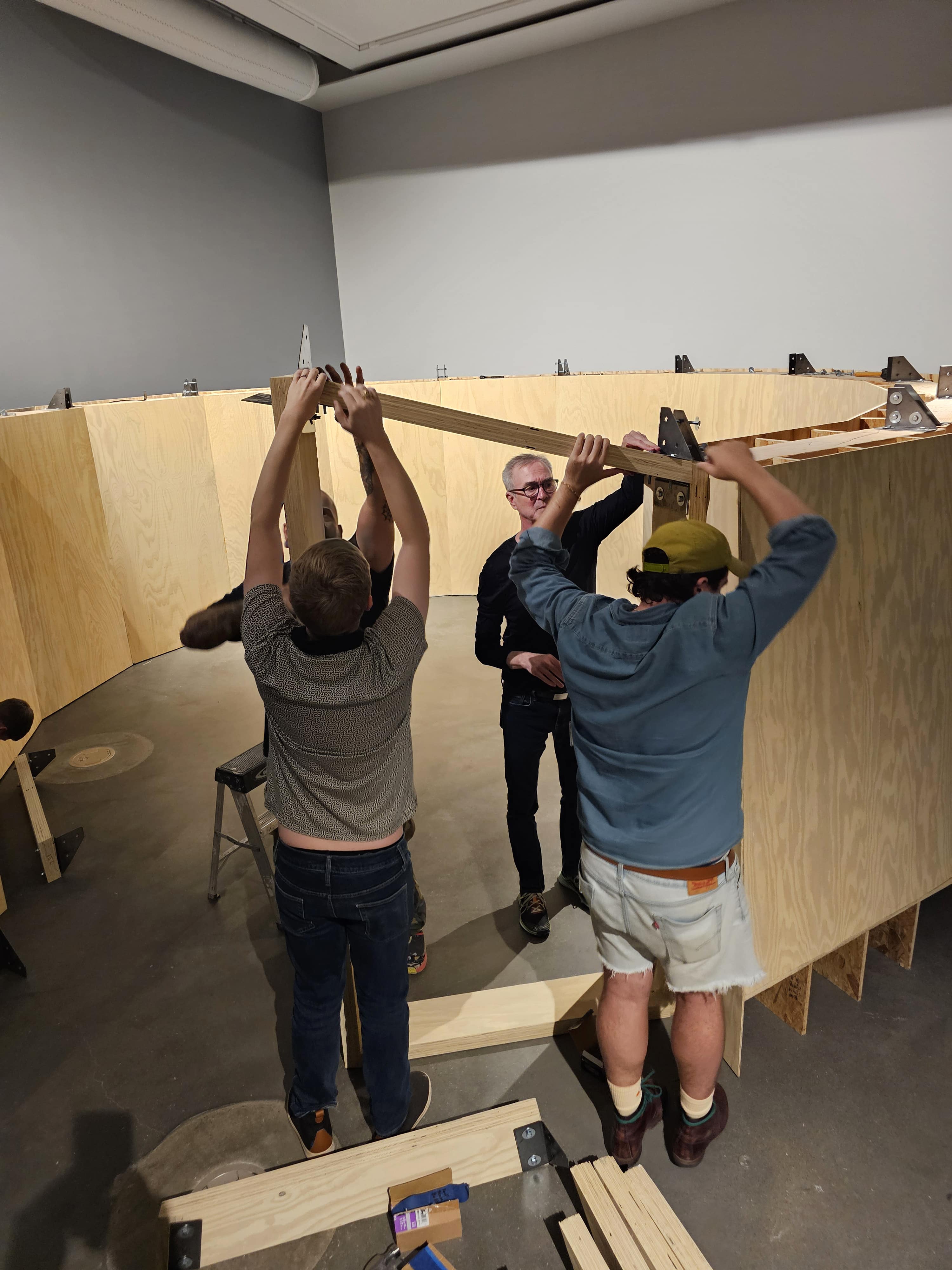
Students, curators, staff, and volunteers position component modules, aligning parts through numbered joinery. The on-site phase reinforced teamwork, sequencing, and the realities of construction under institutional deadlines.


Immersive Spatial Experience
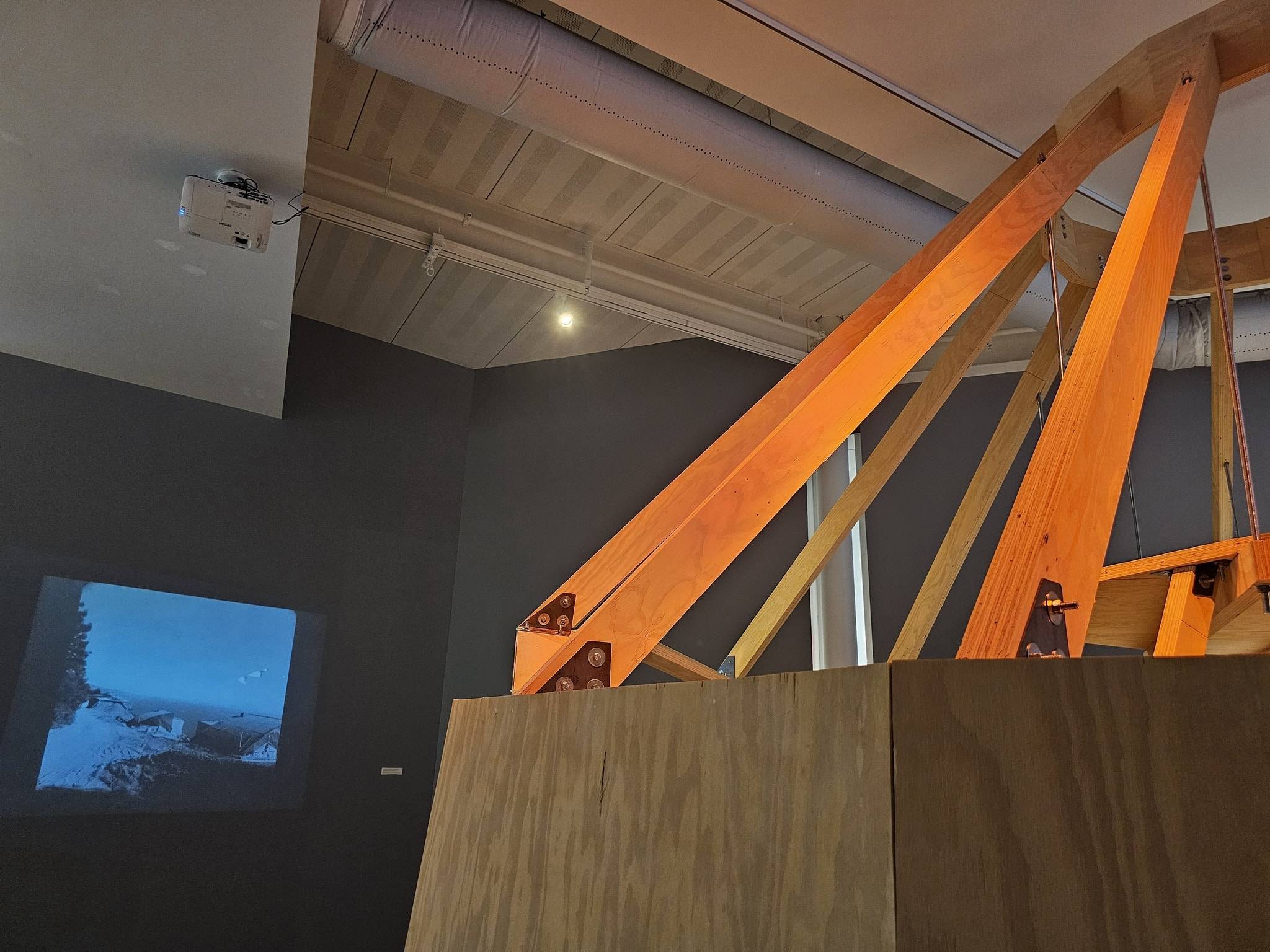
Views of the reconstructed studio highlighting light, proportion, and structure. The project translated digital fabrication into a spatial experience emphasizing fabrication innovation and craft, tectonic rhythm and material warmth.


Reconstructing the Archive
Historic photographs above and student-fabricated installations below illustrate the transformation from precedent to practice. The paired images embody research, material translation, and the public reach of design-build education.


Educational and Public Impact

The project’s outcomes extended beyond technical proficiency. Students gained confidence in design-build workflows, developed material intelligence, and experienced the demands of working within a public cultural institution. For visitors, the installations offered inhabitable encounters with architectural precedents, demonstrating how historic ideas can be reinterpreted through contemporary fabrication systems. For architectural education, the project underscored the value of design-build pedagogy as creative scholarship, merging fabrication, research, and civic engagement.

Its methodology—integrating archival interpretation, iterative prototyping, and institutional collaboration—offers a replicable model for educators seeking to connect academic inquiry with public impact. Outré West demonstrates that design-build education can operate as both technical training and public scholarship, advancing the broader mission of architectural education toward innovation, material intelligence, and social relevance.


More Work


Architecture

Art + Code

Design + Fabrication

Courses + Student Work

© Ken Marold USA, Inc. All rights reserved.

Continue reading

Methods II: Patterns of Architecture

Methods 2 : Patterns of Architecture

ARCH 1263
First-Year Methods, Spring

Methods II introduces first-year architecture students to the fundamental relationships between order, pattern, and spatial organization. The course explores how systems of structure, proportion, and geometry shape architectural thinking across scales. Through a series of analog and digital exercises, students translate two-dimensional patterns into three-dimensional constructs, developing spatial literacy and representational fluency.

Working in Rhino and Adobe Creative Suite, they investigate concepts of repetition, variation, and transformation to connect design intent with material logic. Emphasis is placed on process, craft, and iteration as students learn how to communicate design ideas through precise drawings, models, and visual composition. Methods II establishes a foundation for architectural design grounded in systems, structure, and the act of making.

Methods 2 : Patterns of Architecture

ARCH 1263
First-Year Methods, Spring

Methods II introduces first-year architecture students to the fundamental relationships between order, pattern, and spatial organization. The course explores how systems of structure, proportion, and geometry shape architectural thinking across scales. Through a series of analog and digital exercises, students translate two-dimensional patterns into three-dimensional constructs, developing spatial literacy and representational fluency.

Working in Rhino and Adobe Creative Suite, they investigate concepts of repetition, variation, and transformation to connect design intent with material logic. Emphasis is placed on process, craft, and iteration as students learn how to communicate design ideas through precise drawings, models, and visual composition. Methods II establishes a foundation for architectural design grounded in systems, structure, and the act of making.
Foundations in Architectural Systems

Methods 2 introduces students to the underlying systems, hierarchies, and organizational frameworks that shape architectural design. Building on earlier coursework, it transitions students from intuitive composition toward a more systematic and analytical approach to design thinking. The course emphasizes that architecture is not a collection of isolated forms, but an interdependent system of spatial, structural, and environmental relationships. Through drawing, modeling, and digital analysis, students learn to recognize the patterns that govern buildings and cities—grids, fields, frames, and circulations—and how these can be used to order space and meaning. Each assignment deepens the student’s ability to move between observation, abstraction, and invention, grounding creative expression in a disciplined understanding of architectural logic.

Digital Literacy and Representation

Digital literacy forms a central component of the course. Students gain technical fluency in Rhino and Adobe Creative Suite, learning how digital environments can serve as laboratories for design speculation. The course encourages experimentation with precision, how subtle shifts in geometry, hierarchy, or layering can influence perception and performance. Early exercises in orthographic drawing and axonometric projection build foundational drafting skills, while more advanced assignments challenge students to interpret precedent through complex modeling workflows. Students learn not only to produce accurate digital representations, but also to use software as a tool for inquiry, visualizing structural logic, spatial hierarchy, and light behavior. By semester’s end, they demonstrate a professional level of compositional clarity and graphic literacy that supports both academic and practical applications.


Pattern, Logic, and Transformation

At the core of the course is an exploration of architectural pattern as both a design tool and an intellectual framework. Students begin by analyzing canonical works of architecture, unpacking how rhythm, proportion, and repetition generate coherence, and then apply those insights to their own transformations. Working from measured drawings and analytical diagrams, they derive generative rules from existing systems, translating those rules into new forms, geometries, and spatial organizations. This process reveals how architecture evolves through adaptation and variation, as small manipulations in pattern yield entirely new spatial experiences. By synthesizing conceptual abstraction with procedural precision, students cultivate the ability to generate original design propositions that maintain both rigor and elasticity, understanding pattern as a bridge between precedent and invention.


Synthesis Through Visualization

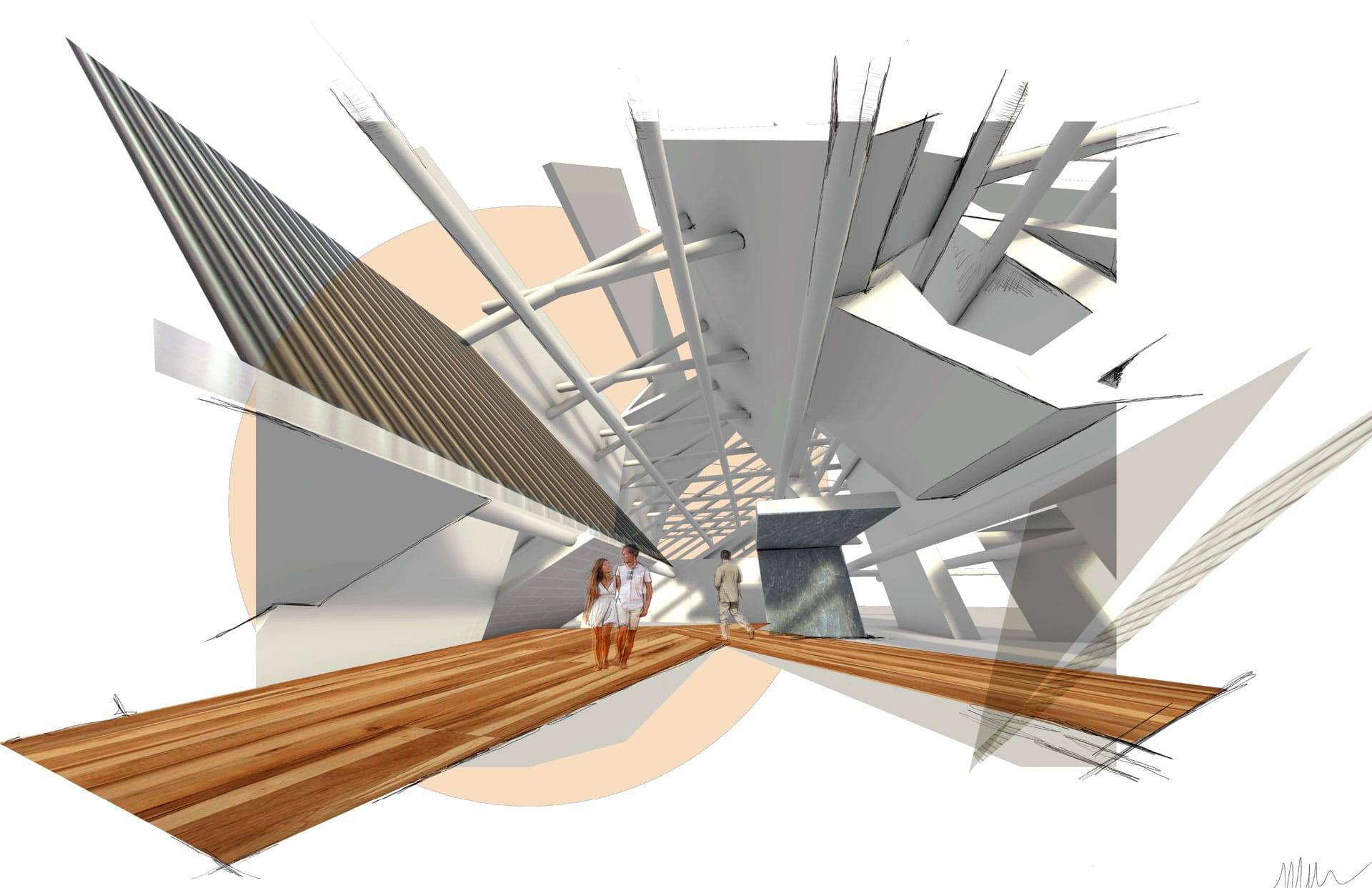
Representation in Methods 2 is not treated as a mode of documentation but as a form of synthesis. Students learn to merge orthographic precision with atmospheric interpretation—producing composite drawings that communicate tectonic order, material character, and experiential quality in a single frame. Exercises in layering, rendering, and compositional hierarchy encourage them to control visual rhythm and spatial depth. The course emphasizes multi-scalar thinking: how detail, structure, and enclosure can be expressed simultaneously in plan, section, and axonometric views. Students are challenged to design their drawings as carefully as their architecture, cultivating the ability to convey clarity, intent, and narrative through visual composition. The final portfolio demonstrates not just technical competence but a developing architectural sensibility capable of expressing conceptual and material complexity through image and model.


Pedagogical Outcomes

By the conclusion of Methods 2, students have developed a deep understanding of how architecture operates as an integrated system, spatial, structural, and representational. They emerge with the ability to identify ordering principles and to transform them across scales and mediums, from analytical drawings to digital models to speculative design proposals. More importantly, they gain the intellectual agility to move fluidly between observation and invention, between digital and analog craft, between analysis and synthesis. The course establishes a foundation for advanced design studios by embedding the habits of disciplined iteration, careful documentation, and rigorous craft. Through the study of architectural pattern, students come to see design not as arbitrary creation, but as a process of reasoning, reflection, and transformation that connects historical precedent to contemporary practice.


Syllabus

Course Overview

Methods II — Patterns of Architecture is a first-year foundations course that introduces students to architectural representation, modeling, and ordering principles across multiple scales. It is designed for freshmen architecture students building their initial skill sets in both analog and digital workflows. The course focuses on Rhino 3D as the primary modeling platform, supported by Adobe Creative Suite for graphics and occasional introductions to Grasshopper for parametric exploration.

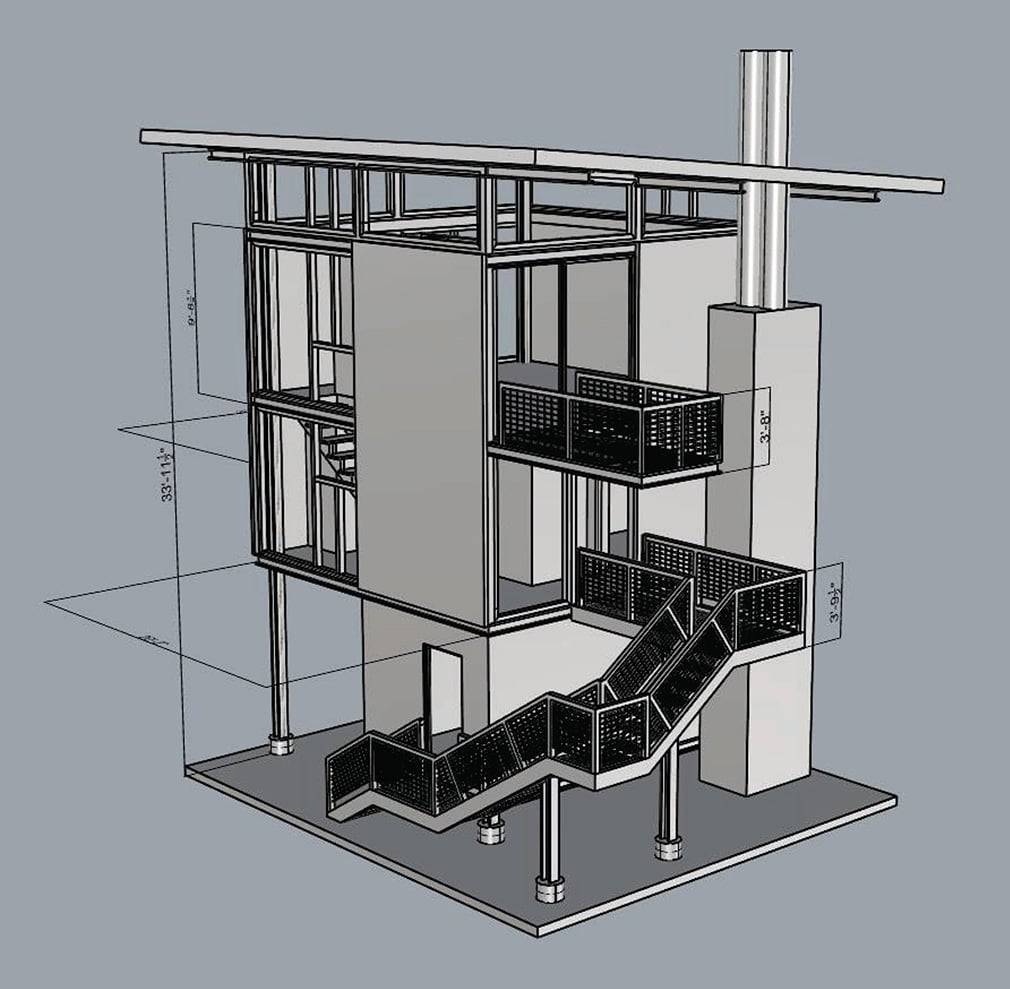
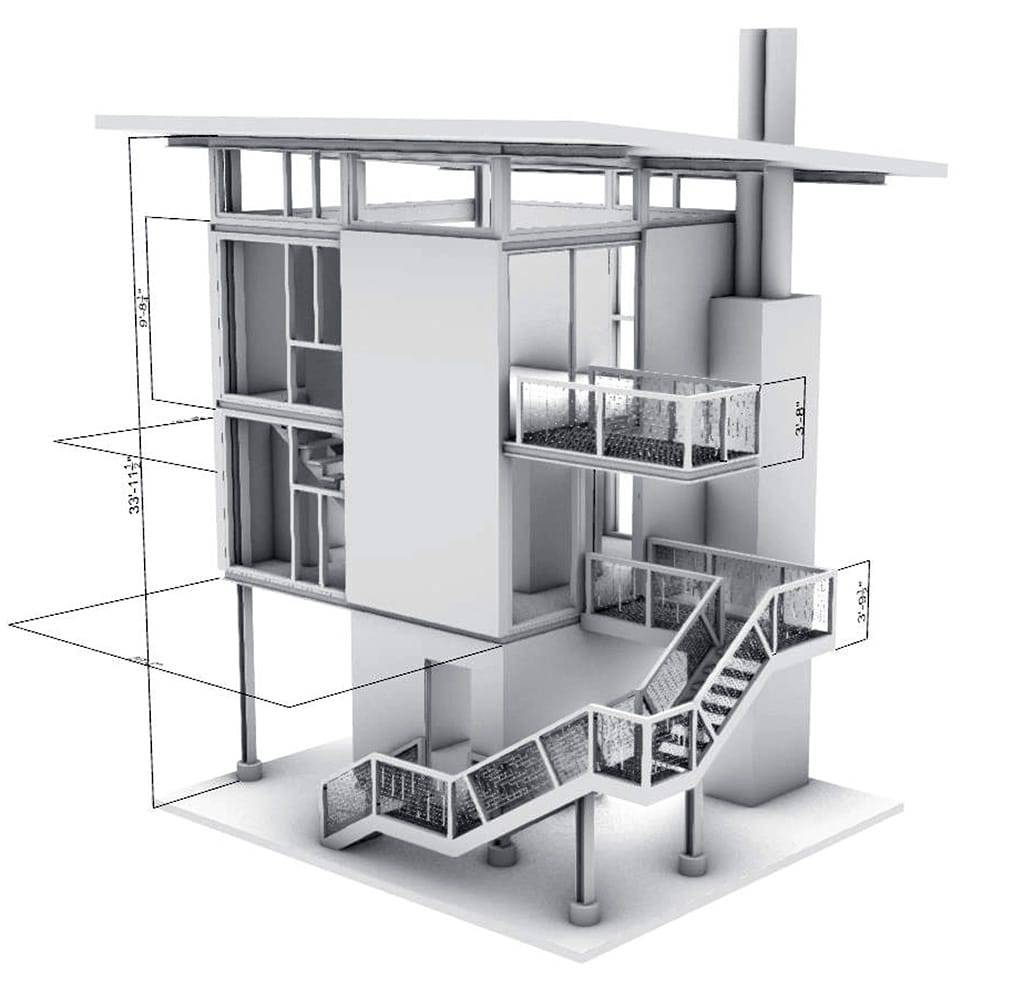
This class is structured as a progression. You will begin with 2D measured drawings (plans, sections, and elevations) of a selected precedent house. These drawings become the foundation for all subsequent work. Over the semester, you will reconstruct the project as a complete digital model, learning how foundational elements, structure, skins, and details come together to create architectural systems. Each assignment reinforces precision, accuracy, and clarity in architectural communication.

Once you develop a complete digital house model, you will learn to site the project on a new topography, integrating architectural and landscape conditions. You will produce drawings and diagrams that explain the building’s spatial and tectonic logic, culminating in section perspectives and axonometric diagrams. Each representation method teaches you how to convey architecture to both professional and general audiences.

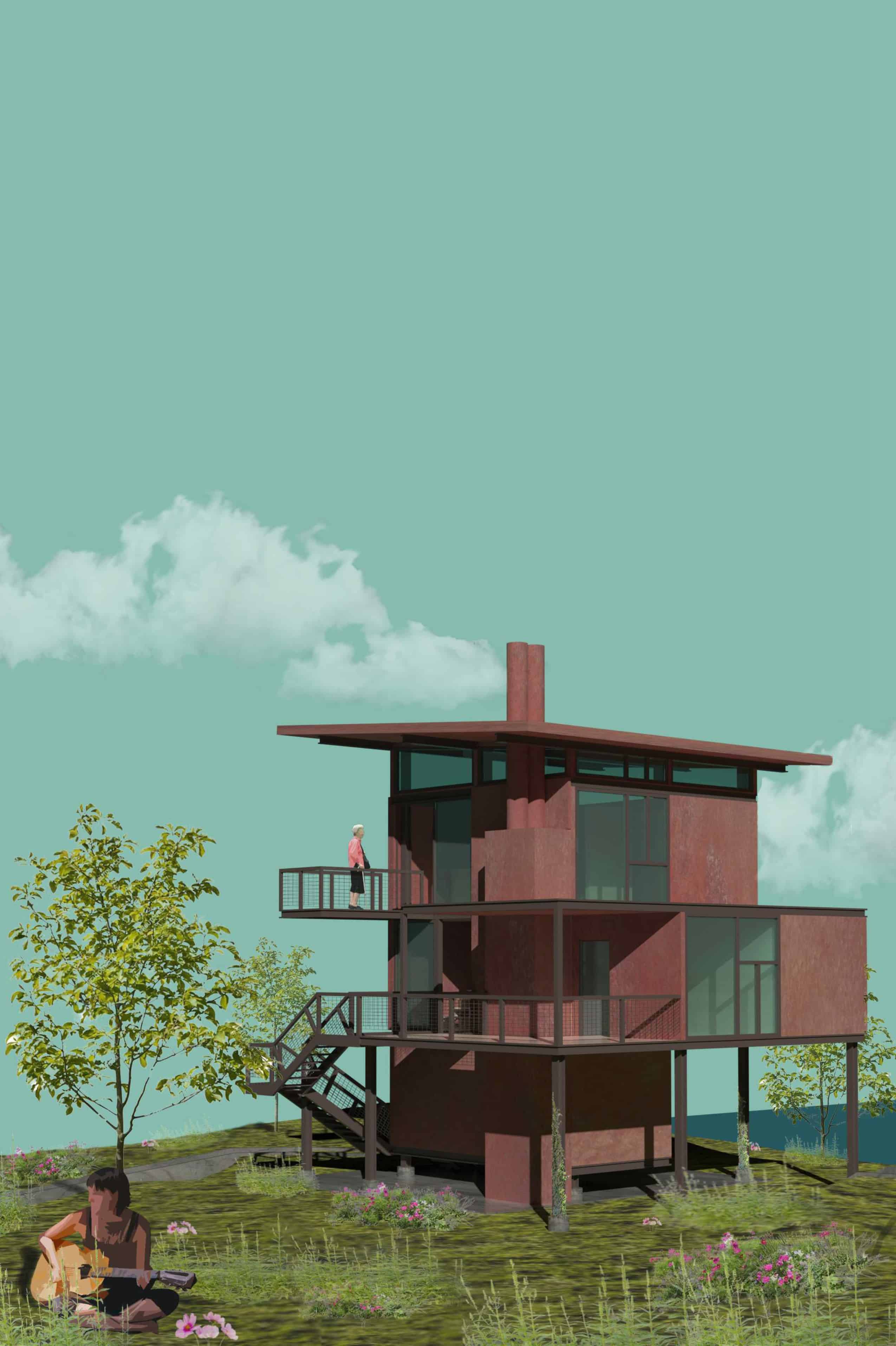
The second half of the semester moves into design transformation and representation. You will analyze the patterns within your chosen precedent—spatial, tectonic, or formal—and apply them as a design logic for modification. These transformations allow you to experiment with extension, subtraction, rotation, or recomposition while maintaining coherence with the precedent’s system. The final assignment asks you to communicate your transformed design through atmospheric renderings, combining Rhino output with Photoshop refinements.

Throughout the course, emphasis is placed on developing professional habits from the beginning of your architectural education: organizing files, adhering to naming conventions, practicing iteration, and maintaining clear layers in Rhino. Assignments build cumulatively, giving you a portfolio sequence that demonstrates growth from 2D drawing to 3D modeling, site integration, diagramming, transformation, and rendering.

As a first-year architecture student, this course will give you foundational skills in digital representation, architectural analysis, and conceptual thinking. You will learn to see architecture not just as isolated forms, but as systems of relationships among structure, skin, site, and space. The work you complete here will prepare you for future design studios, where these representational tools and conceptual strategies become essential to developing your own architectural voice.

Course Description

An introduction to organizational strategies across a range of architectural scales. Ordering principles are investigated from micro through macro, from the materiality and tectonics of details to urban patterns. Architectural assemblies and building technology introduce structural systems and material characteristics. Massing and typology studies introduce relationships of building to site and environment.

Learning Outcomes

Digital Modeling
Develop fluency in Rhino for 2D and 3D, including precision drawing, solids and surface modeling, block instances, and organized layer management.

Parametric Literacy
Gain an introductory understanding of Grasshopper for pattern logic and rule-based variation when useful to the assignment.

Information Graphics
Create diagrams and annotated drawings that clearly convey ideas, assembly, and performance.

Ordering Principles
Identify and apply formal, spatial, and tectonic patterns across scales, from detail to whole.

Visualization
Compose section perspectives, axonometrics, and atmospheric renders that communicate intent and assembly with clarity.

Required Texts and Materials

No textbook is required. Drawing tools and a sketchbook are required. Bring a laptop to every class unless you are meeting in the computer lab.

Software
Rhino 8
Adobe Acrobat
Adobe Photoshop
Adobe Illustrator
Adobe InDesign
Enscape

Suggested
Grasshopper add ons as provided in class
Ching, Francis: Architectural Graphics, Design Drawing, Building Construction Illustrated, Architecture: Form, Space, and Order
Lewis, Paul, Marc Tsurumaki, David Lewis: Manual of Biogenic House Sections

Projects and Assignments

All projects use Rhino. Some introduce or optionally extend with Grasshopper.

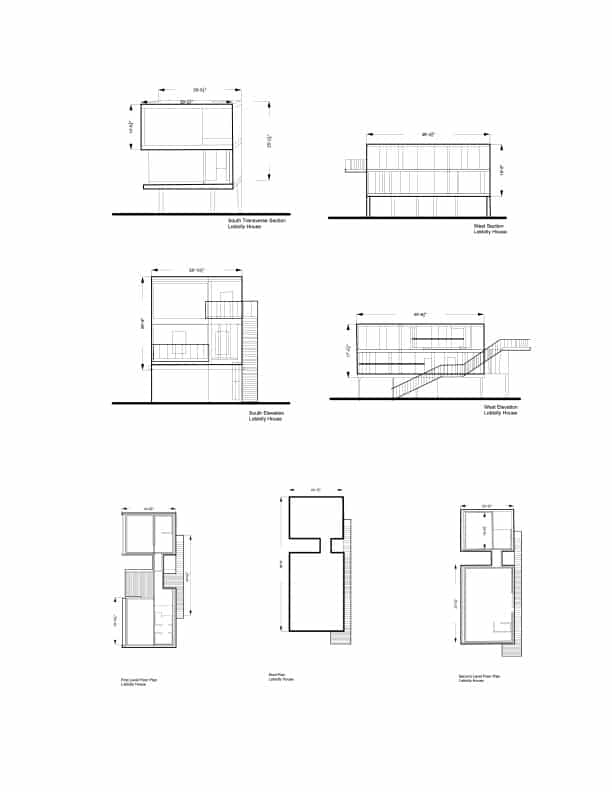
Assignment 1, two dimensional drawing, plans, sections, elevations
Select one house and draft measured plans and sections. This becomes the basis for all subsequent work. Houses demonstrate clear relationships among foundation, structure, interior skin, and exterior skin, and clear delineation of interior and exterior space.

Assignment 2, three dimensional modeling
Build a complete 3D model from your 2D drawings. Adjust drawings as needed to resolve alignment and accuracy. Model in this order: foundation, primary structure, secondary structure, exterior finishes, windows, interior finishes, major millwork. Reference both your drawings and photographs to understand connections and spatial relationships.

Assignment 3, three dimensional topography
Develop a site model using contours and terrain methods in Rhino. Place your building on a provided imaginary lakefront hill, reconciling building and landscape. Explore new opportunities for approach, section, and outdoor space.

Assignment 4, section perspective
Cut a section perspective that best reveals assembly and spatial relationships. Use line weights, poche and hatching, entourage, and contextual cues to communicate construction logic and inhabitation.

Assignment 5, axonometric diagram
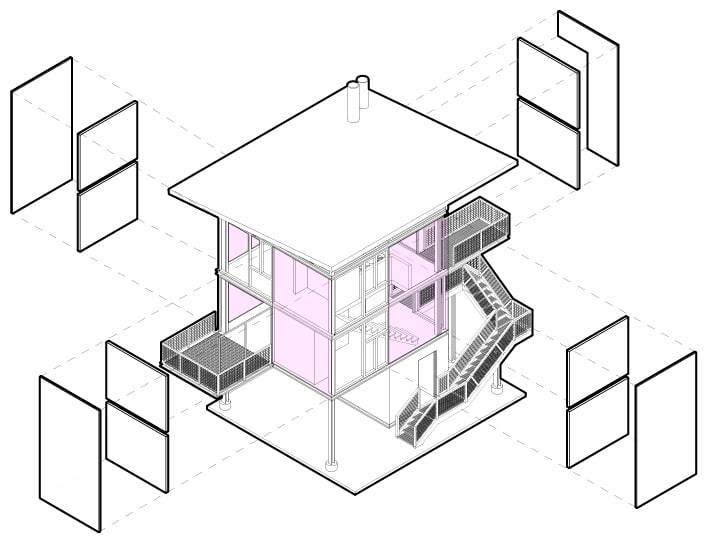
Craft an axonometric diagram that isolates and explains a key concept, such as circulation, assembly sequence, or the blending of interior and exterior. Maintain accurate proportions and use selective color or poche for clarity.

Assignment 6, transformations from patterns
Identify formal, spatial, or tectonic patterns in your precedent and define a rule set. Transform the house by extension, subtraction, rotation, or recomposition according to that logic. Demonstrate feasibility through details, diagrams, and coordinated views.

Assignment 7, rendering
Produce portfolio ready perspectives of the transformed house. Combine a basic Rhino render with exported linework and a restrained Photoshop finish. Select at least one exterior view and one additional view that highlights enclosure and light.

Goals, Pedagogy, and Practices

What we expect of you

  • Be prepared for every class. Bring new work for desk crits, pin ups, and peer reviews. Have required texts, materials, and your laptop in class.
    Communicate. Check email and Canvas daily for news, schedule changes, cancellations, and updates.
  • Attend class and actively participate.
    a. Section 001, one unexcused absence allowed.
    b. Section 002, two unexcused absences allowed.
    c. Section 003, two unexcused absences allowed.
    Beyond what is described above, the next one and one half hours of unexcused absence results in a five percent deduction from the final grade. Each subsequent one and one half hours may result in an additional five percent deduction. More than three hours of excused absences requires a meeting with the instructor to determine how to proceed.
  • Avoid distractions. No social media, videos, or unrelated browsing during class. Silence phones. Step out if you must take a call.
  • Be respectful. Maintain a quiet, supportive, academic environment. Visitors require prior approval. Recording requires consent.
    Digitally submit your work. Submit PDFs and images to your professor. File titles must include full name, course number, semester, and project name.
  • Be honest. Credit designers and authors. Cite all sources. See the Student’s Guide to Academic Integrity and the OU Integrity Office.
  • Previous instruction. Build on what you have learned.

What you can expect of your instructors

  • Start and end class on time.
  • Reply to Canvas messages or emails within twenty-four hours.
  • Provide feedback or grades within two weeks of submission.
  • Assign work that meets learning objectives for a three credit hour course.

Field trips and site visits

Field trips are not expected. If scheduled, students may incur travel related costs. Alternative assignments will be provided for excused non participation.

Learning Activities, Assignments, and Assessments

This course emphasizes learning through doing. You will complete a sequence of digital projects that explore abstraction, composition, ordering systems, and design operations, leading to clear visualization and documentation. Short in class exercises support each larger assignment.

Assigning grades
Eight small to medium sized projects, some with milestones. Portions are due weekly. Assignments are explained in class and posted on Canvas. Submit on the due date.

Assignment 01, 10%
Assignment 02, 15%
Assignment 03, 5%
Assignment 04, 10%
Assignment 06, 20%
Assignment 07, 20%
Assignment 08, 10%

Submissions
Follow posted requirements in Canvas. Submit digital documentation to the assigned location. Name files as LastName_AssignmentNumber_Date.xyz. Keep files under twenty five megabytes. Include a front matter page in multi page PDFs with class name, project title, date, and student name.

Grading scale
A, exceptional work with high rigor and craft.
B, very good work that exceeds average standards.
C, work that meets expectations.
D, poor quality work that minimally meets some expectations.
F, work fails to meet minimum expectations.
Late work is penalized one letter grade per day. Assignments are due at the beginning of class.

Laptop, Lab, and Software Policies

The College of Architecture requires all students to have a laptop. A Windows PC is recommended due to software compatibility. Bring laptops to class unless you are in the computer lab.
Computer Lab B15 is open when not scheduled for class.
This course uses the latest versions of Rhino and Adobe software. Academic licenses are available. Enscape is used for basic rendering.

Course Policies

Academic integrity and plagiarism
Your work must be your own. Put writing into your own words and cite sources. If you have questions, ask. Penalties for serious offenses include a zero on the assignment and may extend to university action.

AI policy, restricted usage
To promote deep learning, the use of generative AI tools such as ChatGPT, Copilot, Claude, Bard, Grammarly AI, Midjourney, and DALL·E is prohibited for any part of coursework in this class, including outlines, research, and writing or image generation. Violations are treated as academic integrity issues.

Attendance and late work
See expectations above. If you anticipate an issue, contact the instructor before the deadline to discuss options. Unapproved late work receives one letter grade deduction per day and may receive delayed feedback.

Cutting class short
Arriving more than five minutes late or leaving more than five minutes early counts as cutting class short. You are allowed two instances without a university approved absence. Each additional instance deducts two percentage points from the final grade.

Technology etiquette
Avoid distractions. No unrelated videos or excessive texting during class.


More Work


Architecture

Art + Code

Design + Fabrication


More Work


Architecture

Art + Code

Design + Fabrication

Courses + Student Work

© Ken Marold USA, Inc. All rights reserved.

Continue reading

Design 4 : Structure and Form 2022/23

Design 4 : Structure and Form

ARCH 2456
Second-Year Spring Studio / 2022_23

Design 4: Structure and Form investigates the relationship between material, structure, and spatial organization as a framework for architectural design. Students explore how geometry, construction logic, and environmental context shape architectural experience. The studio challenges students to move fluidly between conceptual design and tectonic resolution, translating abstract ideas into constructible form.

Through iterative modeling, drawing, and fabrication, students analyze how structure can both define and transform spatial character. Emphasis is placed on clarity of intent, precision of craft, and the ability to communicate architectural systems through visual and material expression. By connecting design research to real-world conditions, Design 4 cultivates a rigorous understanding of how architecture is made—how ideas become space, and how structure drives form.


Design 4 : Structure and Form

ARCH 2456
Second-Year Spring Studio / 2022_23

Design 4: Structure and Form investigates the relationship between material, structure, and spatial organization as a framework for architectural design. Students explore how geometry, construction logic, and environmental context shape architectural experience. The studio challenges students to move fluidly between conceptual design and tectonic resolution, translating abstract ideas into constructible form.

Through iterative modeling, drawing, and fabrication, students analyze how structure can both define and transform spatial character. Emphasis is placed on clarity of intent, precision of craft, and the ability to communicate architectural systems through visual and material expression. By connecting design research to real-world conditions, Design 4 cultivates a rigorous understanding of how architecture is made—how ideas become space, and how structure drives form.


Course Overview

Design IV: Structure and Form extends the conceptual and technical skills developed in Design III: Crafting Place toward projects of greater spatial and structural complexity. The studio positions architecture as an interplay of material, context, and performance. Students learn how design decisions at every scale—from the detail to the urban block—impact form and experience.

The studio emphasizes architecture as a synthesis of concept, structure, and site. Students analyze urban patterns and environmental conditions to understand how context shapes design opportunity. They investigate tectonic systems through modeling, digital simulation, and material testing, uncovering how architectural form can emerge from forces of gravity, light, and use. The semester culminates in a comprehensive building design sited in downtown Norman: the Norman Center for Urban Farming, a hybrid of educational, civic, and agricultural spaces that embodies sustainable design principles and structural expression.


Objectives

The goals of Design IV are to develop the student’s capacity to integrate conceptual design, technical precision, and representational clarity. Students learn to balance creativity with constraint by using structure as a generator of architectural form. By the end of the semester, they can:

  • Translate analytical studies of site, context, and environment into spatial strategy.

  • Incorporate structural systems as an integral component of architectural composition.

  • Use iterative physical and digital modeling to test design hypotheses.

  • Apply hybrid modes of representation—plans, sections, montages, renderings—to communicate design intent.

  • Develop a design process that is iterative, reflective, and grounded in making.
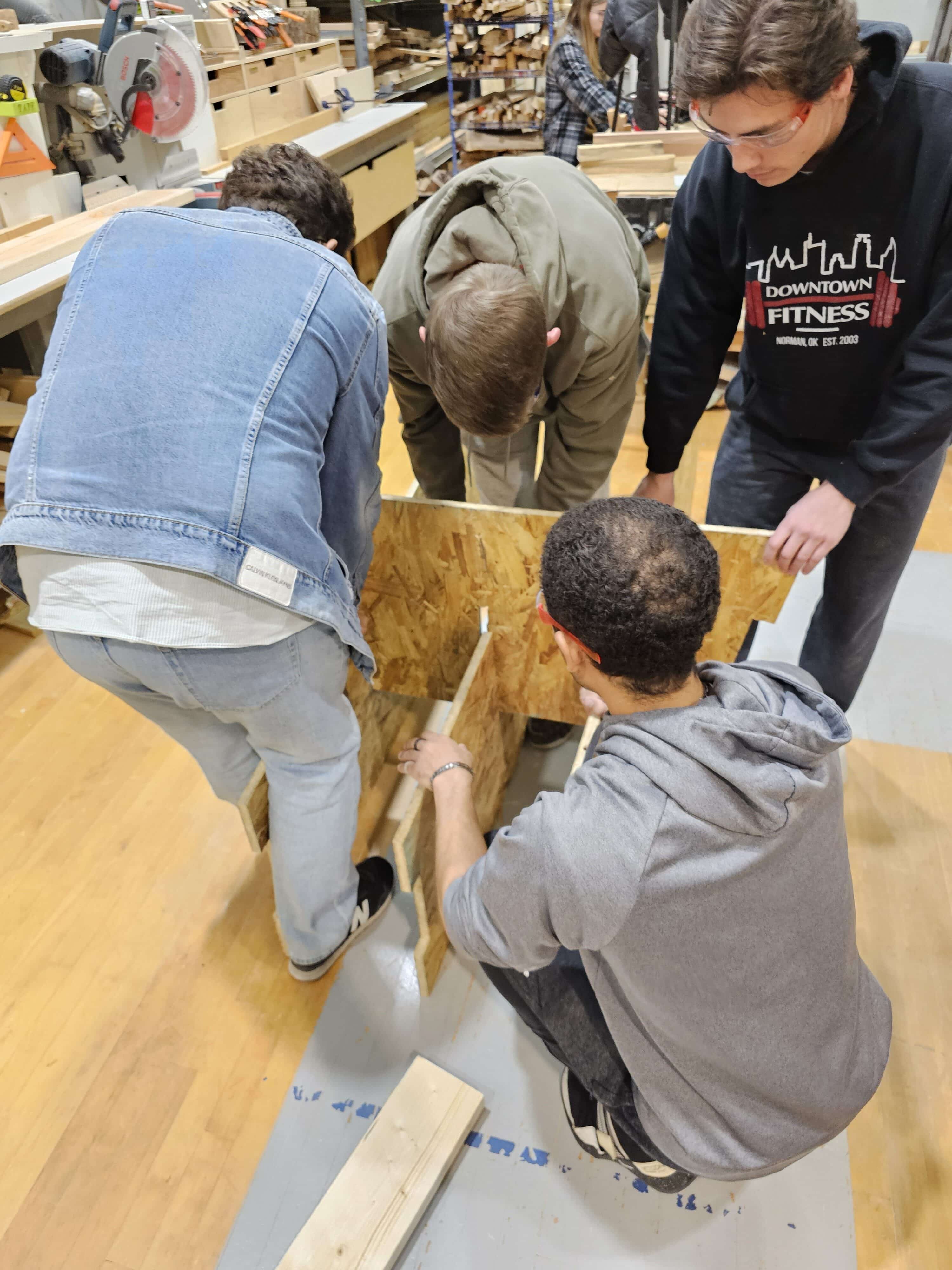
Students leave the studio with a refined understanding of how architectural form operates as both technical system and spatial experience, preparing them for advanced design exploration.


Projects

Projects in Design IV bridge conceptual ambition with structural precision. The semester begins with analytical exercises that build contextual understanding and culminates in a comprehensive architectural proposal. Each project stage introduces a new mode of inquiry—research, analysis, synthesis, and refinement—while reinforcing the relationship between design intent and tectonic expression.

Representative projects include Material Systems Study, Spatial Frames Pavilion, and the Norman Center for Urban Farming. The final project integrates urban analysis, environmental performance, and material experimentation to produce an 8,000-square-foot community and educational facility dedicated to sustainable food production. Students explore programmatic complexity, circulation, and sectional organization while testing structural and environmental systems through drawings, digital models, and iterative fabrication.

Across all phases, projects emphasize critical thinking, technical accuracy, and representational clarity. Through this progression, students develop the ability to translate conceptual design into structural and material resolution.


Intent

The intent of Design IV is to foster an architectural understanding rooted in structure, material, and context. The studio positions construction not merely as technique, but as a medium for spatial and cultural expression. Students are encouraged to see architecture as both an intellectual discipline and a physical practice—where making and meaning reinforce one another.

Through rigorous experimentation, students engage with construction as a poetic act. They learn that structural systems are not constraints but opportunities to give architecture coherence and presence. The course invites reflection on how buildings occupy place, respond to light, and express material honesty. By engaging technical reasoning alongside conceptual depth, students learn that design is at once speculative and grounded—a process of shaping the tangible and the experiential.


Pedagogy

The studio operates as both workshop and think tank. Weekly lectures, discussions, and reviews anchor an iterative design process that values exploration as much as refinement. Assignments build sequentially, integrating research, precedent analysis, site documentation, digital modeling, and fabrication.

Critiques are structured to promote dialogue and reflection. Students are challenged to present and defend their design logic through verbal, visual, and physical representation. Readings and case studies from contemporary and historical architecture situate studio work within a broader discourse of tectonics, sustainability, and form-making.
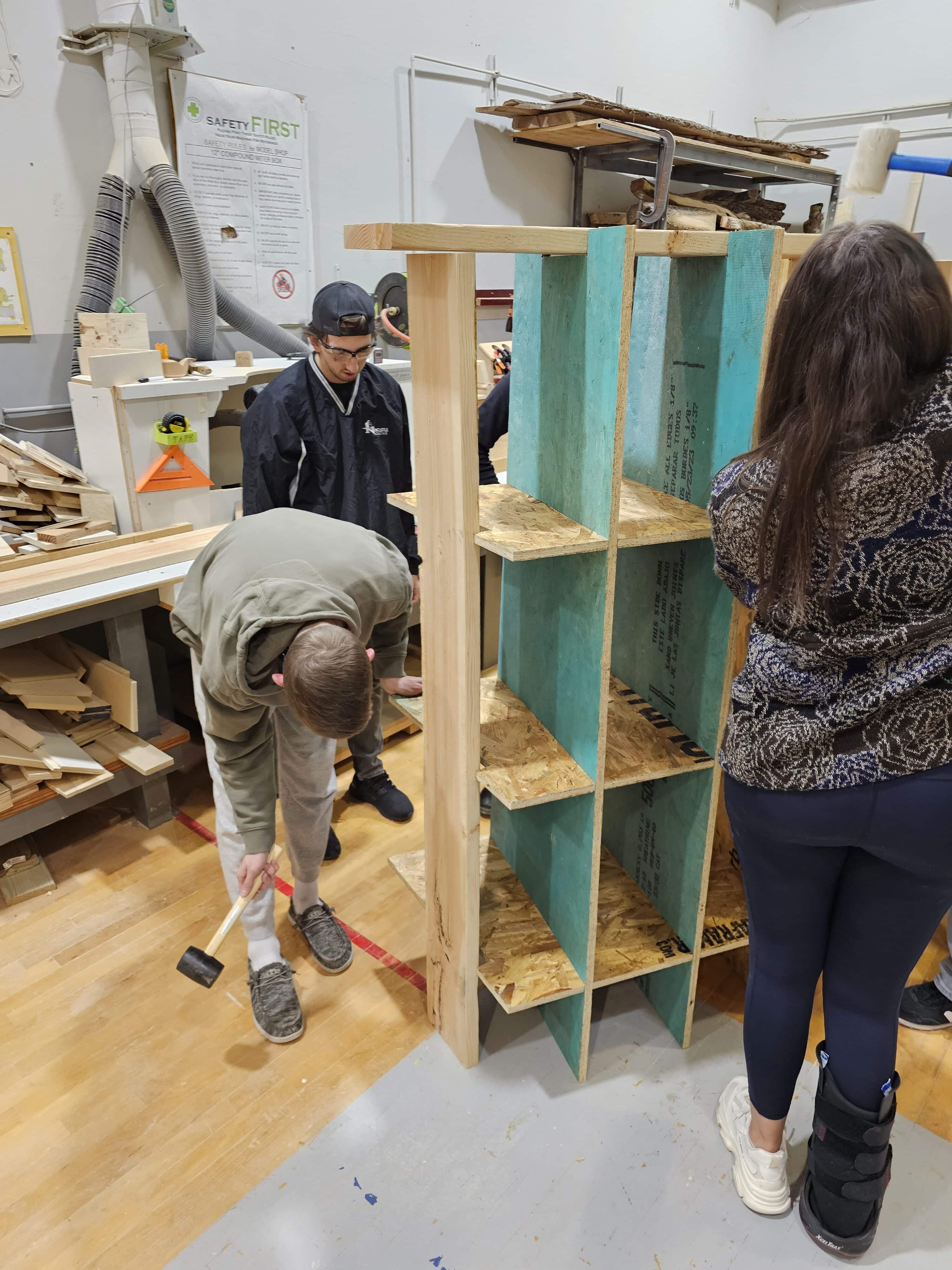
The pedagogical structure emphasizes learning through making, encouraging full-scale testing, model fabrication, and material experimentation. This process not only builds technical literacy but also cultivates curiosity and the confidence to approach design as an iterative act of discovery.


Tools and Methods

Students engage a broad toolkit that spans analog and digital practices. Rhino, Revit, and Adobe Creative Suite are used for modeling and visualization, while fabrication tools such as CNC routers, laser cutters, and 3D printers allow for precision prototyping. Environmental modeling software supports daylight and performance studies, integrating environmental awareness into the design process.

Hybrid representation is central to the studio’s workflow. Students create drawings and models that function simultaneously as design tools and analytical instruments. Emphasis is placed on detail, scale, and craft—reinforcing the connection between representation and construction. By the end of the semester, students demonstrate fluency across drawing, modeling, and making, capable of articulating architectural ideas from concept to fabrication.


Outcomes

Students completing Design IV are able to synthesize design, structure, and material into coherent architectural proposals. They demonstrate technical competency, conceptual rigor, and a developed ability to communicate complex ideas through visual, physical, and digital media.

Projects reflect an understanding of how architecture mediates between structural necessity and experiential richness. Students learn to orchestrate circulation, light, and enclosure through structural strategy, and to articulate their designs as both built systems and spatial experiences. The course cultivates emerging designers who can balance conceptual invention with technical precision—those prepared to approach future design challenges with confidence, adaptability, and craft.


More Work


Architecture

Art + Code

Design + Fabrication

Courses + Student Work

© Ken Marold USA, Inc. All rights reserved.

Continue reading

Envisioning Space

Envisioning Space

ARCH 4970/5970
Gibbs Collective Creating Seminar

Envisioning Space is a cross-disciplinary seminar exploring how architecture, art, and technology converge through digital fabrication, computation, and immersive media. Students investigate how data, light, and material behavior inform the design of spatial environments and artifacts that move fluidly between digital modeling and physical construction. Each project begins as a conceptual study in mapping, perception, or environmental response, evolving through generative design, prototyping, and fabrication into tangible works that test the boundaries of material expression.

The course cultivates fluency across digital tools and fabrication workflows, challenging students to transform information into experience. Projects span architecture, industrial design, and installation, producing hybrid outcomes that exist as both visualization and built artifact. Emphasis is placed on precision, experimentation, and reflection, encouraging students to see making as both an analytical process and a creative act. By merging conceptual inquiry with technological rigor, Envisioning Space positions design as a means of discovery—where craft, computation, and imagination meet to redefine how we perceive and construct space.


Envisioning Space

ARCH 4970/5970
Gibbs Collective Creating Seminar

Envisioning Space is a cross-disciplinary seminar exploring how architecture, art, and technology converge through digital fabrication, computation, and immersive media. Students investigate how data, light, and material behavior inform the design of spatial environments and artifacts that move fluidly between digital modeling and physical construction. Each project begins as a conceptual study in mapping, perception, or environmental response, evolving through generative design, prototyping, and fabrication into tangible works that test the boundaries of material expression.

The course cultivates fluency across digital tools and fabrication workflows, challenging students to transform information into experience. Projects span architecture, industrial design, and installation, producing hybrid outcomes that exist as both visualization and built artifact. Emphasis is placed on precision, experimentation, and reflection, encouraging students to see making as both an analytical process and a creative act. By merging conceptual inquiry with technological rigor, Envisioning Space positions design as a means of discovery—where craft, computation, and imagination meet to redefine how we perceive and construct space.

Course Overview

Envisioning Space is an advanced digital design and fabrication seminar that examines how spatial ideas are conceived, represented, and constructed across physical and digital environments. The course challenges students to rethink architectural process through experimentation and technology, merging art, design, and fabrication into an integrated creative practice. Students explore how perception, data, and cultural context can inform the production of new spatial forms and immersive experiences. Through conceptual modeling, algorithmic design, and prototyping, they investigate the translation of information into material and sensory outcomes. The seminar encourages risk-taking and curiosity, positioning digital tools not as endpoints but as instruments for discovery and creative transformation.

Objectives

The seminar develops both conceptual and technical fluency by bridging theory, computation, and making. Students learn to integrate parametric modeling, generative scripting, and data-driven design strategies into iterative design processes. Environmental, cultural, or perceptual data become design inputs that shape both material and formal outcomes. Digital geometries are translated into realized artifacts through advanced fabrication workflows, including CNC milling, laser cutting, and 3D printing. Throughout the semester, students learn to synthesize design thinking and craft, developing work that is conceptually grounded and technically refined. The course also emphasizes the ability to present and critique design through high-quality visualizations, physical prototypes, and interactive documentation. These objectives establish a foundation for independent inquiry, giving students the confidence to approach emerging technologies as active collaborators in their creative process.


Projects

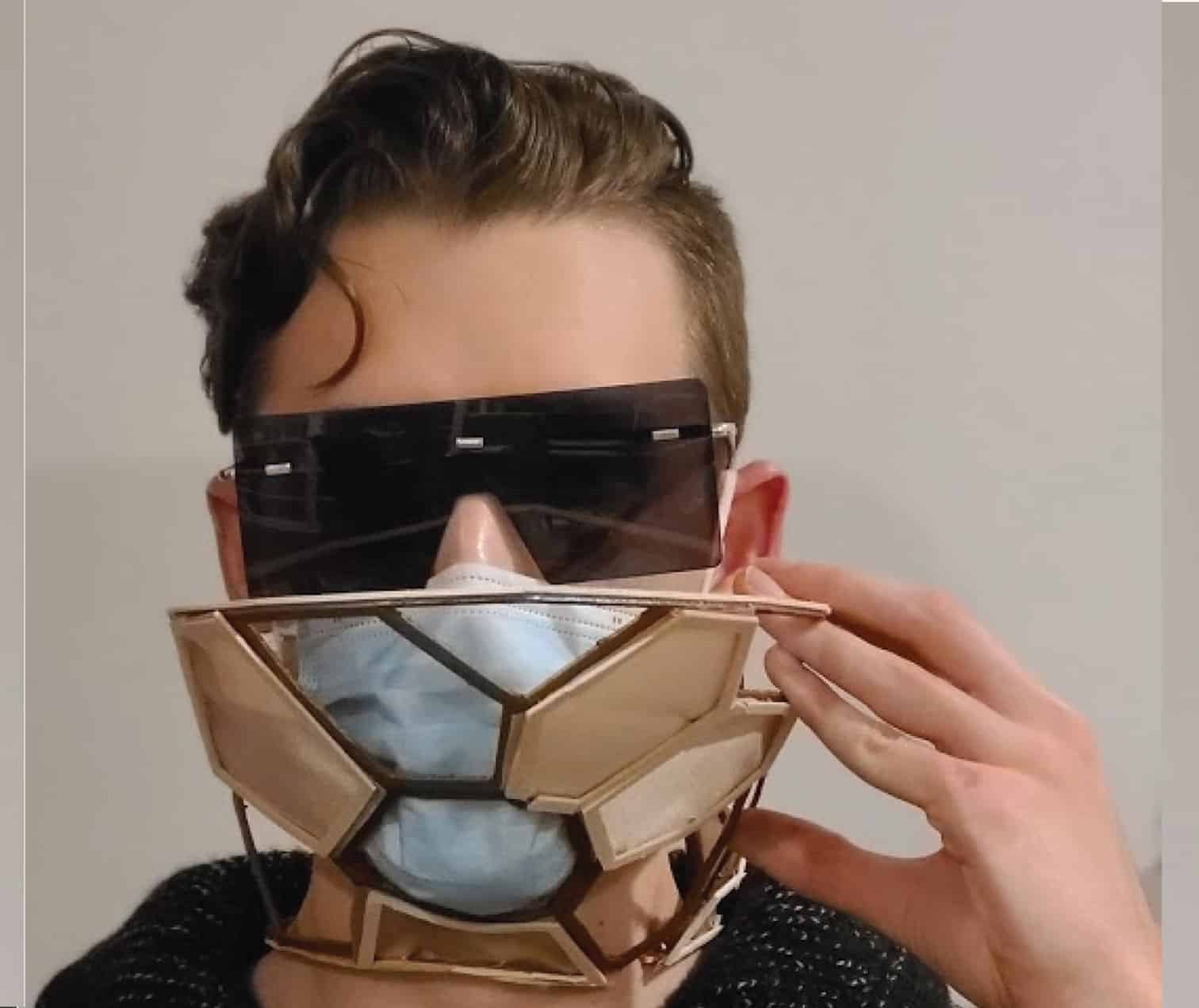
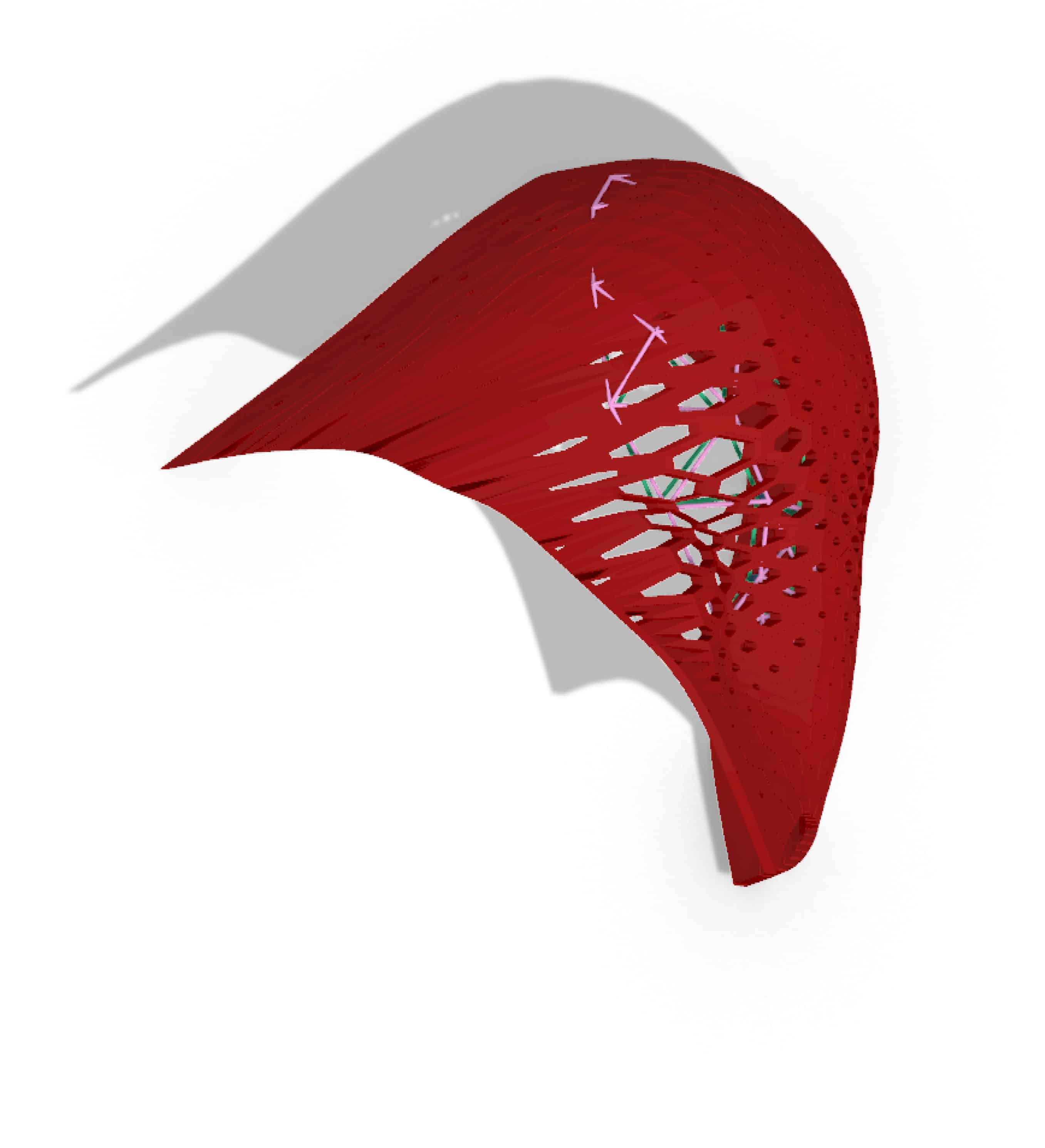
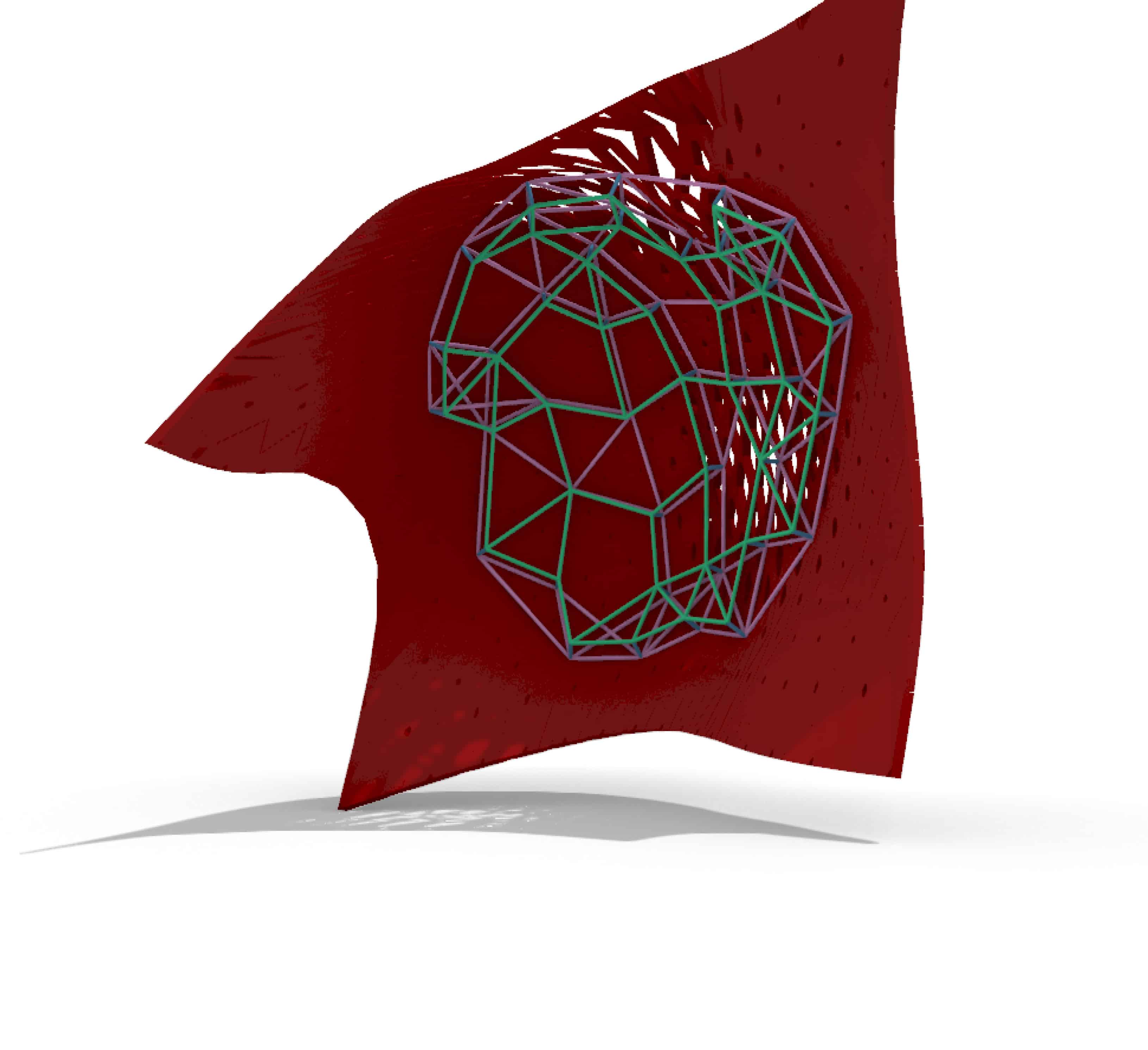
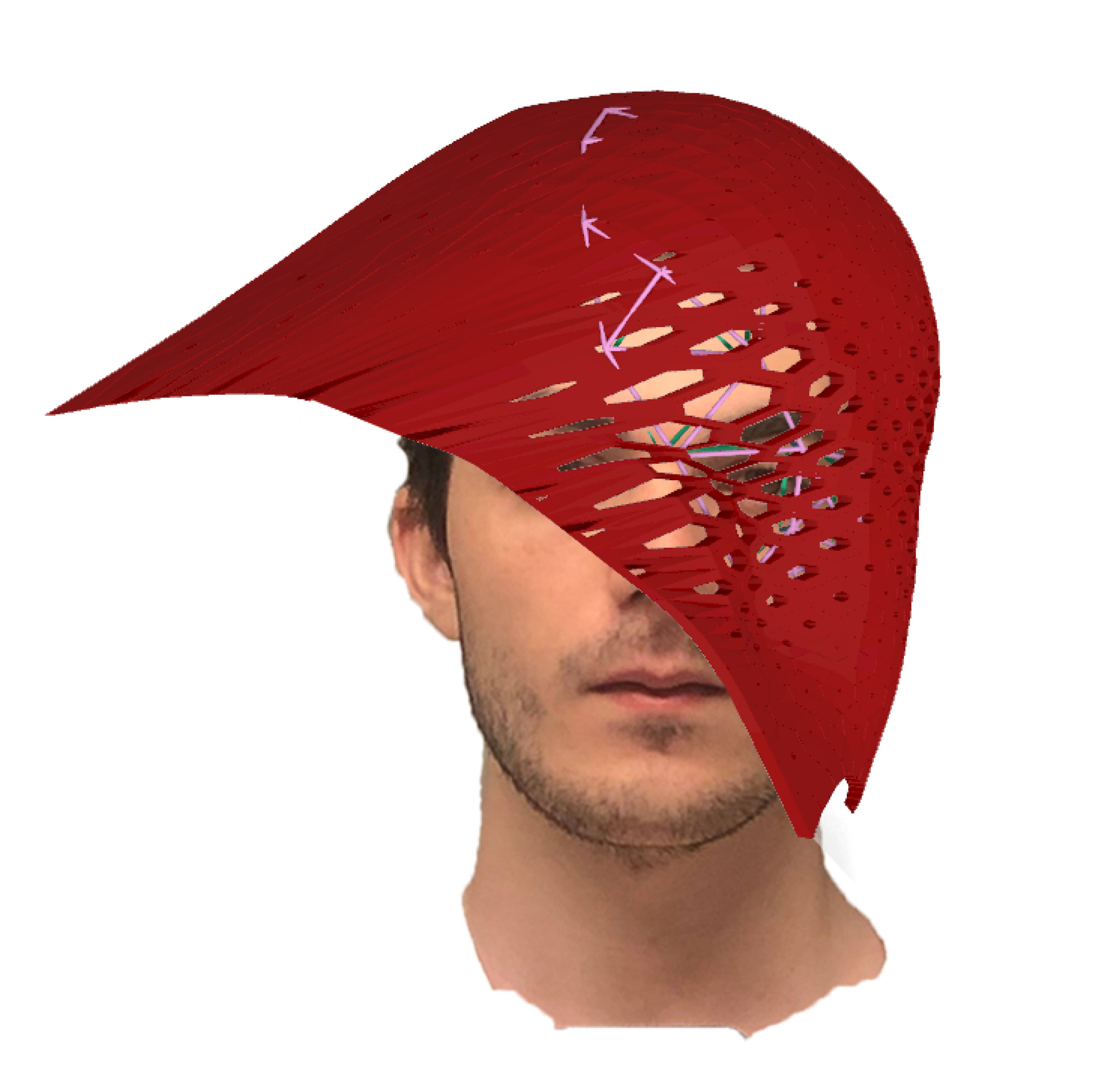
Each semester, students produce a series of projects that combine digital precision with physical experimentation. Assignments progress from conceptual frameworks—such as perception, mapping, and data visualization—to realized forms that merge computation, structure, and material behavior. Past projects include Wearable Architecture, Informed Systems: Data-Driven Surfaces, and Mobile Medical Clinic for the Wichita Housing Authority. These exercises integrate environmental or bodily data with fabrication workflows, resulting in hybrid artifacts that cross the boundaries of architecture, product design, and installation. Students are encouraged to develop their own conceptual approach while engaging with technical and cultural questions. Projects culminate in physical prototypes fabricated in the Creating_Making Lab, often incorporating generative modeling, pattern development, or responsive surface geometries. The outcomes of this course are frequently experimental, sometimes unconventional, but always grounded in process, craft, and precision.


Frameworks

This seminar operates through a series of topic-based modules that rotate each academic year. Each topic introduces a unique lens for exploring computation, fabrication, and perception while reinforcing the seminar’s central goal: to translate data, experience, and material intelligence into spatial form.


Mapping and Perception

Focus: Perception, data, and representation — mapping sensory and environmental phenomena through computational and physical techniques.

Projects:

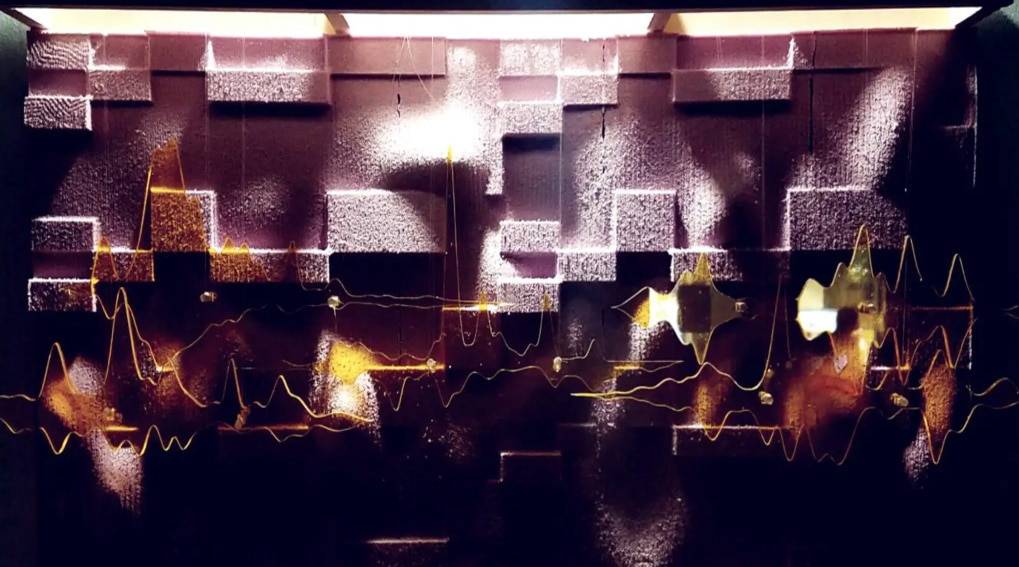
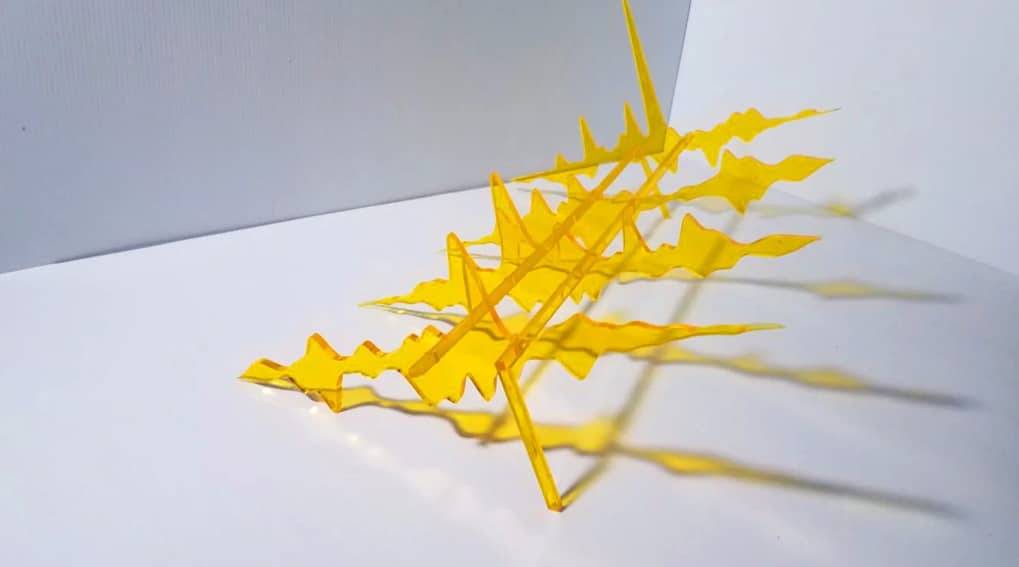
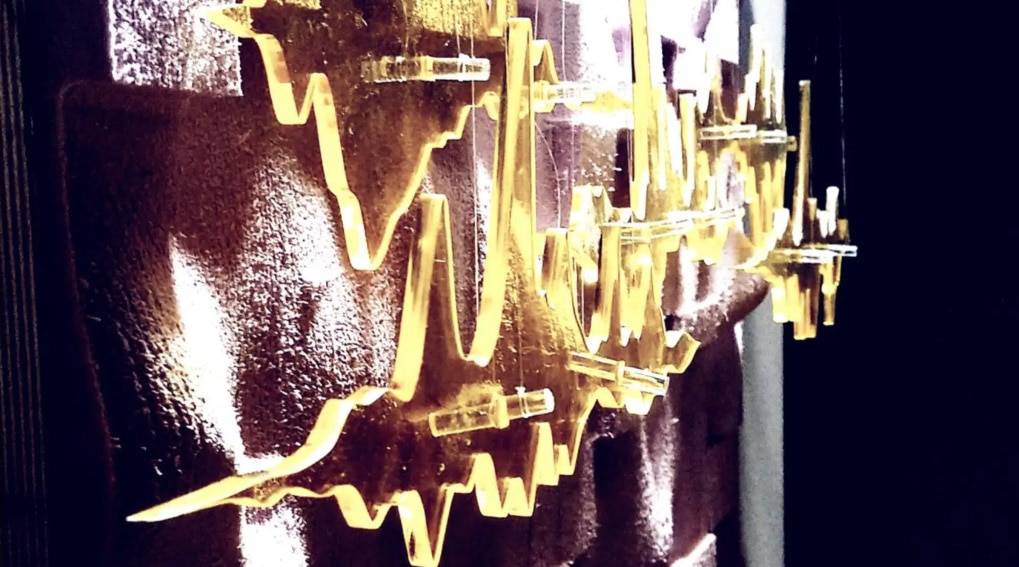
  • Visualizing the Sounds of an Arrangement — translating sound into spatial and graphic form through data collection and parametric modeling.
  • Framing a Sense of Place — exploring representation, perspective, and contextual framing as design drivers for spatial artifacts.

  • Augmentation of a Performance — developing installations that respond to movement, performance, or environmental input.

  • Presenting a Pause — creating spatial moments of reflection and stillness through material layering, light, and scale.

Tools & Methods: Rhino, Grasshopper, Processing, Python, data mapping, CNC milling, 3D printing, laser cutting.
Outcome: Data-informed installations and models combining environmental mapping, sensory design, and digital fabrication.
Computational Fabrication Systems

Focus: Generative fabrication and computational design — using scripting and digital workflows to drive physical production.

Projects:

  • Coplanar Threading — examining planar relationships through digital modeling and layered construction.

  • Constructive Geometries — studying the assembly logic of geometric systems and digital joinery.

  • Informed Systems: Data-Driven Surfaces — designing adaptive surfaces derived from environmental or user-generated datasets.

  • Renegades Exhibition Family Zone — developing digital design components for the Renegades: Bruce Goff and the American School exhibition.

Tools & Methods: Rhino, Grasshopper, Python, algorithmic modeling, CNC milling, fabrication workflows, exhibition design.

Outcome: Complex digital-to-fabrication pipelines exploring how parametric design translates into architectural and exhibition contexts.

Environmental and Programmatic Design

Focus: Digital prototyping and hybrid representation — expanding architectural thinking into data-driven design, environmental systems, and mobility.

Projects:

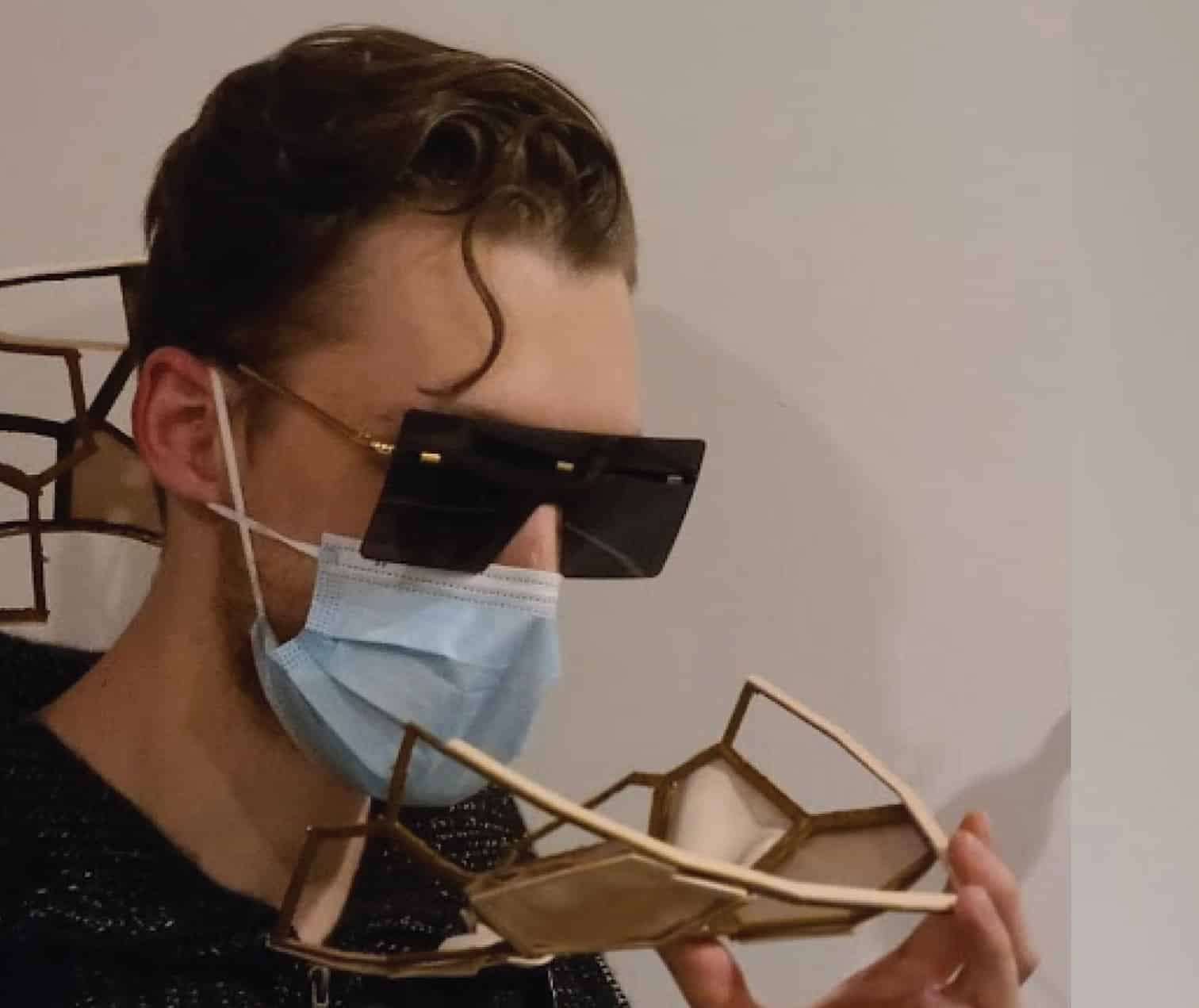
  • Wearable Architecture: Mapping and Fabrication — designing small-scale architectural systems that interact with the body and environment.

  • Informed Systems: Data-Driven Surfaces — developing digital surfaces responsive to environmental or behavioral datasets.

  • Sectional Assemblies: Laminar Constructs — exploring the intersection of computational geometry, material performance, and fabrication logic through a fully modeled design-build prototype.

Tools & Methods: Rhino, Grasshopper, Python scripting, data visualization, 3D printing, CNC workflows, virtual critique platforms (remote semester).

Outcome: Computationally driven projects combining environmental analysis, digital fabrication, and socially responsive design.


Summary

Each Envisioning Space cycle builds on the others, allowing students to engage computation, fabrication, and data through multiple design perspectives. Whether visualizing phenomena, fabricating complex geometries, or modeling adaptive systems, the seminar situates digital tools as a means for discovery, experimentation, and the creation of new spatial logics.


Intent

The intent of Envisioning Space is to cultivate critical design thinking through hands-on exploration and the integration of computational logic. The course builds on the idea that space can be both measured and imagined—an outcome of data, perception, and material transformation. Students develop the ability to move fluidly between digital abstraction and physical fabrication, understanding how systems and context influence form. Through this dual lens, Envisioning Space encourages students to ask how architecture, art, and technology intersect to represent and reimagine the world around us. By merging digital tools with analog craft, the course positions design as a bridge between physical experience and virtual expression. Students leave the seminar with a broadened perspective of architecture as an evolving practice capable of addressing material, social, and environmental complexity.


Pedagogy

Envisioning Space blends studio culture with seminar-driven discussion, workshops, and critiques. The course structure alternates between technical instruction, conceptual conversation, and fabrication practice. Readings from Arturo Tedeschi, Lisa Iwamoto, Neil Leach, and Achim Menges provide theoretical grounding in computational design and digital materiality, situating the seminar within a broader architectural discourse. Technical sessions introduce advanced methods in Rhino, Grasshopper, and Python scripting, while fabrication workshops focus on precision, craft, and iterative testing. The seminar emphasizes learning through making, encouraging students to test ideas at multiple scales and levels of complexity. Critiques and peer dialogue play a central role, fostering an environment where process, experimentation, and execution carry equal weight. Collaboration is also emphasized, framing design as a shared act of exploration that benefits from collective intelligence and open exchange.


Tools and Methods

Students work across analog and digital platforms using Rhino, Grasshopper, Python, and a range of digital fabrication techniques. Projects often combine algorithmic modeling with physical production through CNC routing, 3D printing, and laser cutting. Students also explore data acquisition, environmental mapping, and visualization as generative design tools. The course encourages them to view technology critically—as an extension of thought rather than a substitute for design intuition. Emphasis is placed on refining craft, managing digital complexity, and understanding fabrication as both a technical and conceptual process. Through hands-on experimentation, students develop a hybrid skill set that merges computation, precision, and creative authorship, enabling them to move seamlessly between design intent and realized form.


Outcomes

By the end of the course, students gain advanced fluency in computational and fabrication workflows, producing work that bridges architecture, industrial design, and immersive media. The resulting projects demonstrate a deep understanding of how information, material, and culture intersect to generate new spatial experiences. Through this process, students cultivate both technical mastery and conceptual independence, learning to use digital tools not only for precision but as instruments of speculation and critique.

The seminar instills an understanding that design operates across multiple scales and mediums—from the fabrication of an artifact to the simulation of a spatial environment. Students leave with the ability to articulate how geometry, data, and material processes contribute to architectural thinking, and how those same principles can extend to adjacent fields such as installation art, product design, and interactive media. Projects often culminate in complex hybrid outputs that exist simultaneously as digital visualizations, physical prototypes, and immersive experiences, reflecting the increasingly interdisciplinary nature of design practice.

Throughout the semester, students are encouraged to document their processes rigorously, maintaining blogs, digital portfolios, or visual journals that record the evolution of their ideas. This habit of reflection reinforces the value of iteration and the capacity to communicate complex ideas clearly through visual and written formats. Graduates of Envisioning Space emerge with a versatile design sensibility, a strong technical foundation, and a nuanced understanding of how making can be both analytical and poetic. The skills developed in this seminar prepare them to contribute to evolving areas of architecture, design, and technology where innovation depends on the seamless integration of craft, computation, and imagination.


More Work


Architecture

Art + Code

Design + Fabrication

Courses + Student Work

© Ken Marold USA, Inc. All rights reserved.

Continue reading