Author: admin

Squall

F08CECF8-EDEF-6DE2-3813A687877B682F

Squall

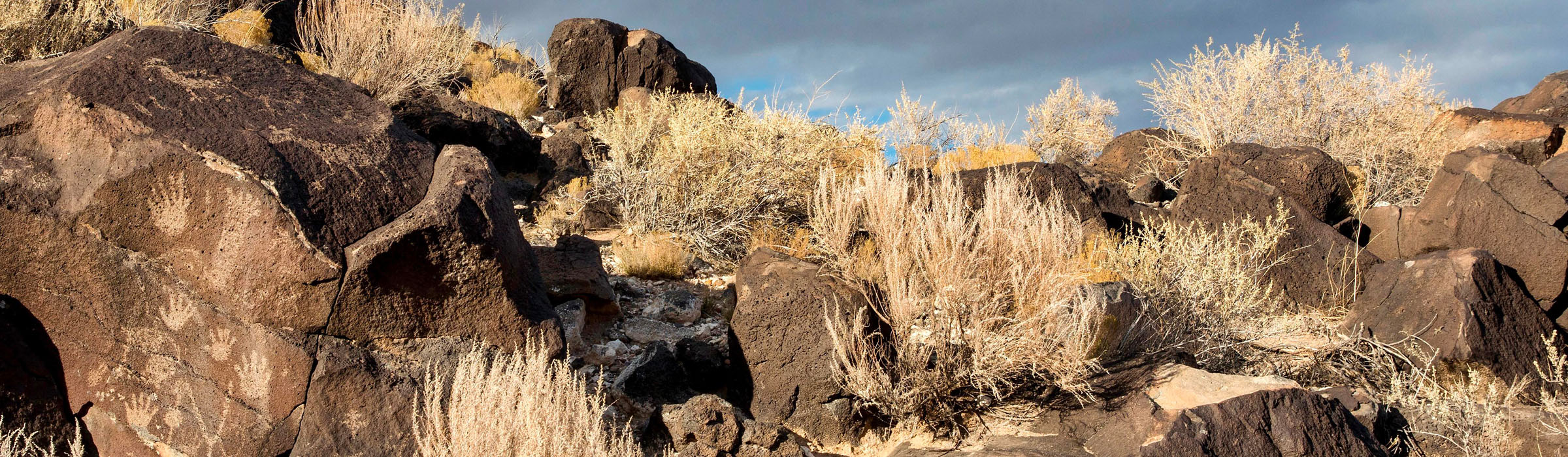
petroglyphs national monument, albuquerque, new mexico

status : complete

GPS, Geo-tagging, Mapping, Digital Imaging

Project Overview
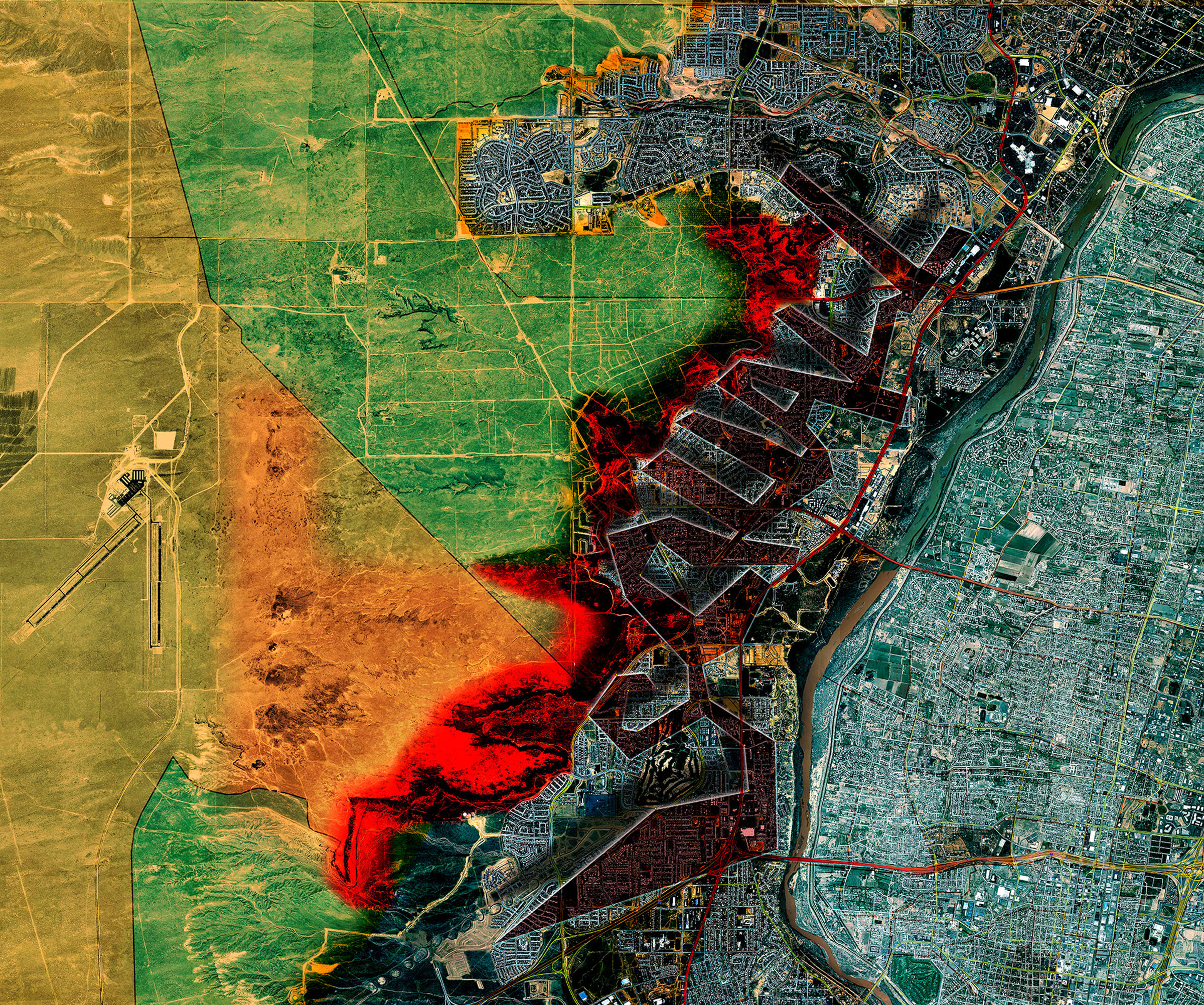
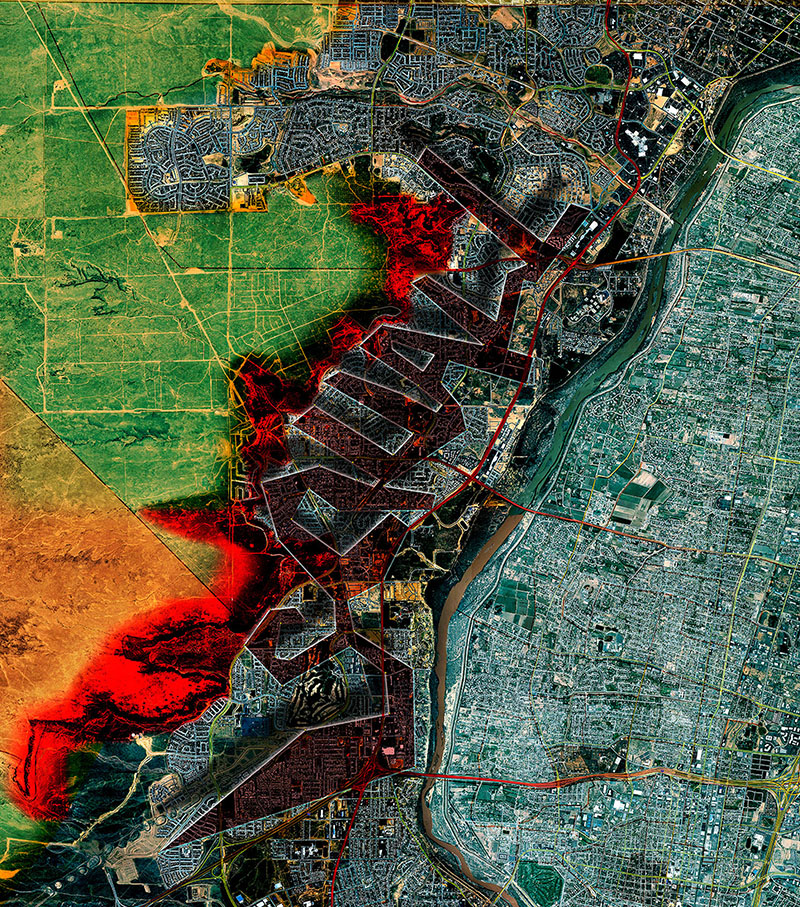
Squall examines the fragile relationship between environment and unchecked suburban sprawl at the edge of Albuquerque, New Mexico. The project stages a confrontation between landscape and development by “writing” onto the land itself — embedding a geo-tagged message across the terrain through a sequence of GPS points. When connected, these coordinates reveal a text-based intervention overlaid onto aerial and satellite imagery, confronting viewers with the storm-like advance of suburban expansion into fragile ecological and cultural territory.

  • squall
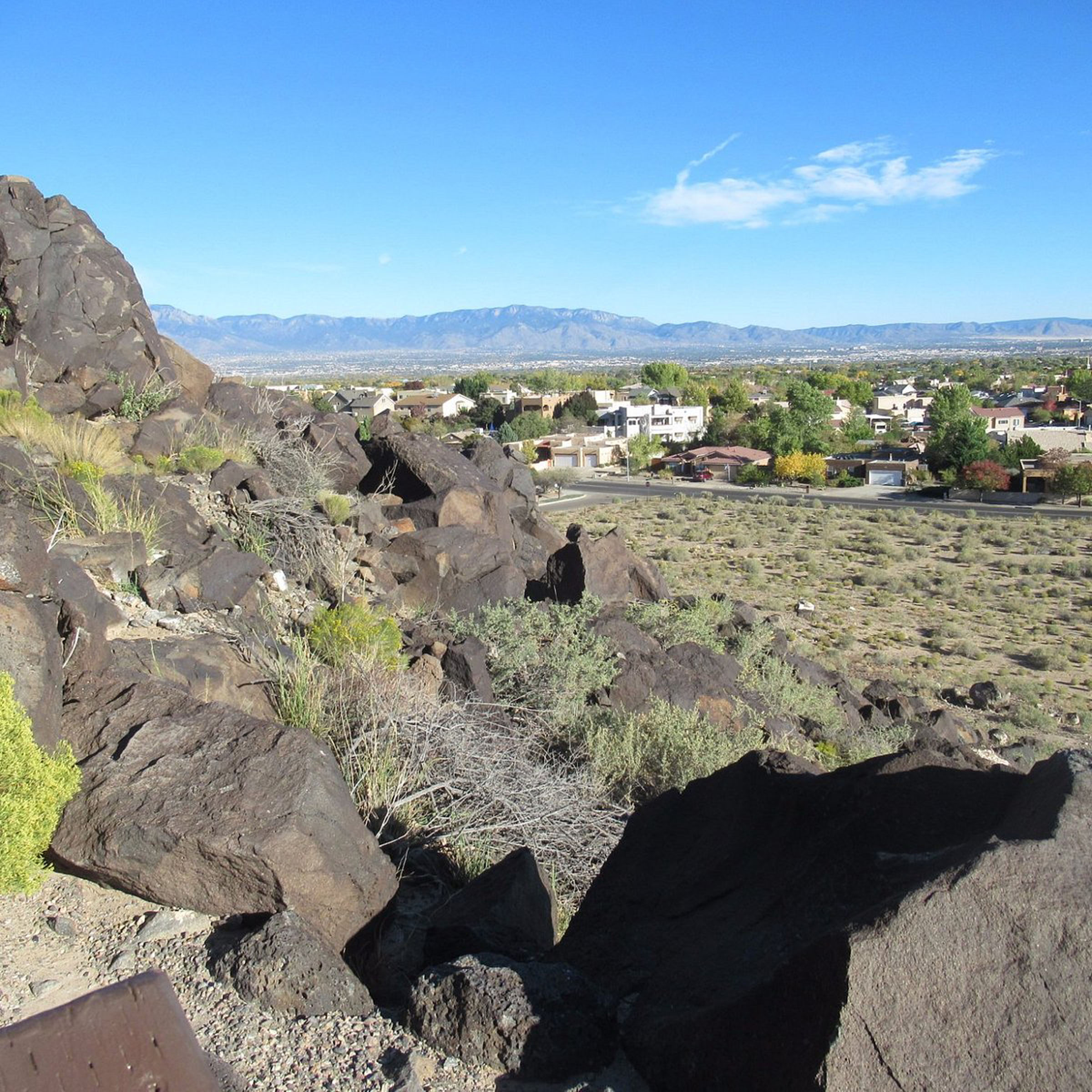
  • view-from-the-mesa-point

Context and Site
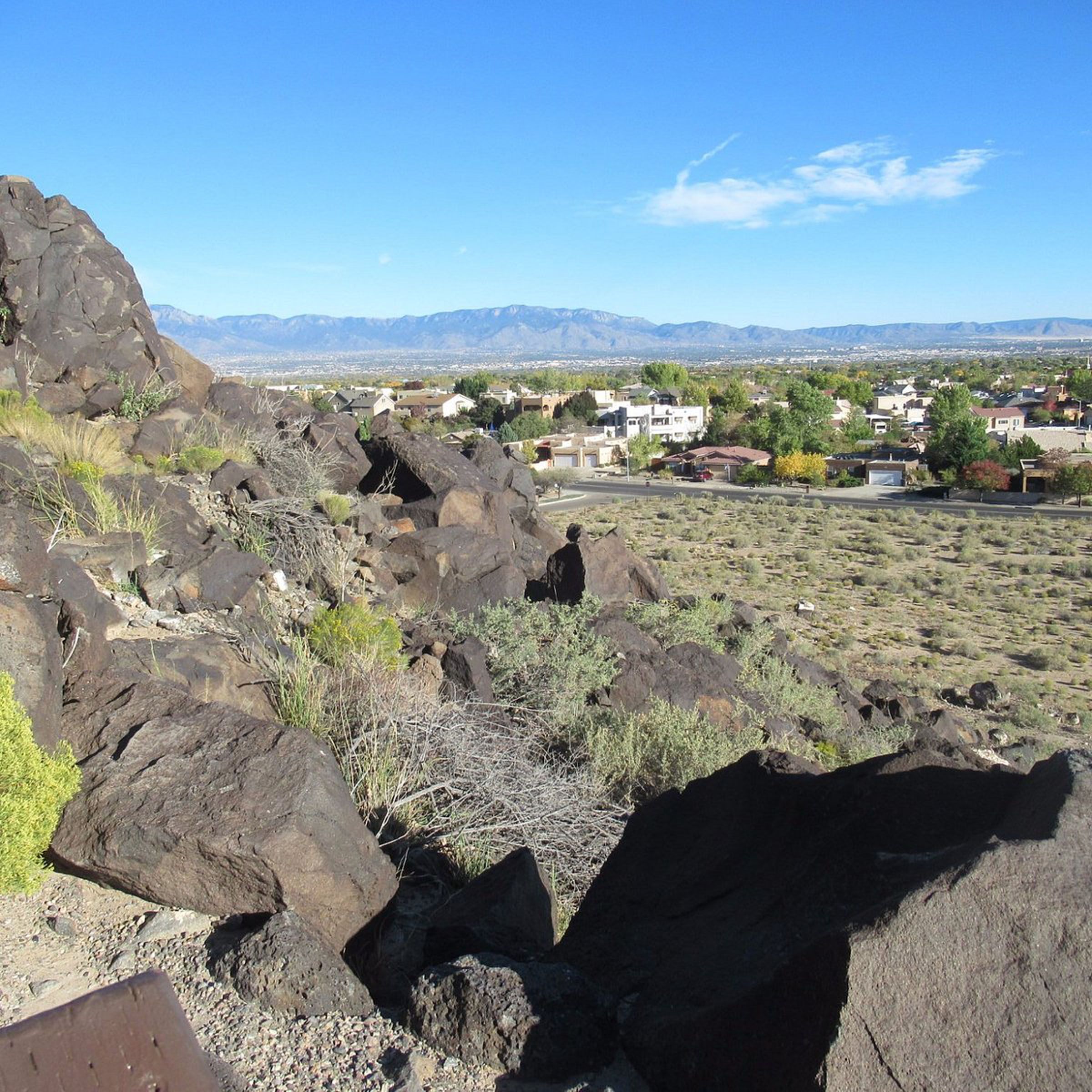
The project is situated at the boundary of Petroglyph National Monument and Petroglyph Estates, a master-planned subdivision emblematic of contemporary sprawl. Petroglyph National Monument protects over 24,000 images carved into volcanic rock, created 400–700 years ago by the ancestors of today’s Pueblo people and later by Spanish settlers. It is among the largest and most significant petroglyph sites in North America. In stark contrast, Petroglyph Estates represents the rapid, homogenized spread of suburban housing, encroaching upon a landscape that holds both cultural and ecological significance.

Methods and Strategy
Using handheld GPS devices, coordinates were systematically dropped across the suburban fringe, within streets, cul-de-sacs, and open spaces surrounding Petroglyph Estates. When plotted and connected, the points form a large-scale word across the landscape, visible in mapping software and satellite imaging. This geo-tagging method transforms suburban space into a charged surface for inscription, mirroring both ancient acts of carving into volcanic stone and contemporary acts of marking through digital coordinates.

Conceptual Framework
The work highlights a clash of temporalities and values: the permanence of petroglyphs etched into stone versus the transience of asphalt, drywall, and speculative development. Just as a sudden squall brings turbulence and change, suburban growth operates as a stormfront sweeping across the desert, consuming open space and eroding cultural memory. By inscribing a message at territorial scale, Squall calls attention to this encroachment while also questioning how technology mediates our understanding of land, boundaries, and heritage.

Impact
Squall is both a critique and a proposal. It critiques the ease with which suburban frameworks overwrite cultural landscapes, reducing them to backdrops for housing tracts. Simultaneously, it proposes a method of resistance: geo-tagging as an act of contemporary inscription that reclaims spatial agency. In doing so, the project transforms mapping into a form of cultural commentary, revealing the storm of sprawl as not only a physical condition but also a narrative inscribed into land and memory.

Conclusion
By overlaying digital coordinates onto terrain marked for centuries by indigenous petroglyphs, Squall underscores the fragility of cultural and ecological landscapes under pressure from suburban expansion. It positions technology as both witness and participant in this conflict, turning data into a form of drawing and mapping into a mode of resistance. The project invites reflection on the cumulative impact of growth and the need for more deliberate, culturally informed approaches to land stewardship.

More Work

Architecture


  • Wichita Mobile Clinic

    anadarko, oklahoma

  • SA Architects

    cranston, rhode island

  • OKC Greenhouse

    oklahoma city, oklahoma

  • Pawtucket Day Nursery

    pawtucket, rhode island

  • Meeting Street Center for Excellence

    providence, rhode island

  • Norterly Island Nature Center

    Chicago, Illinois

  • National Institute of Flamenco

    old town plaza, santa fe, new mexico

  • Corrales Comunity Pathway + Pedestrian Park

    corrales, new mexico

  • CRCUIT

    albuquerque, new mexico

  • The Construction of Art

    providence, rhode island

  • Santa Fe Univeristy School of Fine Arts

    Santa Fe, New Mexico

Design + Fabrication


  • Flatpack Foldable Structural Connections

    rhino, grasshopper, mild steel

  • Renegades

    Fred Jones Jr Museum of Art

  • Surface Flux

    python, c#, grasshopper, pla, wood, steel

  • Carbon Fiber Connections

    grasshopper, rhino, pla, carbon fiber

  • Acoustic Diffusion Panel

    grasshopper, rhino, cnc, rigid insulation

  • Hyperbolic Bending

    grasshopper, rhino, laser cut acrylic, bristol board

  • Filtration : Infiltration

    python, grasshopper, rhino, 3d printing

  • Recursive Paneling

    laser cut mylar

  • Sweet Crude

    python, c#, grasshopper, wood, plasti-dip, carbon, gelatin

  • Ruling Lines

    laser cut cell cast acrylic, stainless steel braided wire

  • Volumetric Aggregations

    processing, grasshopper, rhino, cast acrylic, black walnut, hickory

  • Cellulose Bookcase

    pine, black walnut, compressed wood fiber board, stain

  • Asher Chair

    rhino, pla, birch plywood

  • Andraditic Mass

    arduino, firefly, rhino, 3d printed pla, baltic birch plywood

  • Cholla

    grasshopper, rhino, black walnut

  • Folding Attractors

    grasshopper. rhino, white museum board

  • Grain Chair

    rhino, cnc milled birch plywood

  • Tracking Parallelograms

    grasshopper, rhino, hickory

  • Infiltration Table

    processing, spalted birch plywood, poplar, enamel, lacquer

Art + Code


  • Prairie Fire

    acrylic, ink, plywood

  • Dixieland Death Cult

    acrylic, plywood

  • Approximation of a Generation

    private tremendous

  • Elemental Worlds

    science museum oklahoma

  • Gonzo Cubes

    solidity, html, css, javascript, illustrator

  • Surface Flux

    python, c#, grasshopper, pla, wood, steel

  • A Line of Force

    arduino, grasshopper, firefly, java, plywood

  • The Drift

    html, css, javascript

  • Gear Institute

    illustrator, photoshop, php, css, html

  • Prism

    unity, c#, spine2d, illustrator

  • Squall

    petroglyphs national monument, albuquerque, new mexico

  • Galileo’s World Interactive

    c#, unity3d, illustrator, photoshop

  • Steel + Light

    convergence arts festival masterworks project, providence, rhode island

  • The God of Skiing

    book design

© [wpsos_year] Ken Marold USA, Inc. All rights reserved.

Continue reading

Gaze

voyeurism

Gaze : Exploring Spatial Weaving, Surveillance, and the Architecture of Voyeurism

wire, paper

status : complete in 2007

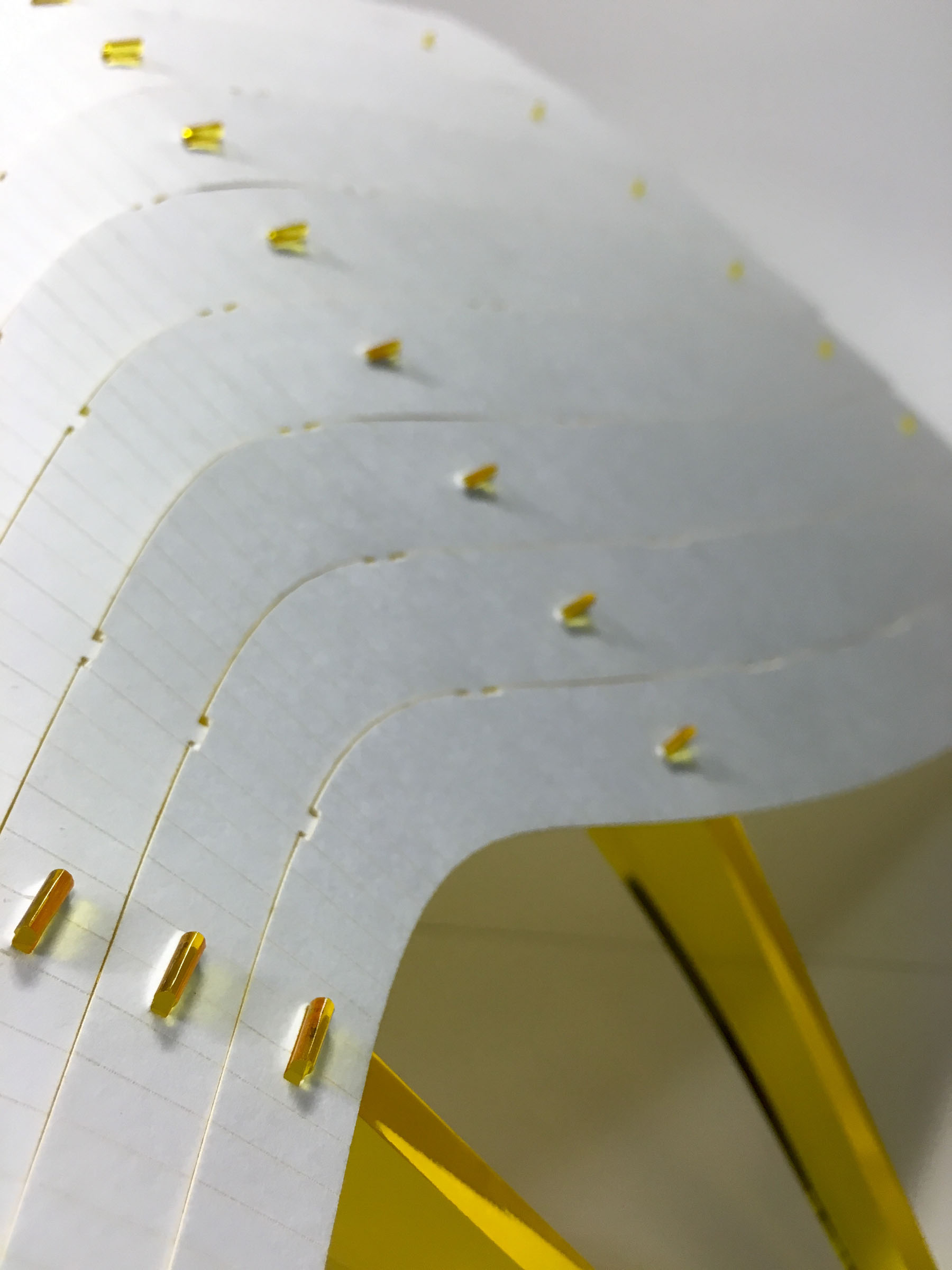
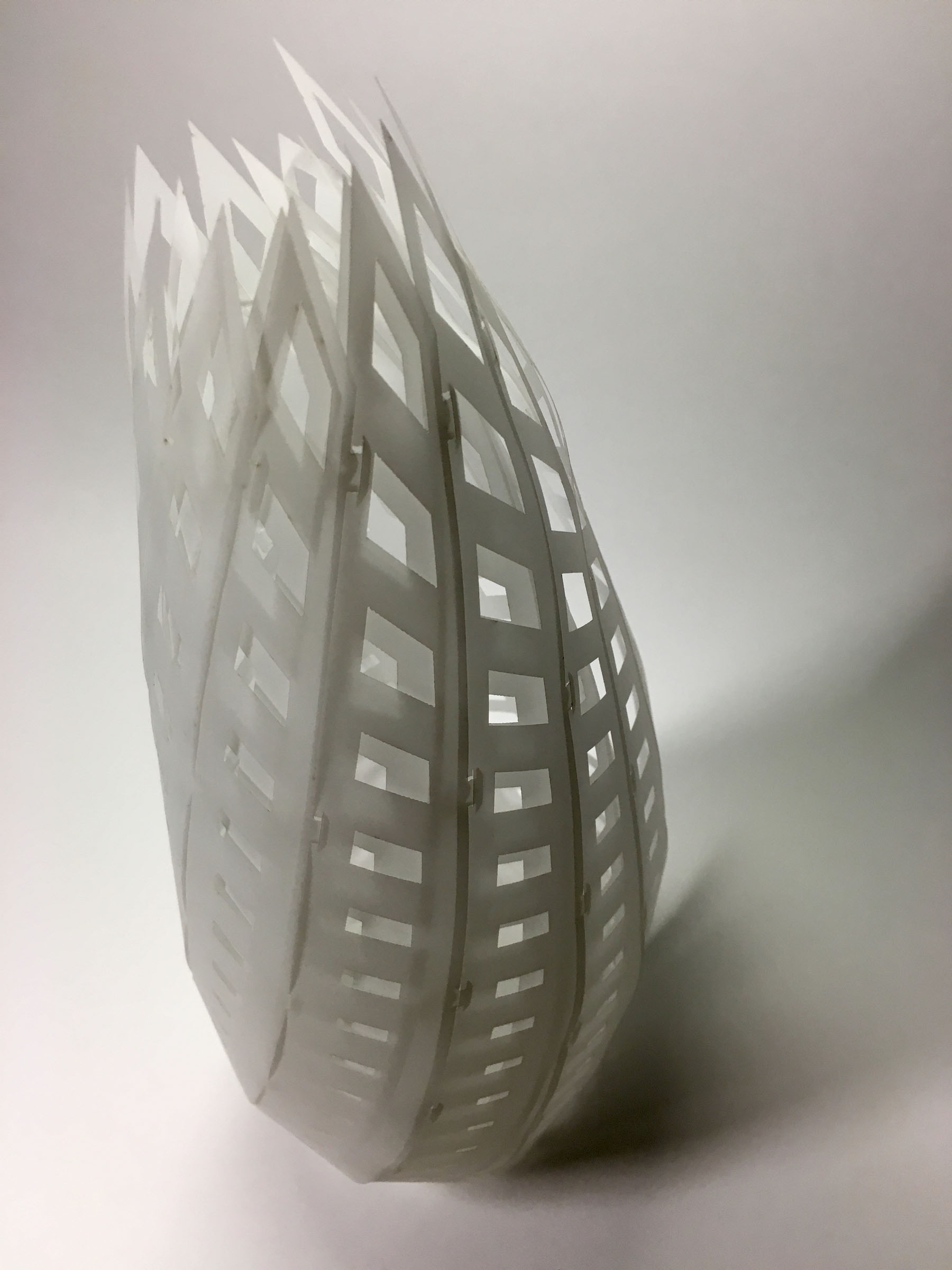
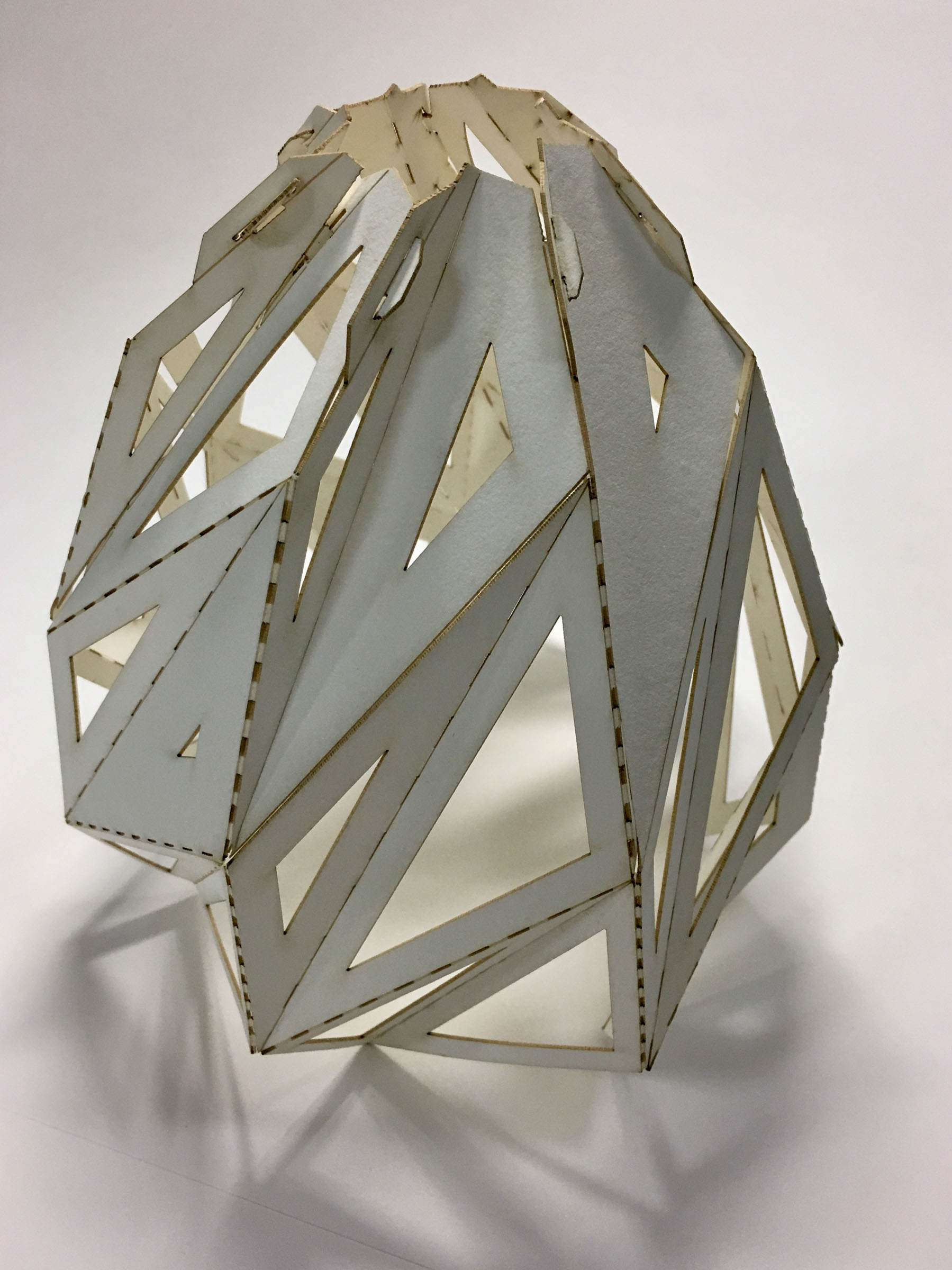
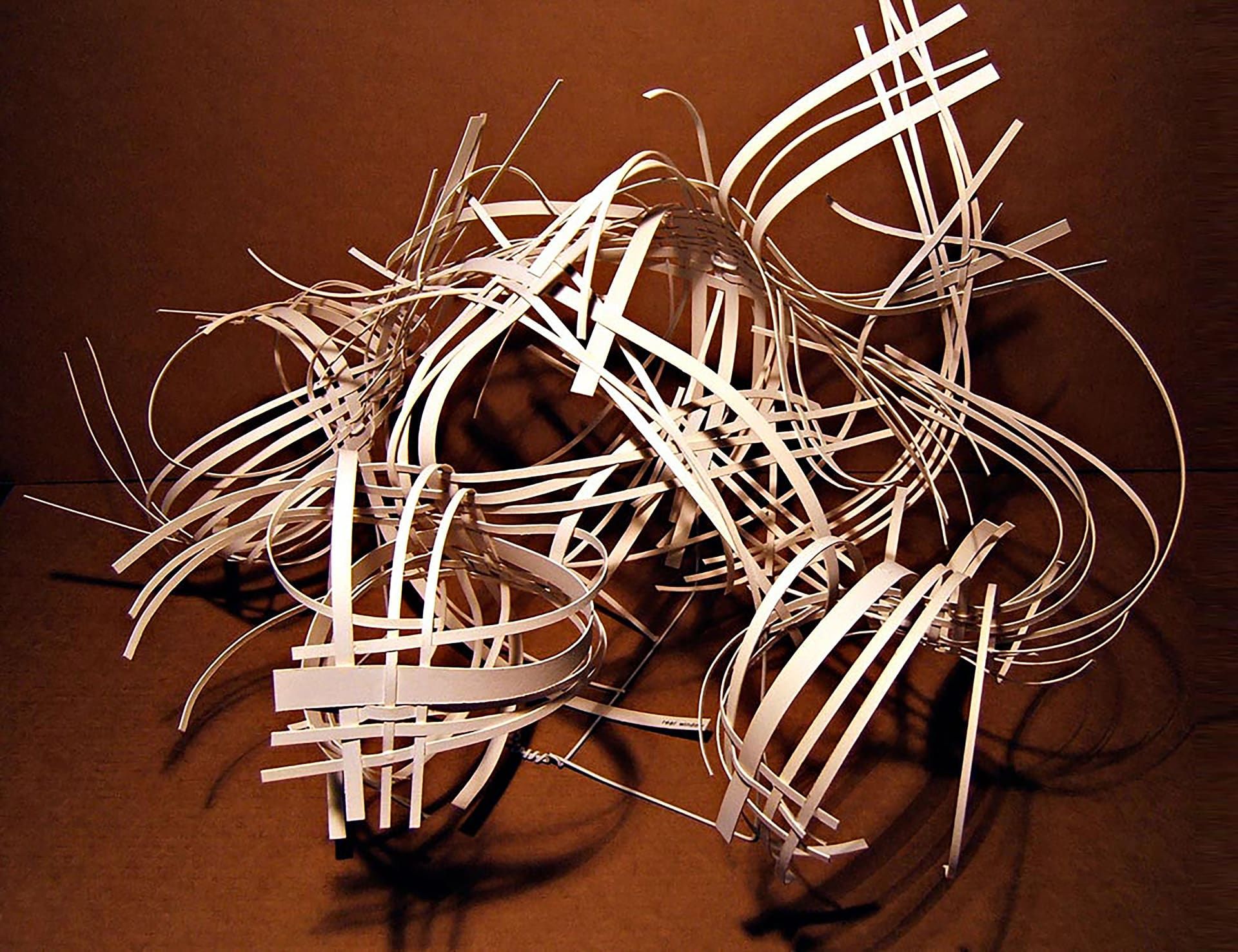
Paper Strips, Conceptual Model

Project Overview
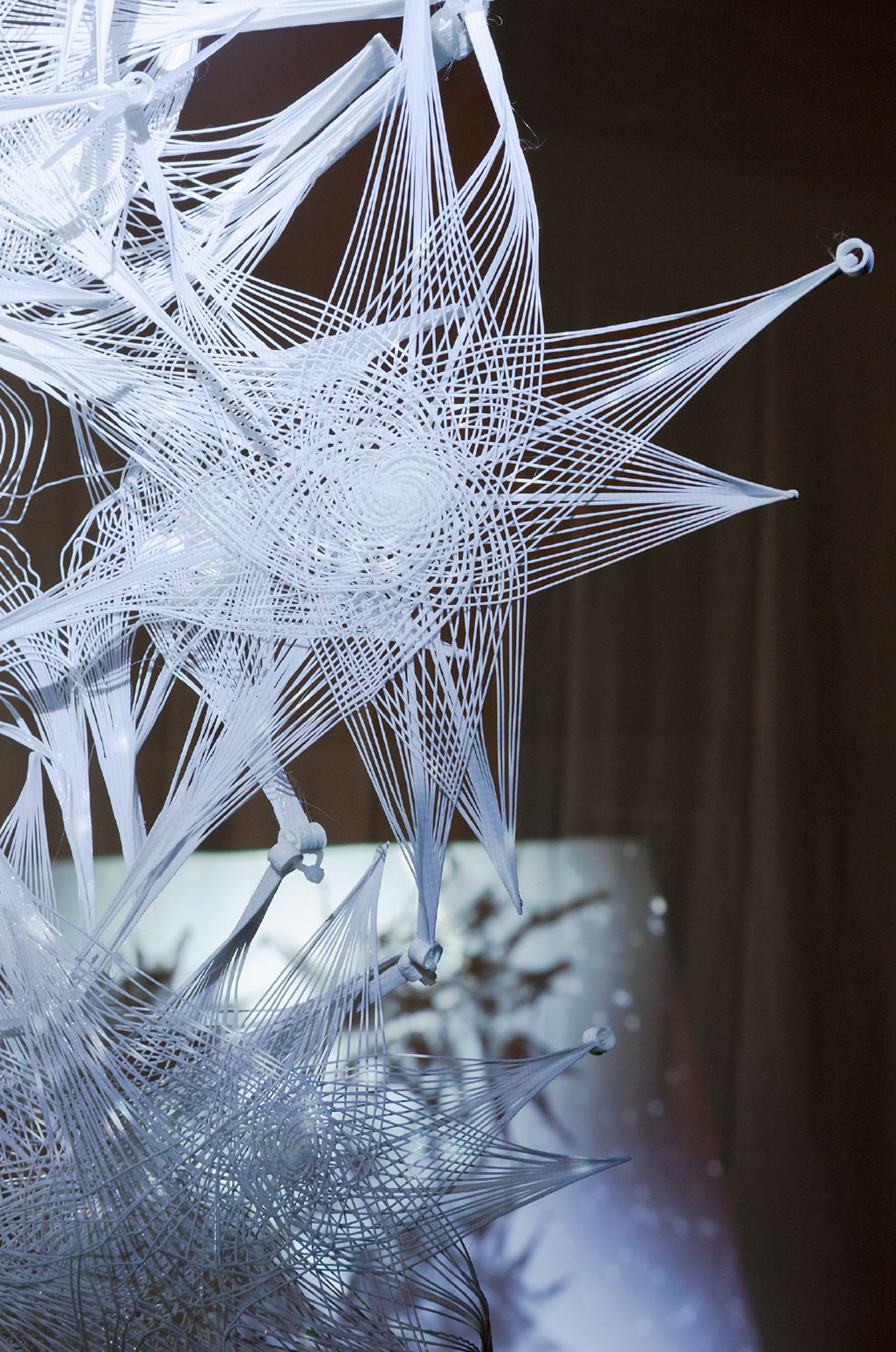
This speculative project examines how architecture can embody narrative, tension, and perception through the act of weaving and layered transparency. Drawing inspiration from Alfred Hitchcock’s Rear Window and its exploration of voyeurism, performance, and psychological unease, the model operates as both a formal study and a conceptual springboard for a pavilion-scale installation. Its central theme is the poetics of looking and being looked at: the interplay of concealment, revelation, and fragmented storytelling made spatial.

Design and Material Strategy
Constructed entirely from thin, pliable white strips, the model develops a field of intersecting lines, woven planes, and warped volumes. These strips function as both structure and skeleton, creating varying densities of enclosure. Tight nodes of woven convergence suggest spatial “rooms” or observation posts, while looser zones offer diffusion, blurring sightlines and producing threshold-like conditions. The weaving thus oscillates between exposure and concealment, echoing the psychological duality of voyeurism: watcher and watched, subject and spectacle.

Conceptual Framework
The woven composition imagines architecture as a system of vantage points. Each nodal cluster could expand at pavilion scale into inhabitable micro-environments — veiled capsules or chambers that allow for observation without direct connection. The interstitial weave acts as a permeable membrane: porous to vision yet resistant to passage. This establishes a narrative choreography where occupants remain visually linked yet spatially distinct, reinforcing themes of isolation, surveillance, and fragmented narrative.

Spatial Performance and Atmosphere
The strips arc, fold, and sweep dynamically, evoking a sense of frozen movement. In some areas, the weave spirals inward, intensifying focus and drawing the eye into tight, concealed moments. Elsewhere, it flares outward, dispersing tension into a looser, more ambiguous field. Shadows cast by the model extend these patterns beyond the physical structure, layering the ground plane with secondary geometries of light and absence. This interplay of material and shadow suggests an optical architecture where perception itself becomes material.

Speculative Pavilion Application
Scaled up, the pavilion would choreograph experiences of glancing, peering, and crossing sightlines. Visitors would move through a fragmented environment where visual access is constant but partial, always layered with awareness of being seen in return. Semi-permeable architectural surfaces could be augmented with digital projections, responsive materials, or interactive systems. Projections might reveal silhouettes, fragmented dialogue, or subtle animations triggered by movement, heightening the cinematic atmosphere and embedding narrative into the act of inhabitation.

Conclusion
Exploring Spatial Weaving situates architecture as both physical and narrative medium. By weaving together form, shadow, and perception, the project proposes a new way of inhabiting psychological space — one where architecture functions as both stage and script, performer and observer. The resulting pavilion is less a static structure than an evolving scene of encounters: an architecture of glances, echoes, and fragmented stories.

voyeurism
© [wpsos_year] Ken Marold USA, Inc. All rights reserved.

Continue reading

CRCUIT

crcuit_detail2

CRCUIT

albuquerque, new mexico

type : concept
status : completed in 2006

Pedestrian Reclamation and Social Tracing across the Grid

Project Overview
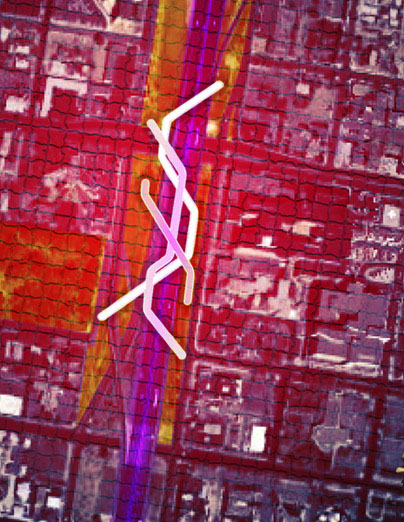
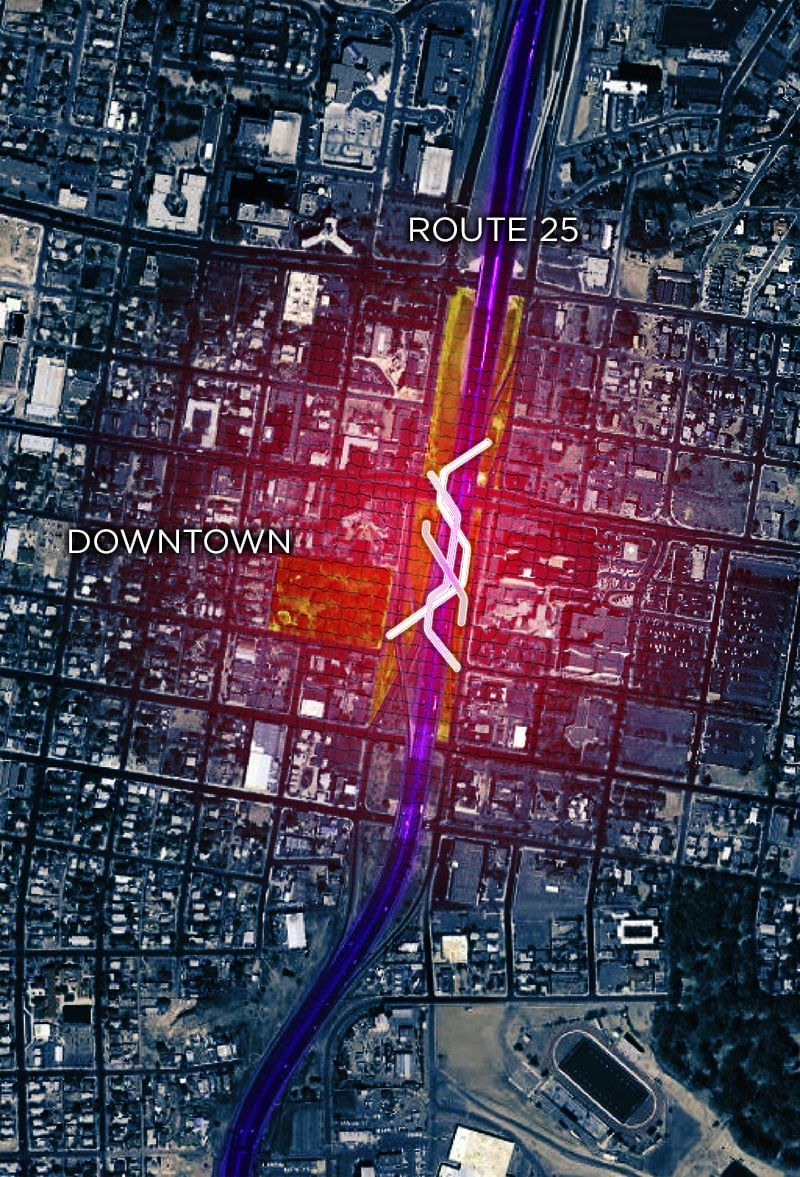
This conceptual proposal inserts a spatial hack into the rigid Cartesian grid of downtown Albuquerque, a nonlinear circuit that weaves above and through infrastructural barriers to reclaim a space for slow, pedestrian interaction. Positioned over Route 25 at the intersection of fragmented neighborhoods and urban voids, the intervention acts as both architectural promenade and data-responsive archive, proposing a new kind of urban interface: one where memory, presence, and passage are made visible.

Conceptual Framework
The design emerged from a desire to recover what is often lost in the urban condition, unplanned social interactions, residual traces of presence, and the layered time scales of daily life. In contrast to the flattened logic of the vehicular grid, this circuit operates at the pace of human movement, creating a space where individuals do not just pass each other, but leave behind spatial imprints, architectural residues of collective presence.

Where sidewalks fail to generate meaningful public interaction, often due to sprawl, scale, or disuse, this structure offers a woven architectural overlay, a new syntax of movement that enables engagement not through direct encounter alone, but through deferred social exchange. Visitors’ movements, gestures, and occupations are cataloged as part of an evolving archive of urban inhabitation.

Design Language and Surface Weaving
The architectural surfaces are articulated as a continuous weave, planes folding and twisting to form occupiable thresholds, elevated paths, enclosures, and overlooks. This weaving strategy serves not only as a spatial organizer but as a conceptual act: stitching together a broken urban fabric while expressing multiplicity and fluidity over rigidity and control.

The surfaces lift and bifurcate, producing variable conditions of exposure, enclosure, and overlap. These forms create nested zones of rest and gathering along the spine of the intervention, shifting in response to flow patterns, sightlines, and programmatic insertions. Landscape, infrastructure, and architecture are blurred, interacting at seams, nodes, and splits within the continuous form.

Site and Urban Strategy
Located at the intersection of downtown, UNM, and the ARTSlab district, the project intervenes in a zone characterized by infrastructural dominance and social disconnection. The circuit burns a path across this condition, elevated above the freeway, suspended over arterial roads, and bridging otherwise disconnected pedestrian environments. It functions not as a destination, but as a tool for re-threading latent public potential into the daily field of the city.

The mapping overlays, referencing circuitry diagrams and heat maps, represent an urban grid reprogrammed for human interaction, not vehicular flow. The intervention establishes a “soft” data network where architectural form becomes an interface for both immediate and residual public activity.

Speculative Technologies
As a research catalyst, the project began a personal trajectory into the intersection of architecture and digital sensing. The idea of collecting ambient social data, through computer vision, motion tracking, or environmental sensing, led to early investigations into projection mapping and responsive façade systems. These technologies were imagined not simply as spectacle, but as architectural media: capable of recording and replaying public memory in real time or asynchronously, allowing ephemeral social interactions to persist in space.

Conclusion
CRCUIT proposes a reprogramming of urban space, not through demolition or replacement, but through spatial overlay and temporal disruption. It challenges the dominance of efficiency and speed in the city’s infrastructure, offering instead a woven surface for public presence, memory, and circulation. Through folded form and digital possibility, the project reclaims a forgotten layer of urban life: one made not of plans and parcels, but of movement, memory, and shared time.

  • Site-Map_Concept
  • crcuit_detail3
  • crcuit_detail2
  • crcuit_detail1
  • crcuit_900x610

More Work

Architecture


  • Wichita Mobile Clinic

    anadarko, oklahoma

  • SA Architects

    cranston, rhode island

  • OKC Greenhouse

    oklahoma city, oklahoma

  • Pawtucket Day Nursery

    pawtucket, rhode island

  • Meeting Street Center for Excellence

    providence, rhode island

  • Norterly Island Nature Center

    Chicago, Illinois

  • National Institute of Flamenco

    old town plaza, santa fe, new mexico

  • Corrales Comunity Pathway + Pedestrian Park

    corrales, new mexico

  • CRCUIT

    albuquerque, new mexico

  • The Construction of Art

    providence, rhode island

  • Santa Fe Univeristy School of Fine Arts

    Santa Fe, New Mexico

Design + Fabrication


  • Flatpack Foldable Structural Connections

    rhino, grasshopper, mild steel

  • Renegades

    Fred Jones Jr Museum of Art

  • Surface Flux

    python, c#, grasshopper, pla, wood, steel

  • Carbon Fiber Connections

    grasshopper, rhino, pla, carbon fiber

  • Acoustic Diffusion Panel

    grasshopper, rhino, cnc, rigid insulation

  • Hyperbolic Bending

    grasshopper, rhino, laser cut acrylic, bristol board

  • Filtration : Infiltration

    python, grasshopper, rhino, 3d printing

  • Recursive Paneling

    laser cut mylar

  • Sweet Crude

    python, c#, grasshopper, wood, plasti-dip, carbon, gelatin

  • Ruling Lines

    laser cut cell cast acrylic, stainless steel braided wire

  • Volumetric Aggregations

    processing, grasshopper, rhino, cast acrylic, black walnut, hickory

  • Cellulose Bookcase

    pine, black walnut, compressed wood fiber board, stain

  • Asher Chair

    rhino, pla, birch plywood

  • Andraditic Mass

    arduino, firefly, rhino, 3d printed pla, baltic birch plywood

  • Cholla

    grasshopper, rhino, black walnut

  • Folding Attractors

    grasshopper. rhino, white museum board

  • Grain Chair

    rhino, cnc milled birch plywood

  • Tracking Parallelograms

    grasshopper, rhino, hickory

  • Infiltration Table

    processing, spalted birch plywood, poplar, enamel, lacquer

Art + Code


  • Prairie Fire

    acrylic, ink, plywood

  • Surface Flux

    python, c#, grasshopper, pla, wood, steel

  • Dixieland Death Cult

    acrylic, plywood

  • Approximation of a Generation

    private tremendous

  • Elemental Worlds

    science museum oklahoma

  • Gonzo Cubes

    solidity, html, css, javascript, illustrator

  • A Line of Force

    arduino, grasshopper, firefly, java, plywood

  • The Drift

    html, css, javascript

  • Gear Institute

    illustrator, photoshop, php, css, html

  • Prism

    unity, c#, spine2d, illustrator

  • Squall

    petroglyphs national monument, albuquerque, new mexico

  • Galileo’s World Interactive

    c#, unity3d, illustrator, photoshop

  • Steel + Light

    convergence arts festival masterworks project, providence, rhode island

  • The God of Skiing

    book design

© [wpsos_year] Ken Marold USA, Inc. All rights reserved.

Continue reading

Northerly Island Nature Center

featured-image

Northerly Island Nature Center

chicago, illinois

status : completed in 2009

Reconnecting Urban Infrastructure with Natural Systems along Chicago’s Lakefront

Project Overview
The Northerly Island Nature Center was envisioned as a civic landscape and architectural complex that reasserts the relationship between built form, ecology, and social life. Located at the southern edge of Chicago’s lakefront, the project navigates the tension between retreat and arrival—providing both refuge from the city and a new civic space for engagement with its natural and infrastructural systems.

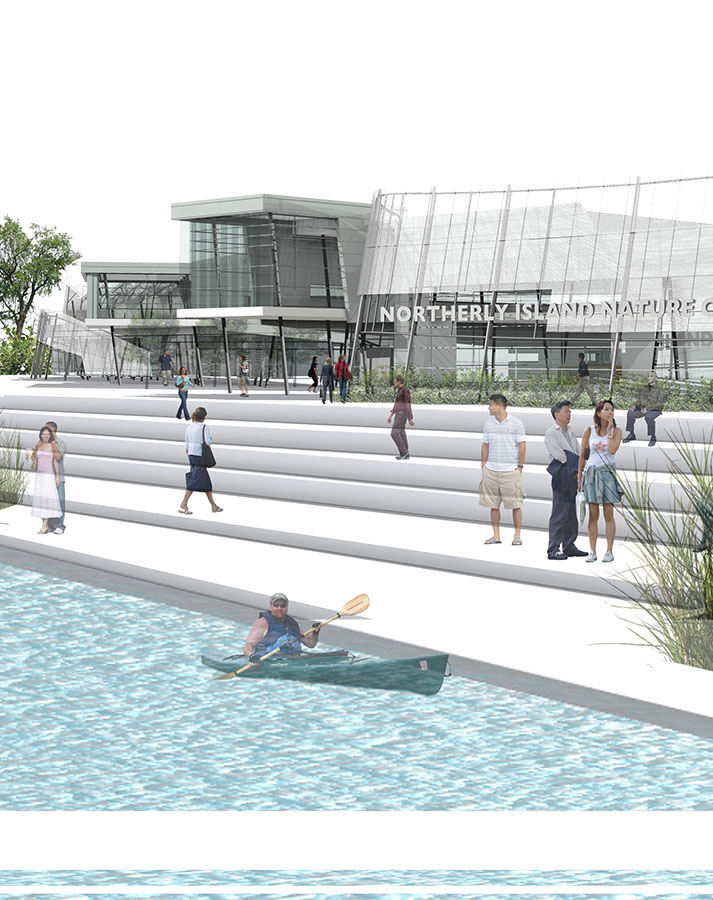
The center is composed of four distinct programmatic volumes—restaurant, nature center, science tower, and event space—linked by a series of connective exterior zones. These interstitial spaces function as the project’s circulatory system: gathering decks, exhibit gardens, and shaded paths that transform moments of transition into sites of interaction, education, and pause.

Site Integration and Spatial Strategy
The master plan orients the project to frame views of Lake Michigan, the urban skyline, and adjacent wetlands. Buildings are positioned along a curved spine that echoes the shoreline and visitor approach paths, establishing a rhythmic sequence of entry, encounter, and rest. Pedestrian circulation is intentionally varied—shifting between direct axial promenades and softer, meandering routes through habitat zones, echoing the duality of “urban edge” and “natural interior.”

Sectional design strategies respond directly to environmental performance criteria. Roof forms and shading devices are tuned for solar exposure, passive ventilation, and wind deflection throughout seasonal changes. Deep roof overhangs and vertical fins modulate daylight, while exposed thermal mass and integrated energy systems manage interior climate. Building orientation and elevation changes negotiate shifting topography and hydrological conditions across the island’s reclaimed landform.

Architecture and Envelope
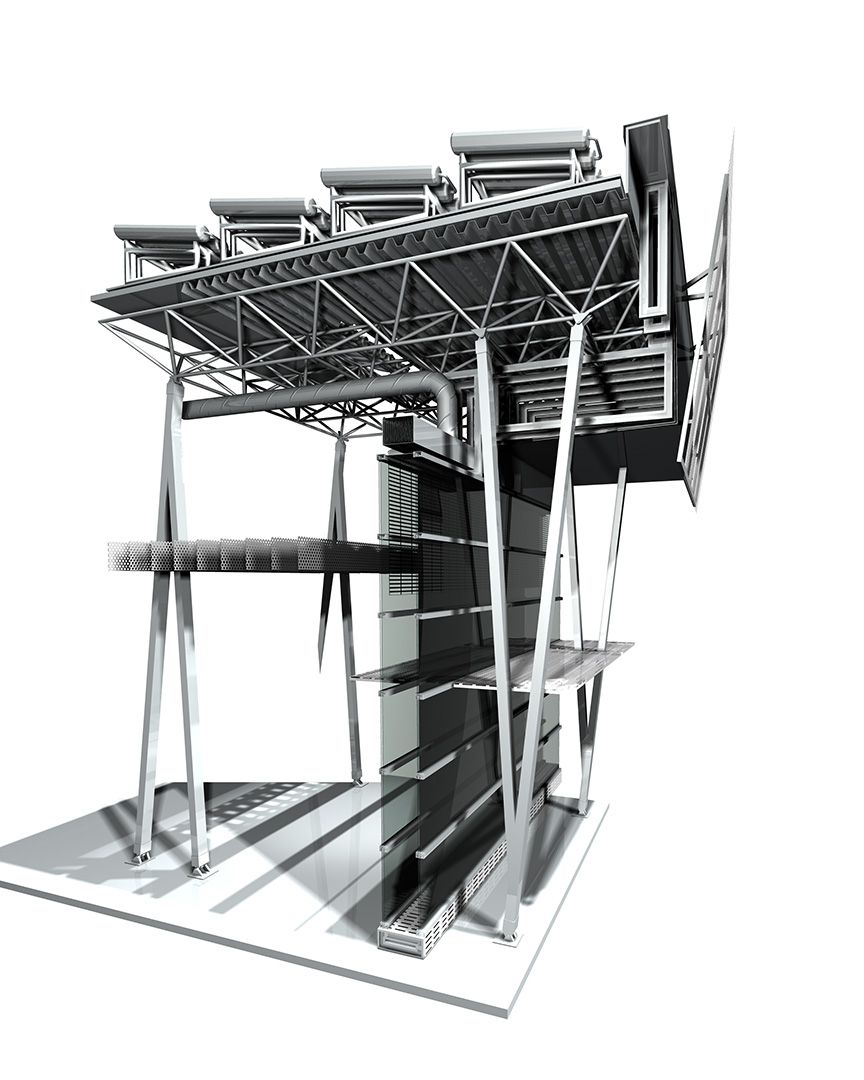
The architectural expression embraces an exposed structural logic, revealing trusses, glazing systems, and mechanical systems in dialogue with the site’s infrastructural character. Curtainwall assemblies, layered with photovoltaic and shading devices, frame long views across the lake while generating electricity and controlling heat gain. The science tower integrates educational programming with technical performance: housing wind turbines, resource monitoring systems, and vertical solar arrays in a highly visible vertical element.

The envelope acts as both a membrane and a filter—glass and perforated surfaces alternate to create moments of openness and opacity, transparency and privacy. Roof canopies and exterior mesh systems are extended to create shaded exterior volumes, supporting educational programs, ecological exhibits, and informal gathering.

Public Realm and Programming
Publicness is a core design driver. The connective landscape is programmed with boat slips, kayak landings, outdoor classrooms, botanical installations, and performance zones. These areas are conceived as shared resources rather than extensions of any single building, enabling unprogrammed and spontaneous occupation by the broader community.

The architecture intentionally resists monumentality. Instead, it is defined by responsiveness—modulating light, movement, and social interaction through adaptable spatial conditions. The complex acts not as a static object in the landscape, but as a living framework that evolves through use and seasonal change.

Conclusion
Northerly Island Nature Center reimagines the edge between infrastructure and ecology as a porous, productive zone of public life. Rather than separating building and landscape, the project binds them through circulation, material continuity, and environmental responsiveness. It becomes not only a destination for retreat, but a platform for reengaging the city’s relationship with its lake, its climate, and its communities.

  • board-1
  • board-3
  • board-2

Process


  • process_board_TOP

  • process_board_BOTTOM

  • nature_center_102707a-b_render_03

  • nature_center_102707a-b_render 01

  • nature_center_102707a-B RENDER 01 NEW

  • nature_center_102507c-render 2 very newest

  • nature_center_102507c-interior perspective B

  • nature_center_102507c-interior perspective A

  • nature_center_102407a-restaurant cross sec render

  • featured-image

  • buildingsection-FINAL__

  • board-4


  • process_board_TOP

  • process_board_BOTTOM

  • nature_center_102707a-b_render_03

  • nature_center_102707a-b_render 01

  • nature_center_102707a-B RENDER 01 NEW

  • nature_center_102507c-render 2 very newest

  • nature_center_102507c-interior perspective B

  • nature_center_102507c-interior perspective A

  • nature_center_102407a-restaurant cross sec render

  • featured-image

  • buildingsection-FINAL__

  • board-4

More Work

Architecture


  • Wichita Mobile Clinic

    anadarko, oklahoma

  • SA Architects

    cranston, rhode island

  • OKC Greenhouse

    oklahoma city, oklahoma

  • Pawtucket Day Nursery

    pawtucket, rhode island

  • Meeting Street Center for Excellence

    providence, rhode island

  • Norterly Island Nature Center

    Chicago, Illinois

  • National Institute of Flamenco

    old town plaza, santa fe, new mexico

  • Corrales Comunity Pathway + Pedestrian Park

    corrales, new mexico

  • CRCUIT

    albuquerque, new mexico

  • The Construction of Art

    providence, rhode island

  • Santa Fe Univeristy School of Fine Arts

    Santa Fe, New Mexico

Design + Fabrication


  • Flatpack Foldable Structural Connections

    rhino, grasshopper, mild steel

  • Renegades

    Fred Jones Jr Museum of Art

  • Surface Flux

    python, c#, grasshopper, pla, wood, steel

  • Carbon Fiber Connections

    grasshopper, rhino, pla, carbon fiber

  • Acoustic Diffusion Panel

    grasshopper, rhino, cnc, rigid insulation

  • Hyperbolic Bending

    grasshopper, rhino, laser cut acrylic, bristol board

  • Filtration : Infiltration

    python, grasshopper, rhino, 3d printing

  • Recursive Paneling

    laser cut mylar

  • Sweet Crude

    python, c#, grasshopper, wood, plasti-dip, carbon, gelatin

  • Ruling Lines

    laser cut cell cast acrylic, stainless steel braided wire

  • Volumetric Aggregations

    processing, grasshopper, rhino, cast acrylic, black walnut, hickory

  • Cellulose Bookcase

    pine, black walnut, compressed wood fiber board, stain

  • Asher Chair

    rhino, pla, birch plywood

  • Andraditic Mass

    arduino, firefly, rhino, 3d printed pla, baltic birch plywood

  • Cholla

    grasshopper, rhino, black walnut

  • Folding Attractors

    grasshopper. rhino, white museum board

  • Grain Chair

    rhino, cnc milled birch plywood

  • Tracking Parallelograms

    grasshopper, rhino, hickory

  • Infiltration Table

    processing, spalted birch plywood, poplar, enamel, lacquer

Art + Code


  • Prairie Fire

    acrylic, ink, plywood

  • Surface Flux

    python, c#, grasshopper, pla, wood, steel

  • Dixieland Death Cult

    acrylic, plywood

  • Approximation of a Generation

    private tremendous

  • Elemental Worlds

    science museum oklahoma

  • Gonzo Cubes

    solidity, html, css, javascript, illustrator

  • A Line of Force

    arduino, grasshopper, firefly, java, plywood

  • The Drift

    html, css, javascript

  • Gear Institute

    illustrator, photoshop, php, css, html

  • Prism

    unity, c#, spine2d, illustrator

  • Squall

    petroglyphs national monument, albuquerque, new mexico

  • Galileo’s World Interactive

    c#, unity3d, illustrator, photoshop

  • Steel + Light

    convergence arts festival masterworks project, providence, rhode island

  • The God of Skiing

    book design

© [wpsos_year] Ken Marold USA, Inc. All rights reserved.

Continue reading

Santa Fe University School of Fine Arts

IMG_7713

Santa Fe University School of Fine Arts

santa fe, new mexico

type : proposal
status : complete

Project Overview
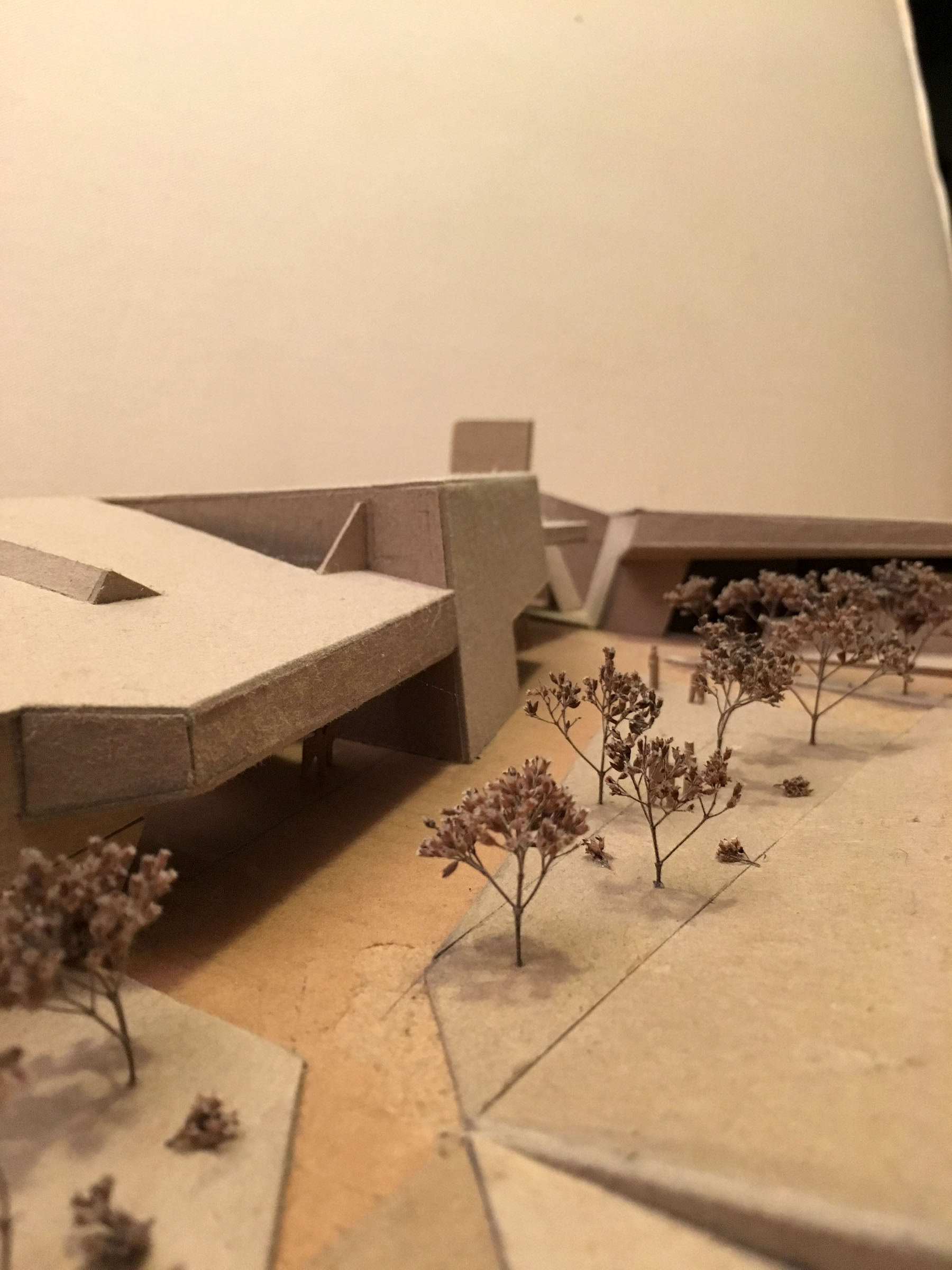
This project explores the convergence of land-form and built-form through a series of strategic tectonic moves that generate both structure and spatial narrative. Conceived as a studio arts building, the project operates as a hybrid of landscape and architecture, an integrated topography where form is derived not from figure, but from deformation, pressure, and fold.

The proposal considers how creative practices can be supported by a spatial framework that is itself expressive of artistic processes: fragmentation, juxtaposition, emergence. A folded horizontal datum gives rise to lifted plates, tapered voids, and embedded masses, creating a sequence of sheltered studios, outdoor courtyards, and informal zones of congregation.

Design Strategy
The building is embedded in a pleated terrain, where sloped planes and planar seams define both architecture and landscape as part of the same operative system. This pleated field is not a literal mimicry of topography, but a constructed ground that negotiates between natural logic and architectural intention. The result is a series of sculpted voids and emergent forms that frame views, shape light, and orchestrate circulation.

Between these horizontal tectonics and the angular surfaces of rising built mass emerges the fissure: a dynamic interstitial condition where architecture reveals its internal structure and spatial relationships. These fissures are not only physical gaps, but conceptual ones, allowing for light to enter, sight to escape, and the rhythms of artistic production to expand outward.

Circulation and Spatial Organization
The layout reveals a sequence of layered public and private zones, academic spaces, art studios, and social gathering areas, stitched together by a series of exterior walks, ramps, and stepped transitions. The use of inclined roof planes and protected undercrofts reinforces the sense of movement through terrain rather than across a floorplate.

Interior and exterior relationships are blurred by threshold conditions: overhangs that press low to the earth, apertures that slice the roof plane, and voids that draw the sky downward into the project’s center. These moves are formal but not decorative, they are spatial decisions driven by light, access, and experiential choreography.

Material Implied Logic
Though rendered here in study model materials, the tectonic expression suggests a dialogue between earthbound mass and industrial surface. The vertical forms read as folded metal, implying a skin that resists and reflects, while the grounded volumes suggest concrete or rammed earth, anchoring the proposal to site and time. This duality of material intent reflects the conceptual duality of the project itself: the structural permanence of architecture and the experimental temporality of creative practice.

Conclusion
This design proposal is a spatial and conceptual landscape for making, a terrain where architecture becomes part of the creative act. Rather than occupying the land, the project participates in it, folding up from the ground and opening itself to the forces around it. Through its careful negotiation of landscape geometry, circulation, and tectonic language, the project becomes both a container for and an expression of the artistic processes it supports.

  • IMG_9422
  • IMG_7856
  • IMG_7713
  • IMG_6445
  • IMG_6188
  • IMG_4958
  • IMG_4704
  • IMG_1641
  • IMG_1609
  • IMG_1609_feature
  • IMG_0615

More Work

Architecture


  • Wichita Mobile Clinic

    anadarko, oklahoma

  • SA Architects

    cranston, rhode island

  • OKC Greenhouse

    oklahoma city, oklahoma

  • Pawtucket Day Nursery

    pawtucket, rhode island

  • Meeting Street Center for Excellence

    providence, rhode island

  • Norterly Island Nature Center

    Chicago, Illinois

  • National Institute of Flamenco

    old town plaza, santa fe, new mexico

  • Corrales Comunity Pathway + Pedestrian Park

    corrales, new mexico

  • CRCUIT

    albuquerque, new mexico

  • The Construction of Art

    providence, rhode island

  • Santa Fe Univeristy School of Fine Arts

    Santa Fe, New Mexico

Design + Fabrication


  • Flatpack Foldable Structural Connections

    rhino, grasshopper, mild steel

  • Renegades

    Fred Jones Jr Museum of Art

  • Surface Flux

    python, c#, grasshopper, pla, wood, steel

  • Carbon Fiber Connections

    grasshopper, rhino, pla, carbon fiber

  • Acoustic Diffusion Panel

    grasshopper, rhino, cnc, rigid insulation

  • Hyperbolic Bending

    grasshopper, rhino, laser cut acrylic, bristol board

  • Filtration : Infiltration

    python, grasshopper, rhino, 3d printing

  • Recursive Paneling

    laser cut mylar

  • Sweet Crude

    python, c#, grasshopper, wood, plasti-dip, carbon, gelatin

  • Ruling Lines

    laser cut cell cast acrylic, stainless steel braided wire

  • Volumetric Aggregations

    processing, grasshopper, rhino, cast acrylic, black walnut, hickory

  • Cellulose Bookcase

    pine, black walnut, compressed wood fiber board, stain

  • Asher Chair

    rhino, pla, birch plywood

  • Andraditic Mass

    arduino, firefly, rhino, 3d printed pla, baltic birch plywood

  • Cholla

    grasshopper, rhino, black walnut

  • Folding Attractors

    grasshopper. rhino, white museum board

  • Grain Chair

    rhino, cnc milled birch plywood

  • Tracking Parallelograms

    grasshopper, rhino, hickory

  • Infiltration Table

    processing, spalted birch plywood, poplar, enamel, lacquer

Art + Code


  • Prairie Fire

    acrylic, ink, plywood

  • Surface Flux

    python, c#, grasshopper, pla, wood, steel

  • Dixieland Death Cult

    acrylic, plywood

  • Approximation of a Generation

    private tremendous

  • Elemental Worlds

    science museum oklahoma

  • Gonzo Cubes

    solidity, html, css, javascript, illustrator

  • A Line of Force

    arduino, grasshopper, firefly, java, plywood

  • The Drift

    html, css, javascript

  • Gear Institute

    illustrator, photoshop, php, css, html

  • Prism

    unity, c#, spine2d, illustrator

  • Squall

    petroglyphs national monument, albuquerque, new mexico

  • Galileo’s World Interactive

    c#, unity3d, illustrator, photoshop

  • Steel + Light

    convergence arts festival masterworks project, providence, rhode island

  • The God of Skiing

    book design

© [wpsos_year] Ken Marold USA, Inc. All rights reserved.

Continue reading

Meeting Street Center for Excellence

meeting_street_final

Meeting Street Center for Excellence

providence, rhode island

status : complete

Project Overview
The Meeting Street Center is a 76,000-square-foot, multi-use educational and clinical facility designed to serve over 3,000 children and families annually. The building is sited on a nine-acre campus and supports a range of integrated services, academic, therapeutic, diagnostic, within a spatial framework that prioritizes accessibility, sensory awareness, and spatial diversity.

Design Strategy
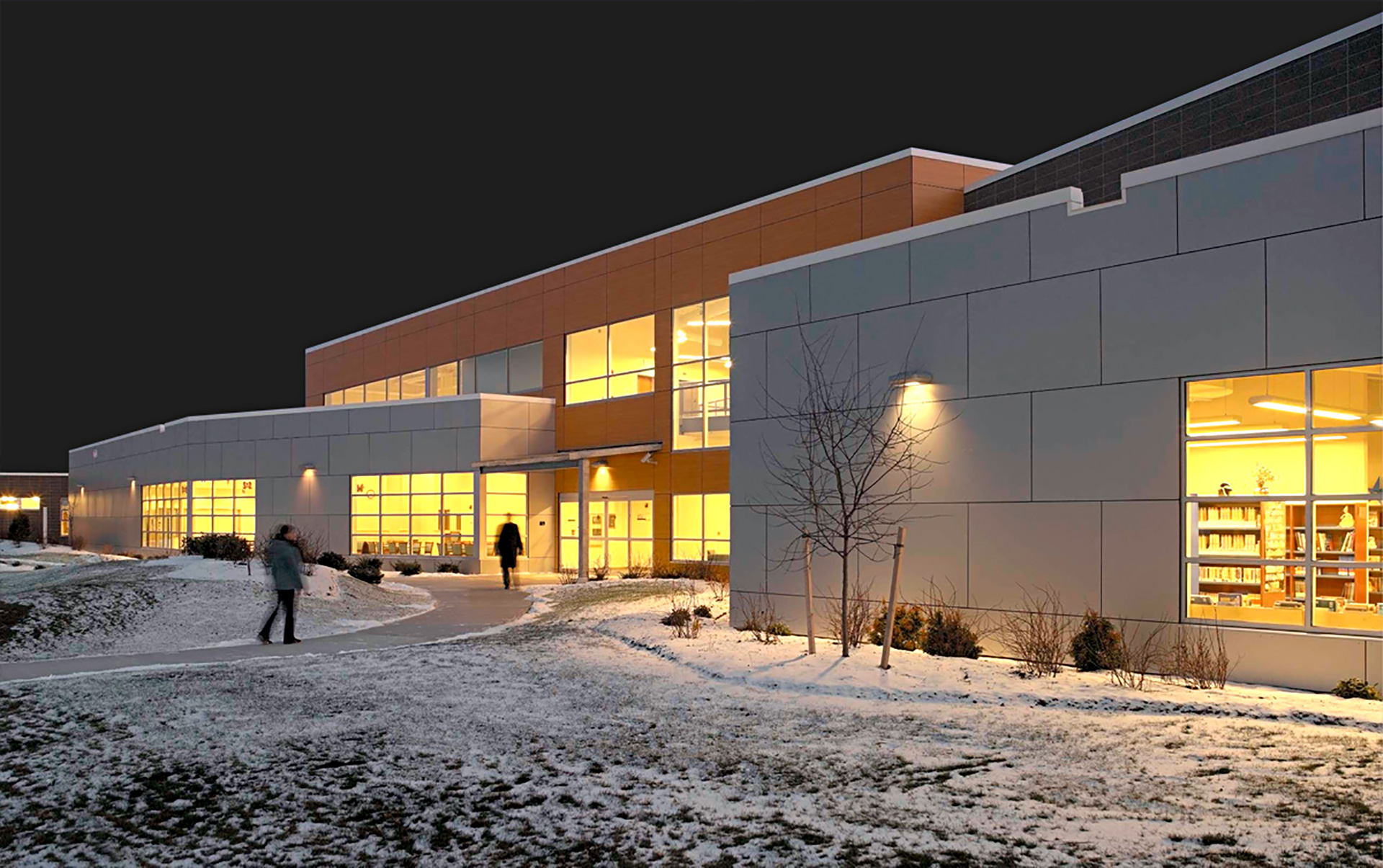
The design emphasizes a spatial dialogue between structure and site, negotiating an emerging urban edge and the open landscape it inhabits. This dual condition informs both the massing and the orientation of the building: portions of the structure reach outward into the landscape, while others curve inward to frame intimate, sheltered outdoor spaces. Public zones, galleries, gardens, and shared lobbies, are positioned to blur the boundary between interior and exterior, creating spaces that are porous, visible, and socially engaging.

A key organizational strategy was the modulation of spatial scale. Narrow corridors give way to expanded atria; framed thresholds open into shared gardens; circulation paths fold into meeting spaces. These shifts in scale reflect the varying sensory needs of the occupants while creating moments of surprise and pause within an otherwise efficient layout.

Circulation and Program
Movement through the building blends two types of spatial logic: linear mechanical corridors and more organic, path-like connectors. This hybrid circulation strategy allows the building to serve multiple programs simultaneously while avoiding institutional monotony. Hallways are widened into informal gathering nodes, waiting areas open into daylit garden bays, and access ramps are integrated into continuous, landscaped interior zones. This allows the building to serve as a framework for social interaction, rather than simply a means of navigation.

Visual access and daylight play a central role in the spatial composition. The building is organized around a series of interconnected volumes, articulated through shifts in height, cladding, and transparency. Generous glazing along circulation spines and entry points brings natural light deep into the plan, while creating lines of sight between classrooms, therapy zones, and outdoor learning environments.

Material Palette
The project uses a restrained material palette to unify the diverse programs within. Exterior panels in muted tones are broken up by brighter, warm-colored modules that signify entry and public gathering areas. Inside, exposed structural systems and bright floor finishes establish orientation and character while supporting legibility for diverse users, including those with sensory processing needs.

Color is used not just decoratively, but as a spatial signal, grounding wayfinding and zone identity. Textures are soft, cleanable, and acoustically tuned. Landscape integration includes native plantings, snow- and shade-appropriate paths, and protected play zones, reinforcing the building’s relationship with its environment.

Conclusion
Meeting Street Center is designed not as a single-purpose facility but as a network of interrelated spaces, academic, therapeutic, administrative, and social, united through a commitment to accessibility and community engagement. It prioritizes clarity without rigidity, flexibility without anonymity, and care without compromise. The building serves as a framework for care, learning, and gathering, designed to grow with its community.

  • meeting_street_final
  • SAA-Meeting-St-EXT-0082web
  • SAA-Meeting-EXT-592web
  • SAA-Meeting-EXT-401web
  • MeetingStreet11web
  • MeetingStreet10web
  • MeetingStreet9web
  • MeetingStreet8web
  • MeetingStreet6web
  • MeetingStreet5web
  • MeetingStreet4web
  • MeetingStreet3web
  • MeetingStreet2web
  • meeting_street_final
  • cafeteriaweb
  • AU_MeetingSt_070123_-004web

Awards


Starnet Design Award
Inspirations Award, Contract Magazine
Silver Design Award, RI Monthly
Outstanding Design, American School & University Magazine
LEED Certified

More Work

Architecture


  • Wichita Mobile Clinic

    anadarko, oklahoma

  • SA Architects

    cranston, rhode island

  • OKC Greenhouse

    oklahoma city, oklahoma

  • Pawtucket Day Nursery

    pawtucket, rhode island

  • Meeting Street Center for Excellence

    providence, rhode island

  • Norterly Island Nature Center

    Chicago, Illinois

  • National Institute of Flamenco

    old town plaza, santa fe, new mexico

  • Corrales Comunity Pathway + Pedestrian Park

    corrales, new mexico

  • CRCUIT

    albuquerque, new mexico

  • The Construction of Art

    providence, rhode island

  • Santa Fe Univeristy School of Fine Arts

    Santa Fe, New Mexico

Design + Fabrication


  • Flatpack Foldable Structural Connections

    rhino, grasshopper, mild steel

  • Renegades

    Fred Jones Jr Museum of Art

  • Surface Flux

    python, c#, grasshopper, pla, wood, steel

  • Carbon Fiber Connections

    grasshopper, rhino, pla, carbon fiber

  • Acoustic Diffusion Panel

    grasshopper, rhino, cnc, rigid insulation

  • Hyperbolic Bending

    grasshopper, rhino, laser cut acrylic, bristol board

  • Filtration : Infiltration

    python, grasshopper, rhino, 3d printing

  • Recursive Paneling

    laser cut mylar

  • Sweet Crude

    python, c#, grasshopper, wood, plasti-dip, carbon, gelatin

  • Ruling Lines

    laser cut cell cast acrylic, stainless steel braided wire

  • Volumetric Aggregations

    processing, grasshopper, rhino, cast acrylic, black walnut, hickory

  • Cellulose Bookcase

    pine, black walnut, compressed wood fiber board, stain

  • Asher Chair

    rhino, pla, birch plywood

  • Andraditic Mass

    arduino, firefly, rhino, 3d printed pla, baltic birch plywood

  • Cholla

    grasshopper, rhino, black walnut

  • Folding Attractors

    grasshopper. rhino, white museum board

  • Grain Chair

    rhino, cnc milled birch plywood

  • Tracking Parallelograms

    grasshopper, rhino, hickory

  • Infiltration Table

    processing, spalted birch plywood, poplar, enamel, lacquer

Art + Code


  • Prairie Fire

    acrylic, ink, plywood

  • Surface Flux

    python, c#, grasshopper, pla, wood, steel

  • Dixieland Death Cult

    acrylic, plywood

  • Approximation of a Generation

    private tremendous

  • Elemental Worlds

    science museum oklahoma

  • Gonzo Cubes

    solidity, html, css, javascript, illustrator

  • A Line of Force

    arduino, grasshopper, firefly, java, plywood

  • The Drift

    html, css, javascript

  • Gear Institute

    illustrator, photoshop, php, css, html

  • Prism

    unity, c#, spine2d, illustrator

  • Squall

    petroglyphs national monument, albuquerque, new mexico

  • Galileo’s World Interactive

    c#, unity3d, illustrator, photoshop

  • Steel + Light

    convergence arts festival masterworks project, providence, rhode island

  • The God of Skiing

    book design

© [wpsos_year] Ken Marold USA, Inc. All rights reserved.

Continue reading

SA Architects

SA Architects

Cranston, RI
Construction Completed: 2004

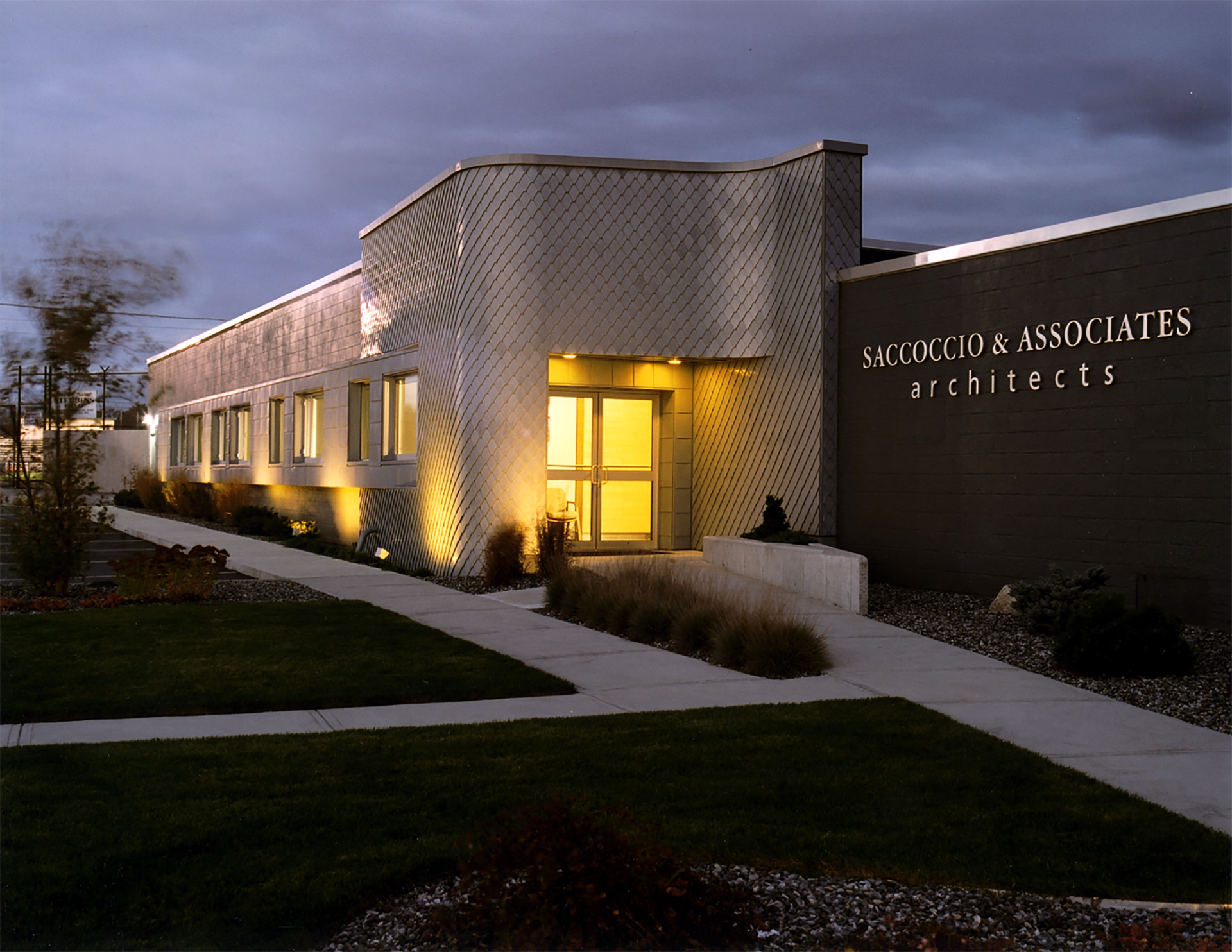
This project repurposes a vacant concrete block furniture warehouse as the new studio and office space for SA Architects. The design operates through a strategy of measured intervention, retaining the pragmatic simplicity of the original structure while marking new insertions through material and spatial contrast.

Key modifications to the building envelope occur along the north and west facades. A sculptural extrusion marks the main point of entry, while a linear strip of new operable windows introduces rhythm, daylight, and ventilation into the deep-plan interior. These interventions are clad in Rheinzink, selected for its material contrast, environmental durability, and ability to register time and weathering across its surface. The rainscreen cladding wraps the additions as a continuous skin, visually separating the new elements from the retained concrete shell.


SA Architects

Cranston, RI
Construction Completed: 2004

Adaptive Reuse of Material, Memory, and Movement

The SA Architects Studio transforms a vacant concrete block warehouse into a contemporary workspace through a process of measured intervention. Rather than conceal its industrial past, the project treats the building’s utilitarian character as a generative condition, something to be revealed, reinterpreted, and extended. The existing structure remains intact, yet its spatial logic is redefined through a series of precise insertions that engage material, light, and movement.

Along the north and west facades, new architectural gestures mark moments of entry and occupation. A zinc-clad extrusion defines the main entry, while a linear band of operable windows brings daylight and ventilation deep into the plan. Rheinzink panels wrap these additions, creating a continuous rainscreen that contrasts the matte texture of the concrete block. Over time, the zinc will patinate, allowing the new surfaces to register age and weather alongside the existing shell—a quiet acknowledgment of architecture’s evolving temporal life.


Exterior Transformation and Landscape Interface

The landscape is treated not as an afterthought but as an extension of the building’s formal and material vocabulary. Along the western edge, a narrow strip of concrete geometries defines seating, planting, and movement in a field of intersecting planes. These ground-level interventions echo the building’s interior faceting, establishing a visual and tactile continuity between inside and out.

The exterior strategy is defined by restraint, each material introduced has purpose. Concrete, zinc, and glass form a disciplined palette that privileges legibility over decoration. Subtle shifts in texture, reflectivity, and scale distinguish the hand of the new from the inherited framework. The result is an exterior condition that balances durability with refinement, allowing the building to express its own process of transformation.

Interior Structure and Spatial Composition

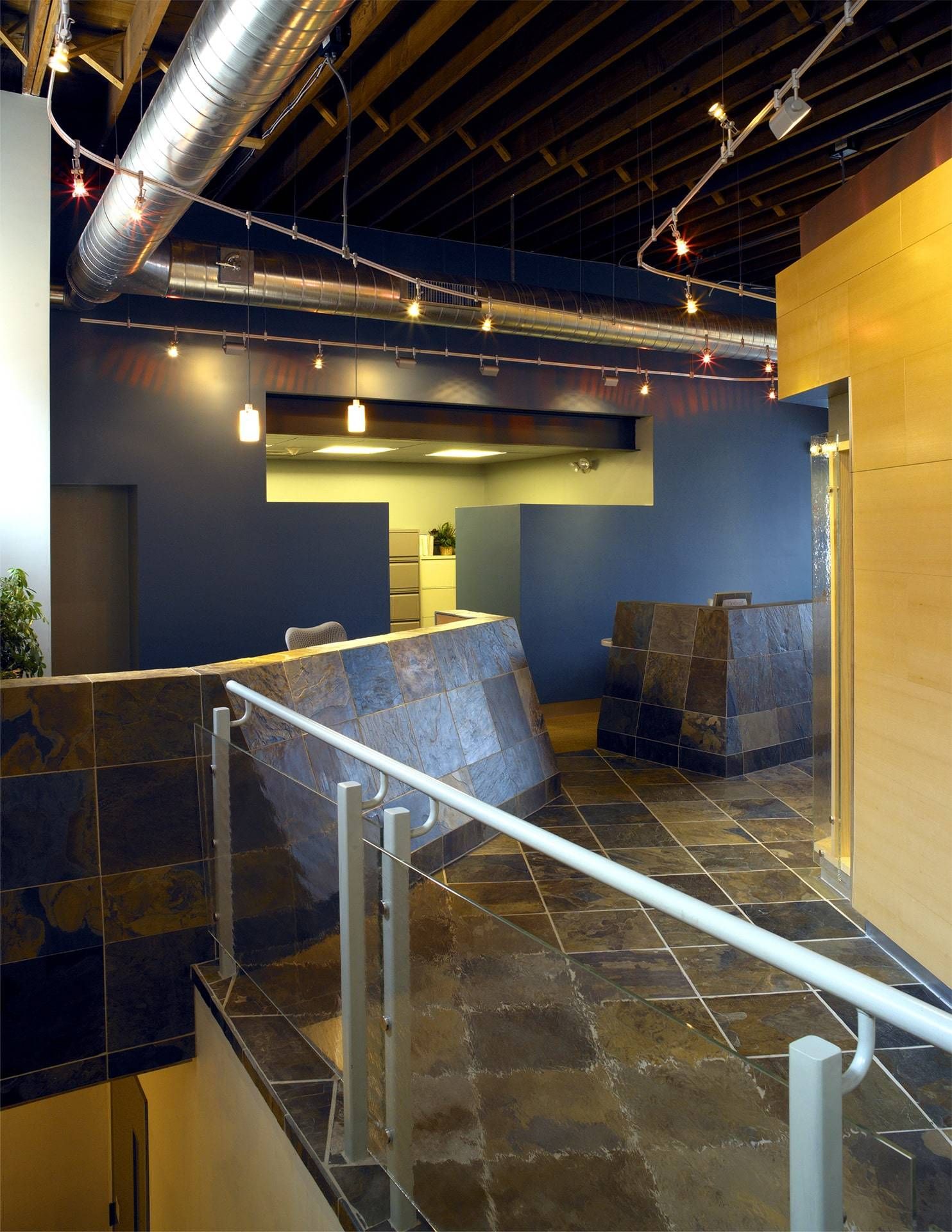
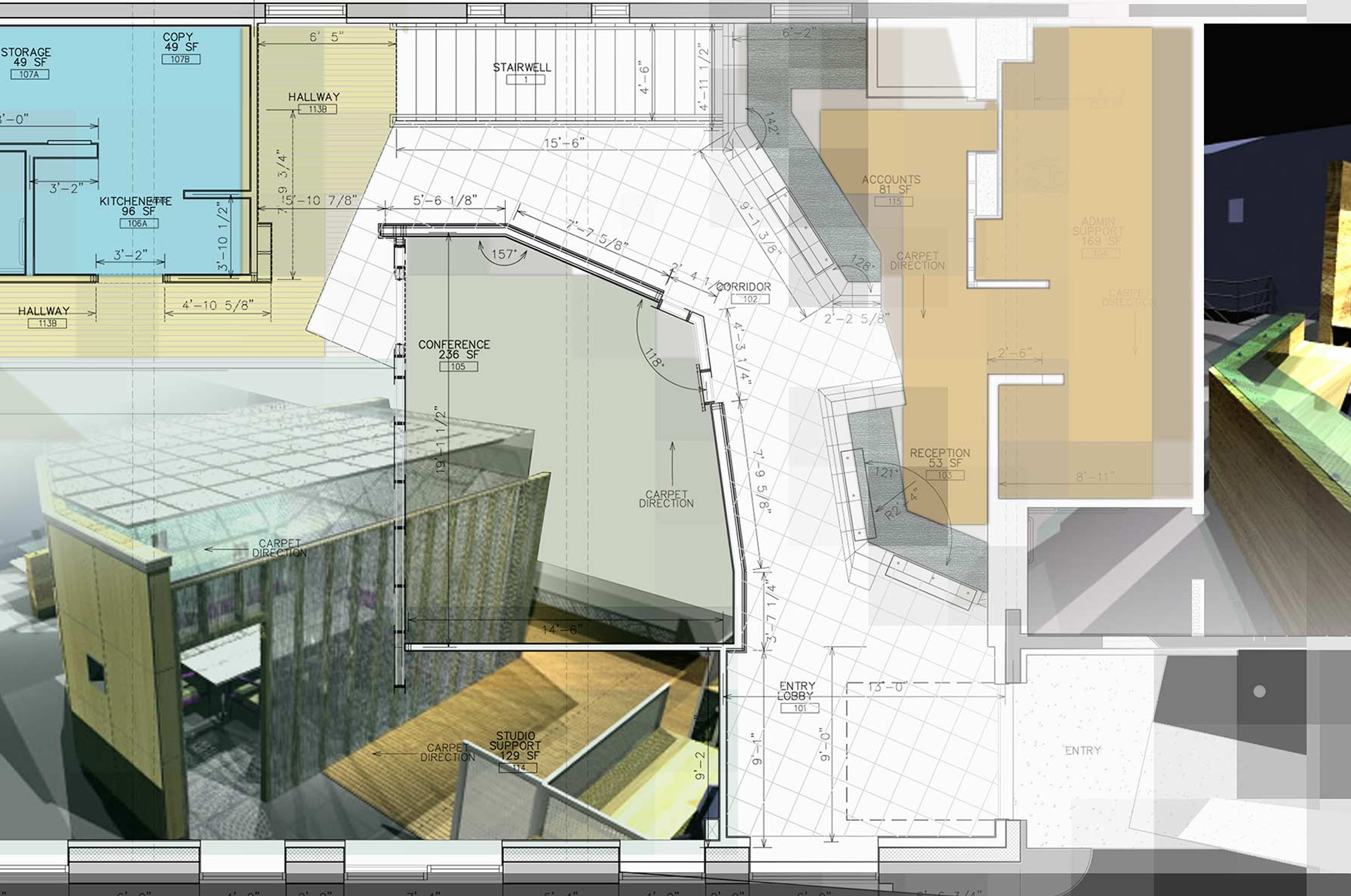
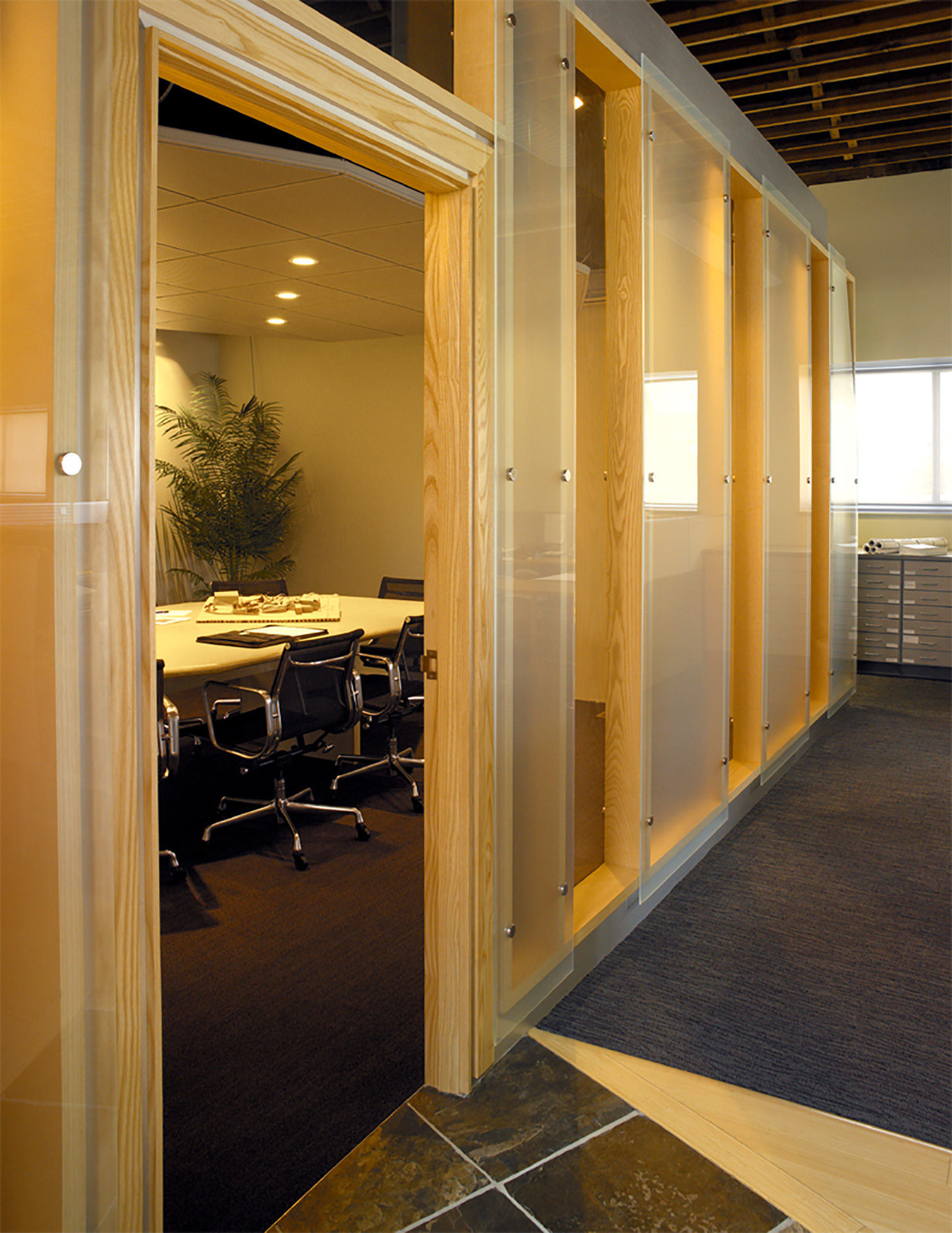
Inside, the open volume of the former warehouse is reinterpreted through a composition of inserted forms that shape rather than subdivide space. These angular, faceted assemblies define the conference room, reception, and studio support zones. Pulled away from the perimeter and the exposed timber truss ceiling, they hover as independent objects within the larger field. This strategy preserves the legibility of the original structure while layering new spatial readings through light, texture, and geometry.

Circulation is conceived as a continuous experience of compression and release. Visitors are guided through a bending corridor that wraps the central conference core before expanding into the main studio volume. This sequence is deliberately choreographed to create tension and release, intimacy and openness—an architectural rhythm that mirrors the dynamics of creative practice. Material junctions are celebrated: slate tile meets glass, timber meets metal, each surface contributing to a dialogue between raw construction and refined finish.


Workplace Identity and Environmental Integration

The studio is designed as a living workspace, one that performs as both a tool and an environment for architectural production. The material palette of wood, zinc, slate, and glass establishes a balance between industrial honesty and crafted precision. Natural light enters from multiple orientations, filtering across angled surfaces and reflecting from the zinc cladding, animating the space throughout the day. Exposed ducts and structural systems are carefully organized, emphasizing performance as an aesthetic of clarity and control.

This project represents a belief that adaptive reuse is an act of editing rather than erasure. By allowing the original structure to remain visible, the new design operates as a continuation rather than an interruption, an architecture that builds upon the memory of use while redefining its contemporary identity. The result is a studio that embodies both discipline and freedom, a space where material, structure, and light converge to frame the ongoing work of architectural imagination.


More Work


Architecture

Art + Code

Design + Fabrication

Courses + Student Work

© Ken Marold USA, Inc. All rights reserved.

Continue reading

Steel + Light

Untitled-1

Steel + Light

Convergence Arts Festival Masterwork

providence, rhode island

status : complete

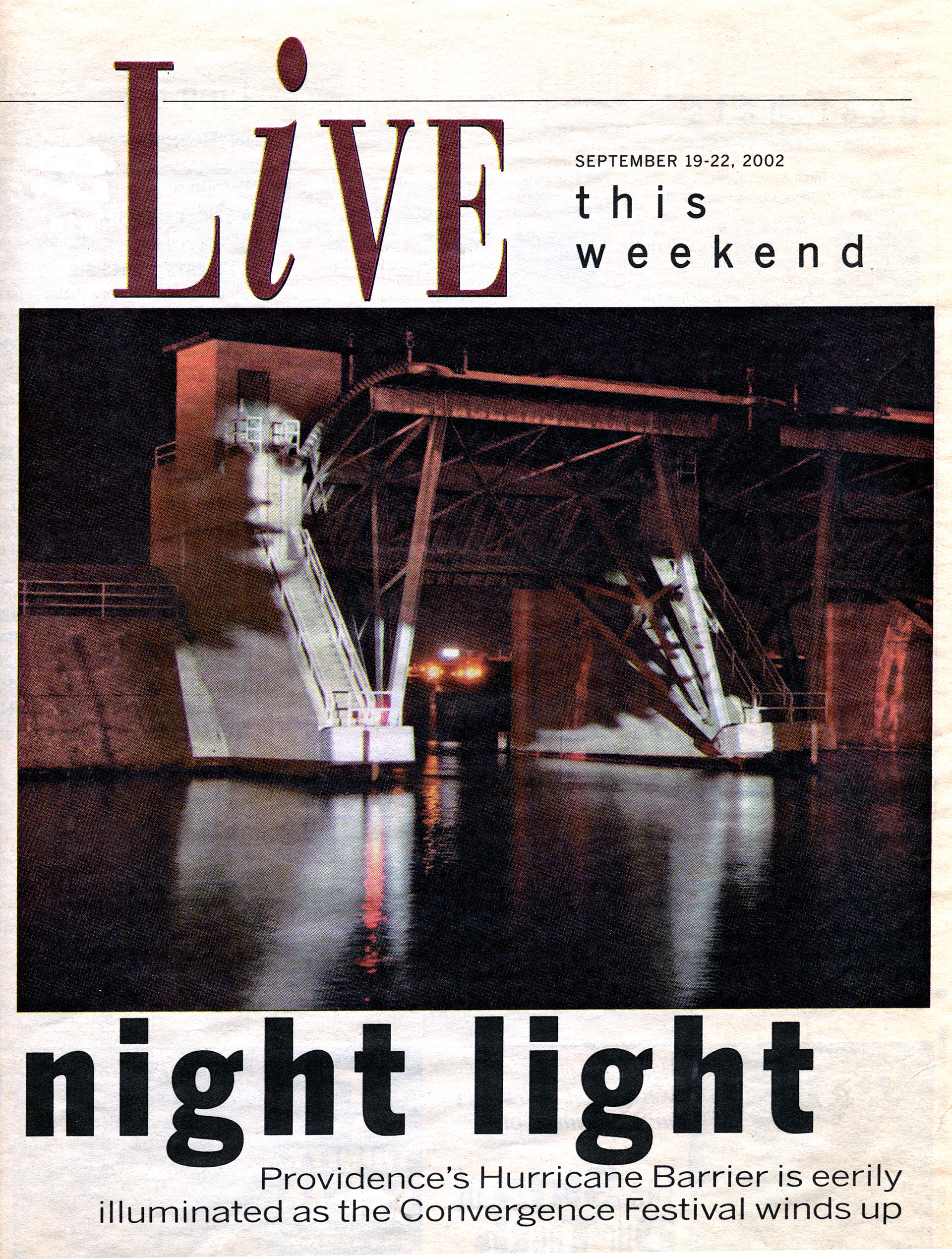
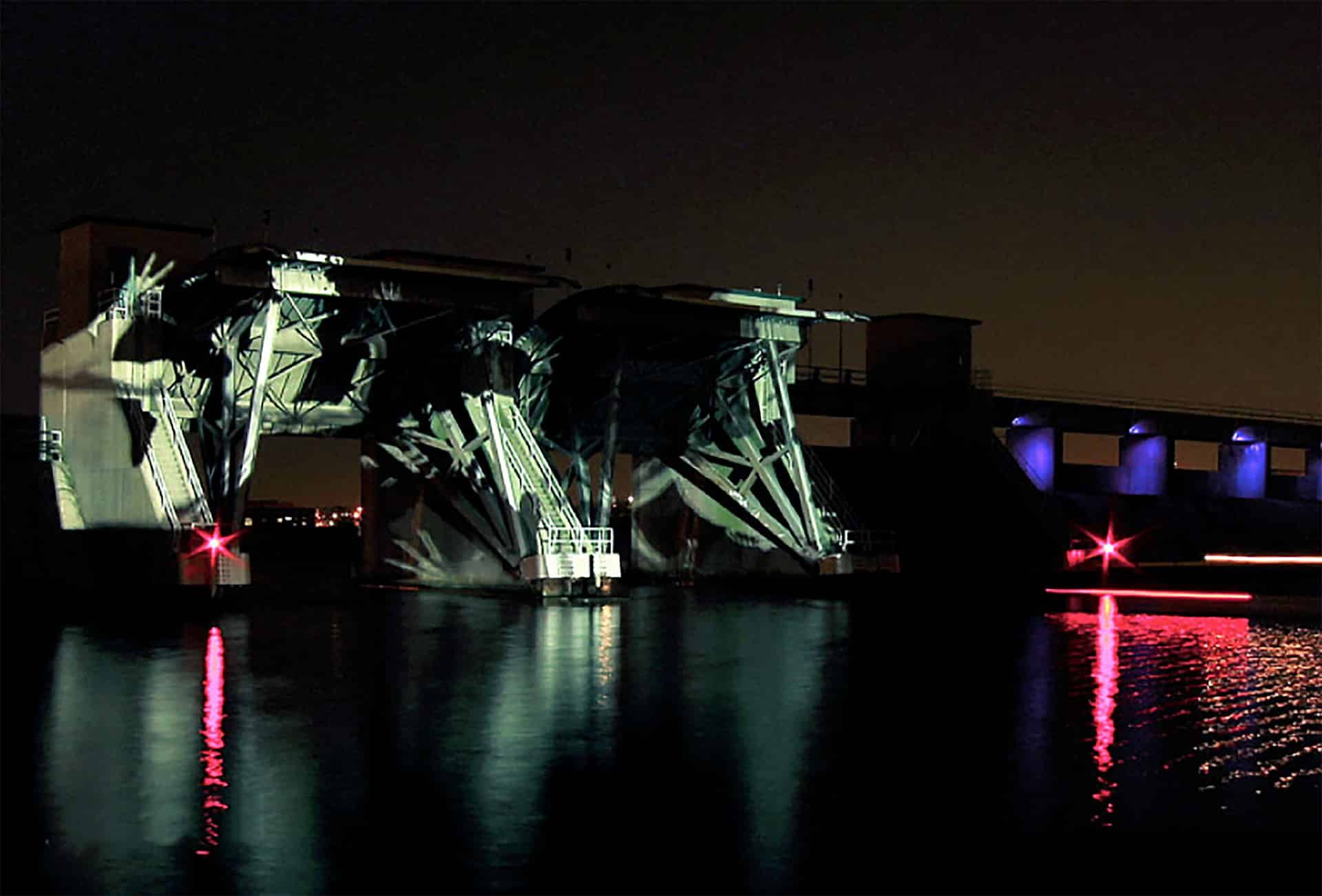
A collaboration with Hogan + Macaulay Architects, this project was conceived as a cinematic montage that explores the use of light as a medium to ‘drape’ imagery across the Providence Hurricane Barrier.

The imagery selected and the compositional choices made for this exhibition included body parts, such as arms, hands and faces, as well as photographs of dancers juxtaposed with more abstract imagery. The entire exhibit was initially simulated on formZ using the exact lighting specs, distances, surrounding light pollution levels, and physical properties to gain insight on our design choices but also to point out any environmental factors that might challenge our preconceptions.

The goal was to create a visual dialog between projected elements of the human form and the highly engineered structural elements of the Hurricane Barrier. The result exceeded our expectations as the dual 12,000 lumen light canons cast intensely vibrant imagery upon the Hurricane Barrier’s three story volumes and lacy structural assemblies, cutting through lightly foggy fall nights over the Narragansett Bay.

  • Untitled-1
  • Untitled-2
  • Untitled-4

More Work

Architecture


  • Wichita Mobile Clinic

    anadarko, oklahoma

  • SA Architects

    cranston, rhode island

  • OKC Greenhouse

    oklahoma city, oklahoma

  • Pawtucket Day Nursery

    pawtucket, rhode island

  • Meeting Street Center for Excellence

    providence, rhode island

  • Norterly Island Nature Center

    Chicago, Illinois

  • National Institute of Flamenco

    old town plaza, santa fe, new mexico

  • Corrales Comunity Pathway + Pedestrian Park

    corrales, new mexico

  • CRCUIT

    albuquerque, new mexico

  • The Construction of Art

    providence, rhode island

  • Santa Fe Univeristy School of Fine Arts

    Santa Fe, New Mexico

Design + Fabrication


  • Flatpack Foldable Structural Connections

    rhino, grasshopper, mild steel

  • Renegades

    Fred Jones Jr Museum of Art

  • Surface Flux

    python, c#, grasshopper, pla, wood, steel

  • Carbon Fiber Connections

    grasshopper, rhino, pla, carbon fiber

  • Acoustic Diffusion Panel

    grasshopper, rhino, cnc, rigid insulation

  • Hyperbolic Bending

    grasshopper, rhino, laser cut acrylic, bristol board

  • Filtration : Infiltration

    python, grasshopper, rhino, 3d printing

  • Recursive Paneling

    laser cut mylar

  • Sweet Crude

    python, c#, grasshopper, wood, plasti-dip, carbon, gelatin

  • Ruling Lines

    laser cut cell cast acrylic, stainless steel braided wire

  • Volumetric Aggregations

    processing, grasshopper, rhino, cast acrylic, black walnut, hickory

  • Cellulose Bookcase

    pine, black walnut, compressed wood fiber board, stain

  • Asher Chair

    rhino, pla, birch plywood

  • Andraditic Mass

    arduino, firefly, rhino, 3d printed pla, baltic birch plywood

  • Cholla

    grasshopper, rhino, black walnut

  • Folding Attractors

    grasshopper. rhino, white museum board

  • Grain Chair

    rhino, cnc milled birch plywood

  • Tracking Parallelograms

    grasshopper, rhino, hickory

  • Infiltration Table

    processing, spalted birch plywood, poplar, enamel, lacquer

Art + Code


  • Prairie Fire

    acrylic, ink, plywood

  • Surface Flux

    python, c#, grasshopper, pla, wood, steel

  • Dixieland Death Cult

    acrylic, plywood

  • Approximation of a Generation

    private tremendous

  • Elemental Worlds

    science museum oklahoma

  • Gonzo Cubes

    solidity, html, css, javascript, illustrator

  • A Line of Force

    arduino, grasshopper, firefly, java, plywood

  • The Drift

    html, css, javascript

  • Gear Institute

    illustrator, photoshop, php, css, html

  • Prism

    unity, c#, spine2d, illustrator

  • Squall

    petroglyphs national monument, albuquerque, new mexico

  • Galileo’s World Interactive

    c#, unity3d, illustrator, photoshop

  • Steel + Light

    convergence arts festival masterworks project, providence, rhode island

  • The God of Skiing

    book design

© [wpsos_year] Ken Marold USA, Inc. All rights reserved.

Continue reading

Pawtucket Day Nursery

Pawtucket Day Nursery

Cranston, RI
Construction Completed: 2004

This project repurposes a vacant concrete block furniture warehouse as the new studio and office space for SA Architects. The design operates through a strategy of measured intervention, retaining the pragmatic simplicity of the original structure while marking new insertions through material and spatial contrast.

Key modifications to the building envelope occur along the north and west facades. A sculptural extrusion marks the main point of entry, while a linear strip of new operable windows introduces rhythm, daylight, and ventilation into the deep-plan interior. These interventions are clad in Rheinzink, selected for its material contrast, environmental durability, and ability to register time and weathering across its surface. The rainscreen cladding wraps the additions as a continuous skin, visually separating the new elements from the retained concrete shell.


Pawtucket Day Nursery

Pawtucket, RI
Construction Completed: 2001

Reimagining Early Education Through Form and Play

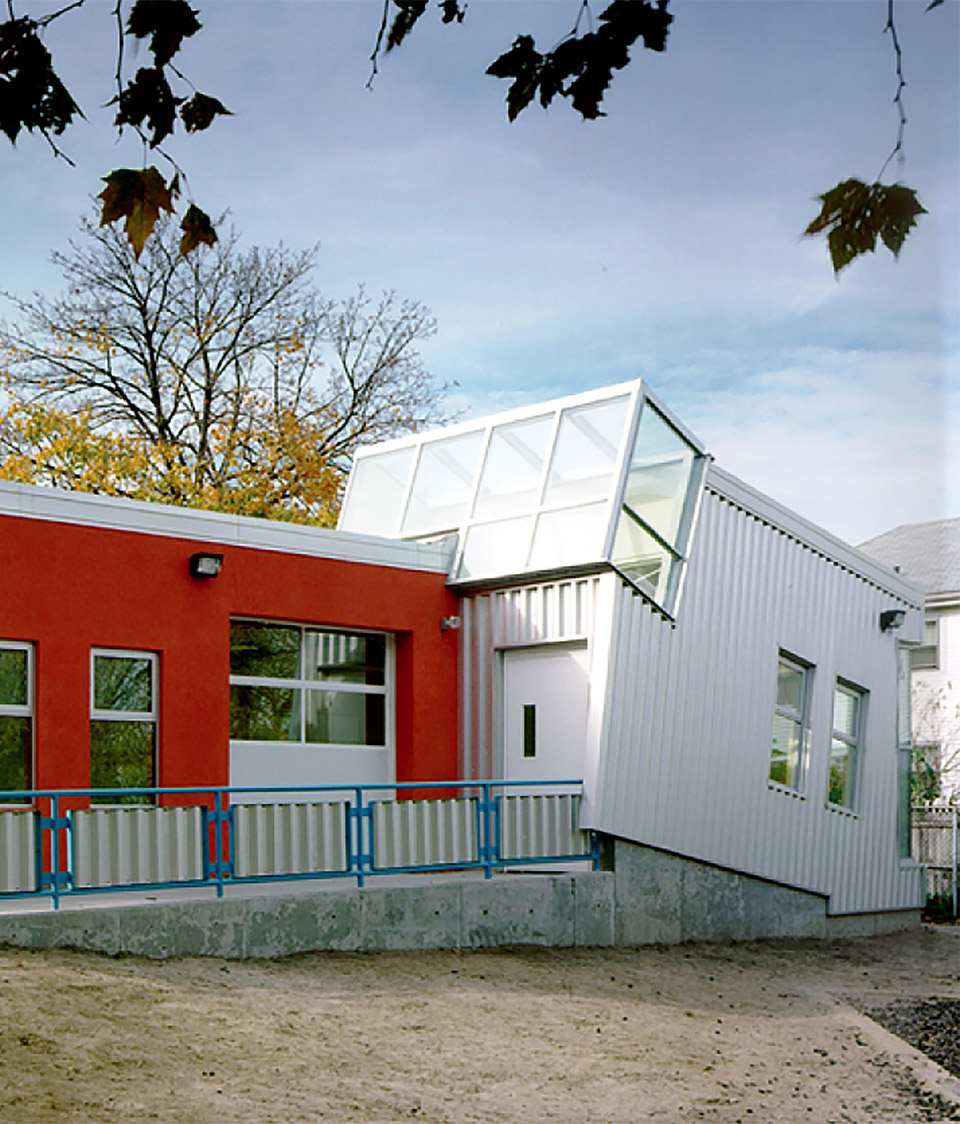
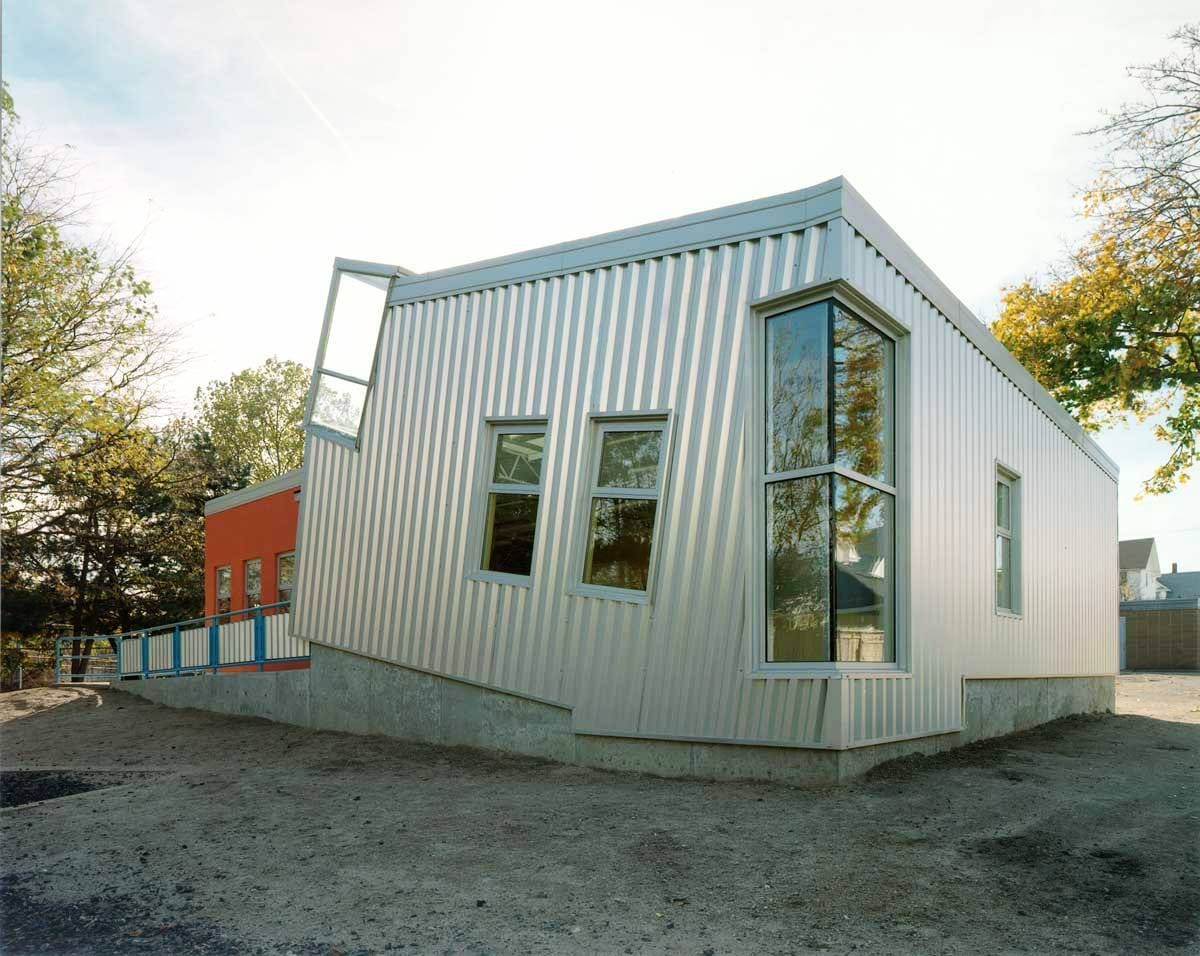
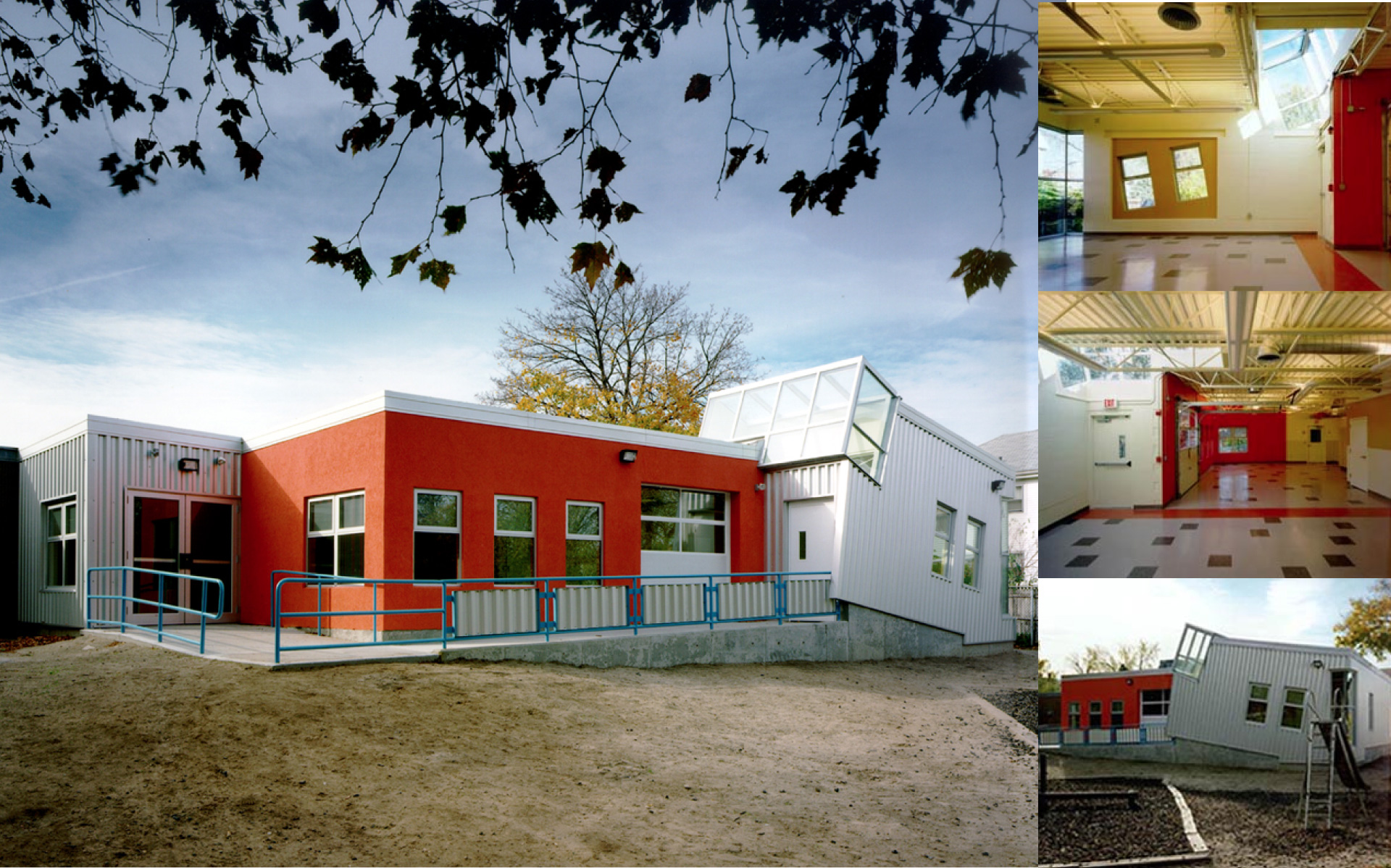
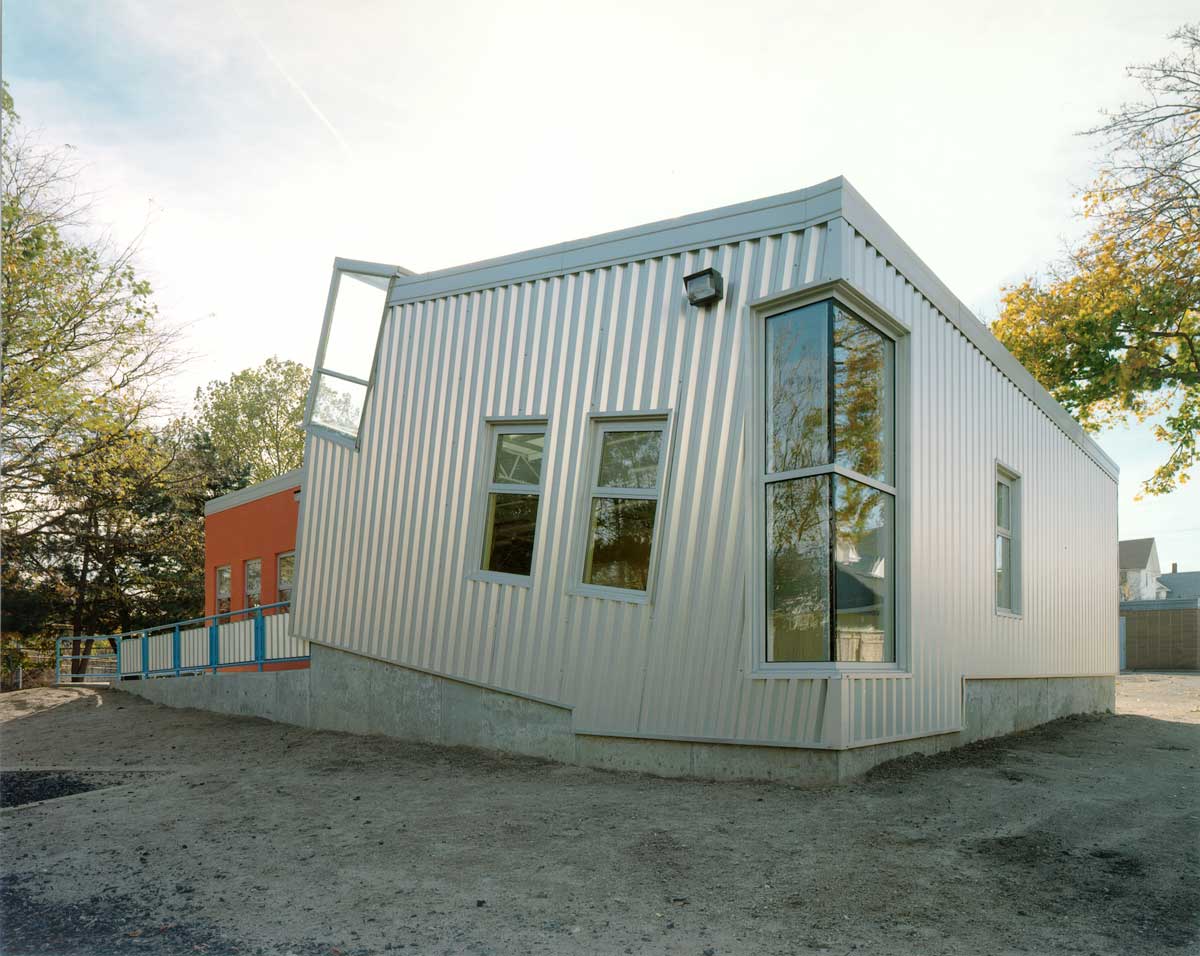
The Pawtucket Day Nursery addition redefines educational space through the architecture of movement, perception, and curiosity. Conceived as a kinetic counterpoint to the existing school, the new volume translates the spirit of play into spatial form. Skewed geometries, tilted walls, and oblique intersections create an animated composition that responds to the dynamic energy of childhood. The design transforms the rectilinear restraint of the original structure into an expressive environment that invites exploration.

Rather than replicate childlike imagery, the project interprets the qualities of improvisation, balance, and discovery as formal operations. Walls shift off-axis, windows tilt toward the sky, and the roof folds to capture daylight from multiple angles. These gestures situate the building within a language of movement—one that reflects how children perceive and navigate space, not through static order, but through fluid, evolving experiences.


Conceptual Framework and Design Intent

At its core, the project frames play as a cognitive and spatial process. Architectural form becomes a teaching tool—one that encourages awareness, observation, and imagination. Each skewed wall and canted aperture transforms light, sound, and view into a series of sensory events. The result is a building that is both structured and improvisational, a framework that mediates between the discipline of learning and the spontaneity of play.

The design’s compositional strategy also reflects a pedagogical philosophy: that environments can shape how children engage with the world. By layering proportion, rhythm, and distortion, the architecture produces conditions of both familiarity and surprise. These calibrated instabilities serve as metaphors for learning itself—an act of continual adjustment, experimentation, and adaptation.

Material Expression and Light

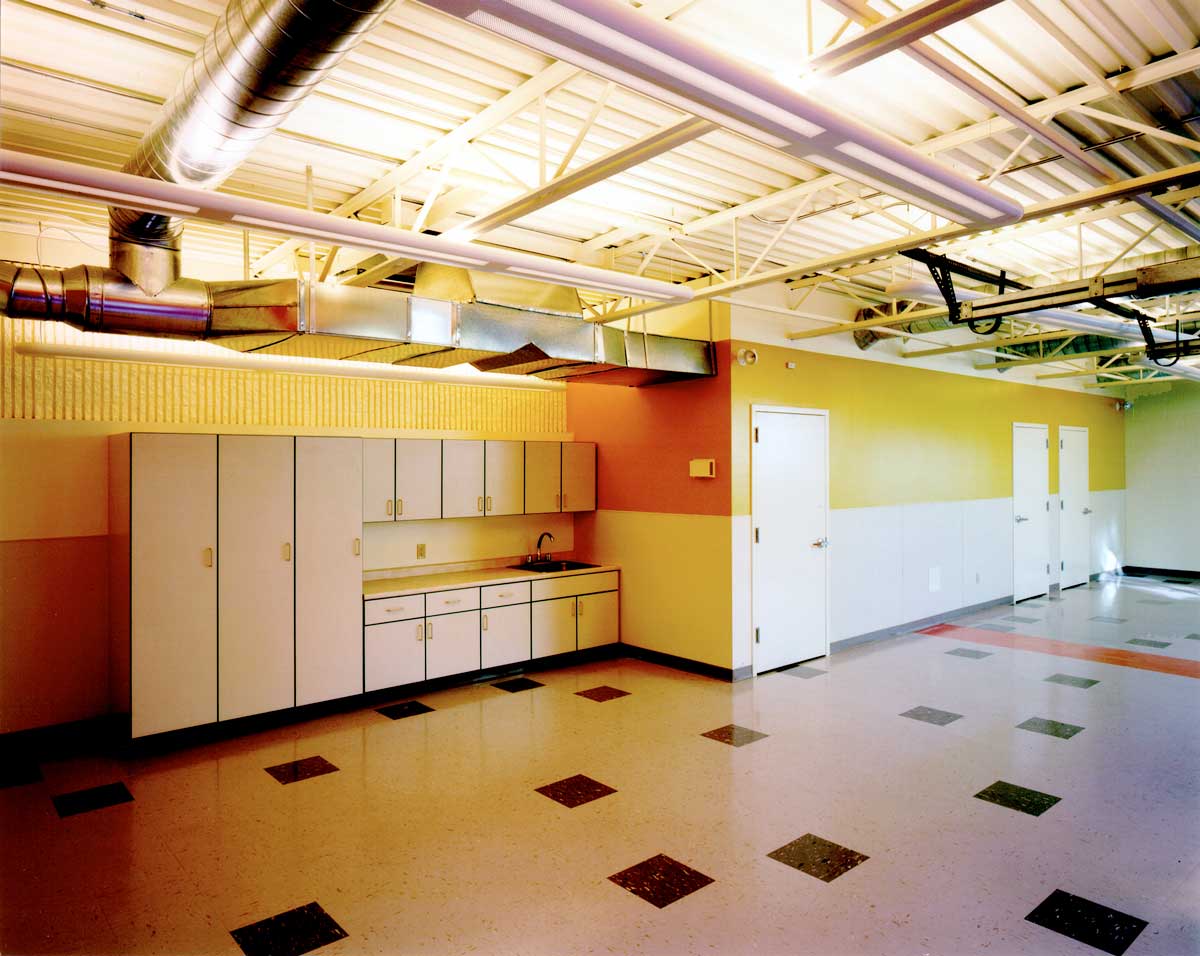
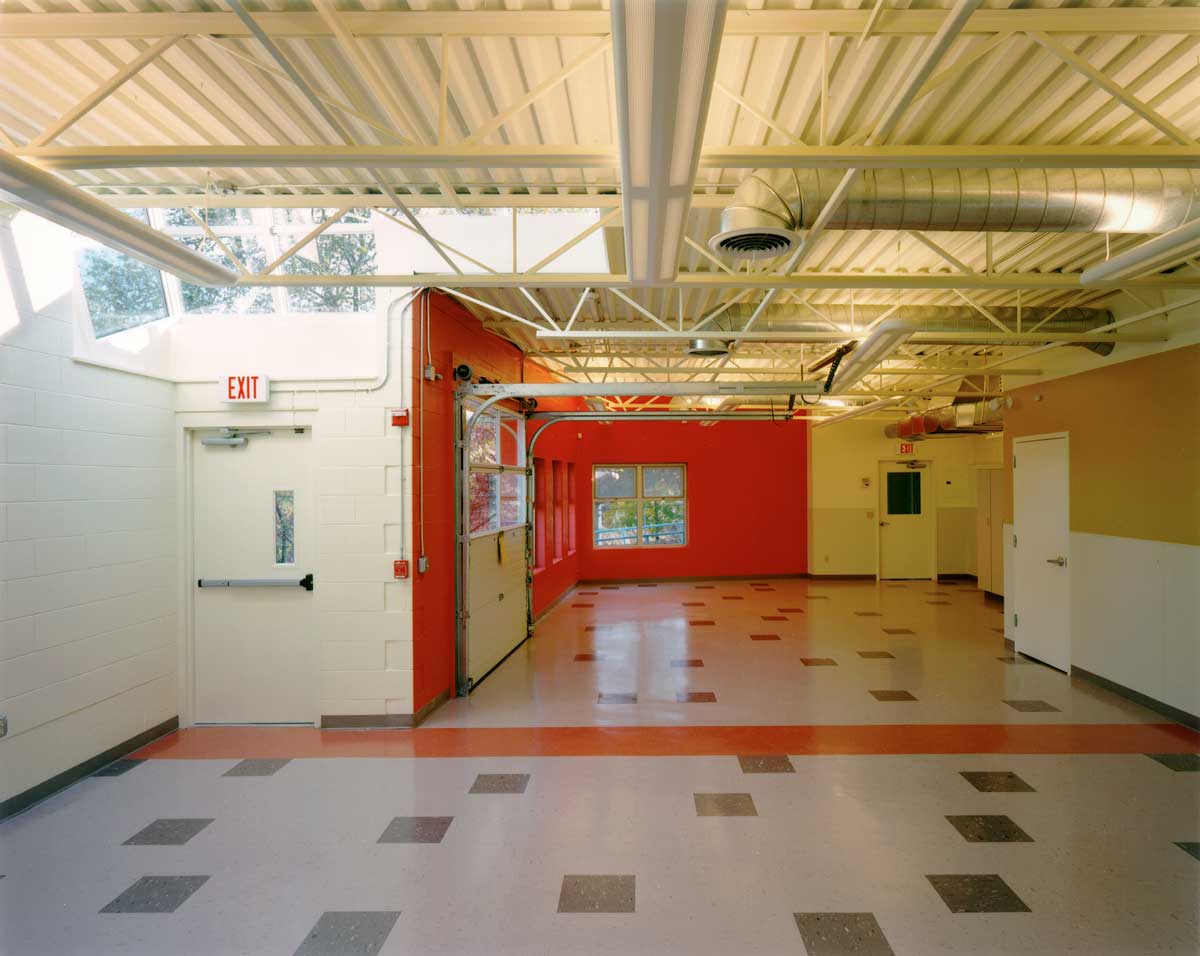
The addition is articulated through a minimal yet vivid material palette that merges industrial resilience with child-centered warmth. Corrugated metal siding and bright stucco planes define a tactile contrast between texture and color. The junction of these two materials becomes a point of tension and continuity, visually tying the new construction to the existing nursery while marking its independence.

Daylight is a primary design material. Angled skylights and canted windows bring changing light into the interior, projecting animated shadows across walls and floors. This interplay of light and surface transforms the interior into a living environment—responsive, temporal, and atmospheric. Each moment of the day reveals a different spatial reading, encouraging occupants to continually rediscover their surroundings.


Interior Experience and Didactic Systems

Inside, the environment functions as both classroom and laboratory. Bright planes of color—reds, yellows, and ochres—activate surfaces and delineate zones of activity. The spatial sequence is intuitive, alternating between open gathering areas and smaller, framed nooks that support reflection and focused learning.

Mechanical and structural systems are intentionally exposed, extending the project’s pedagogical dimension. Trusses, ducts, and conduits are not hidden but celebrated, demonstrating the mechanics of how a building stands, breathes, and performs. In this way, the building becomes a transparent diagram of its own making—an environment where curiosity extends from the curriculum into the architecture itself.

Civic Identity and Lasting Impact

The Pawtucket Day Nursery expansion serves as both a learning space and a civic statement. Its sculptural form asserts the value of creativity in public education, while its material honesty grounds it within the city’s working landscape. The addition accommodates flexible programming—classroom activities, art, play, and community events—reinforcing the school’s role as a social anchor within its neighborhood.

By merging play with structure, imagination with discipline, the project creates an architecture that speaks to both the freedom of childhood and the precision of design. The Pawtucket Day Nursery demonstrates how educational architecture can transcend utility to become formative—shaping not only the experience of space, but the way young minds learn to see, move, and build meaning through their environment.


More Work


Architecture

Art + Code

Design + Fabrication

Courses + Student Work

© Ken Marold USA, Inc. All rights reserved.

Continue reading

The Construction of Art

Untitled-3

The Construction of Art

Vanguard at the Armory

providence, rhode island

type : built
status : completed in 1997

Project Overview
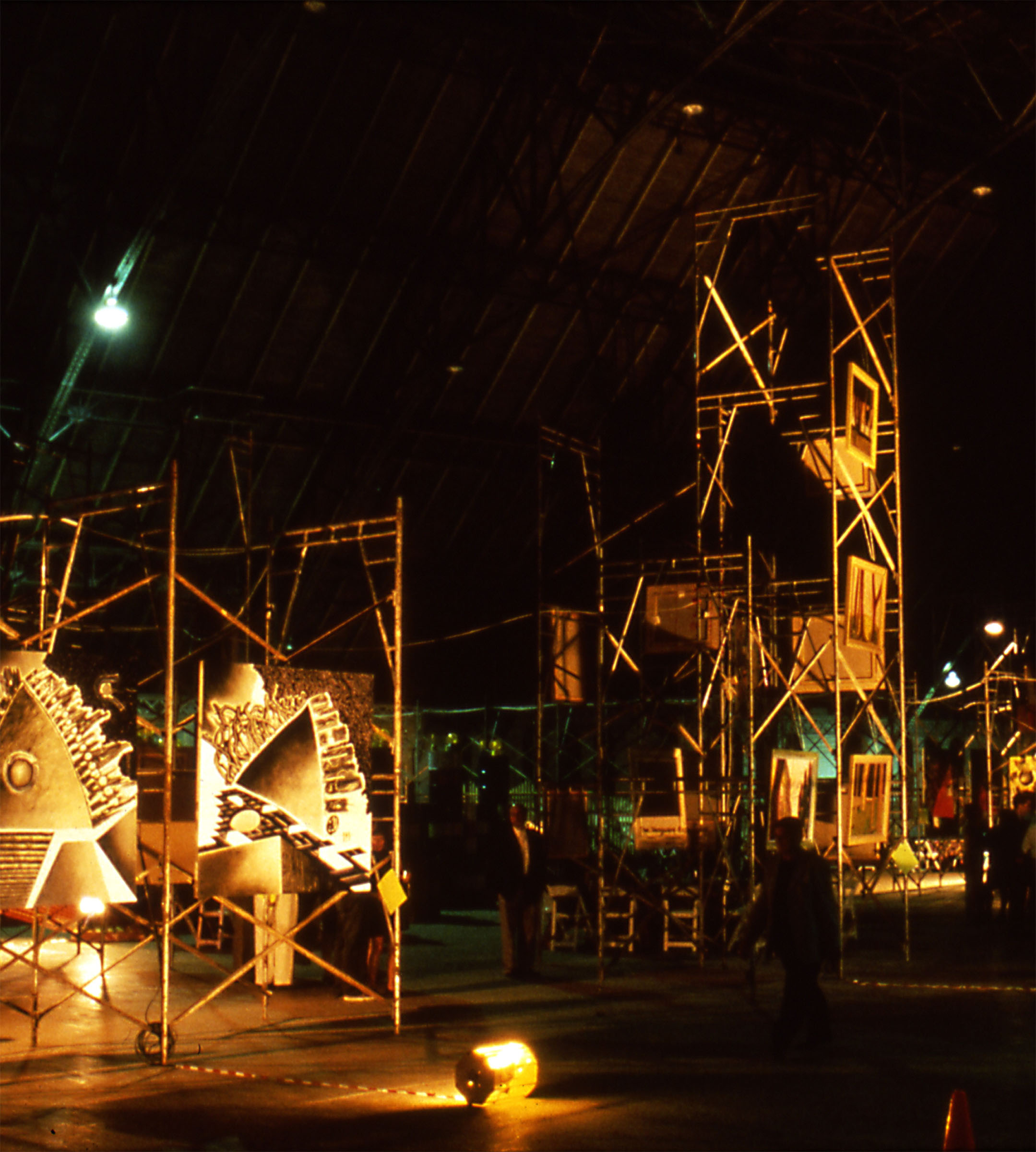
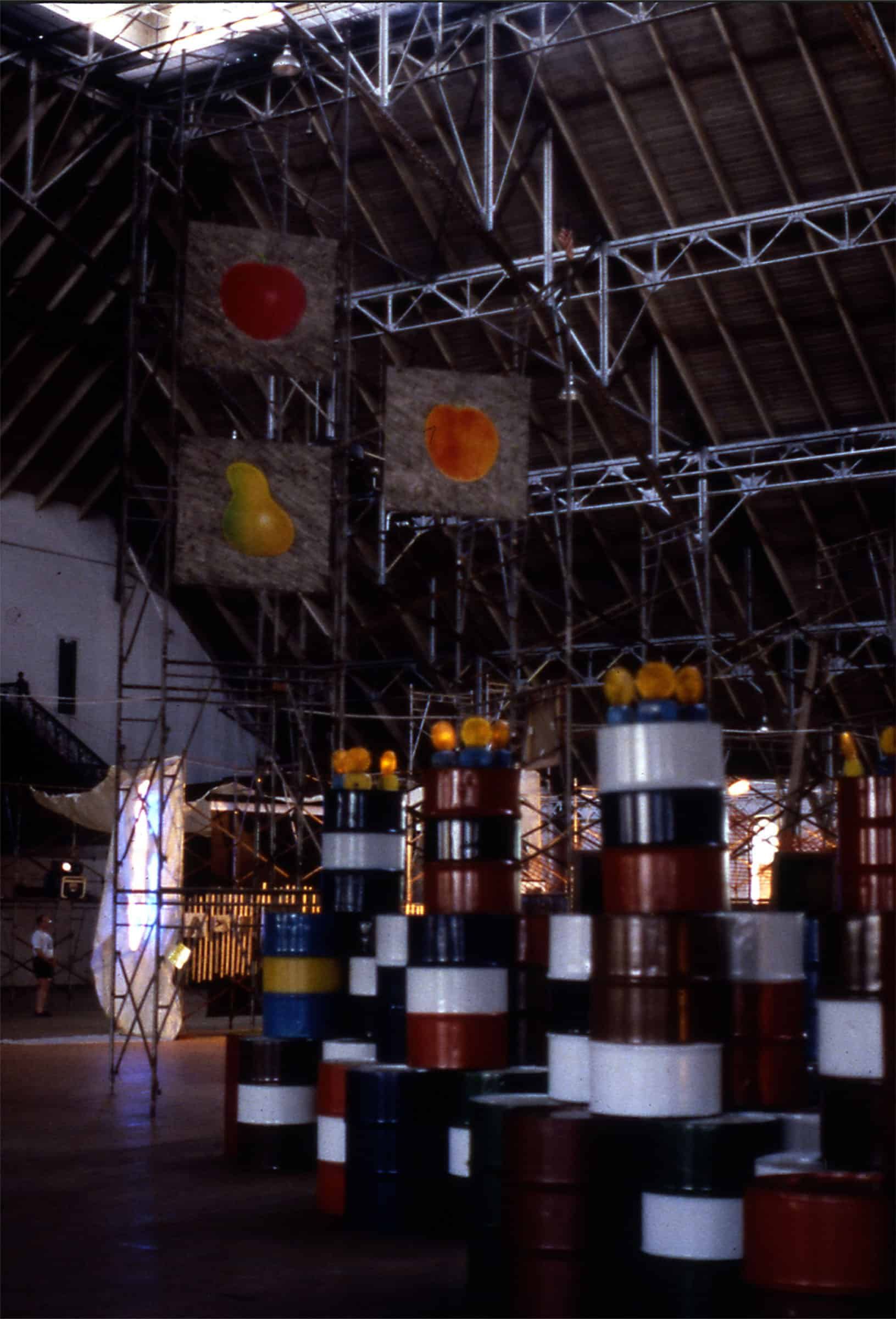
Set within the vast and endangered volume of the Cranston Street Armory’s drill hall, this exhibition transformed a 38,000-square-foot void into a charged space of public encounter and creative expression. A rapid, site-responsive scaffolding system was used to construct temporary gallery spaces for a group art show, redefining a structure known for its historic grandeur as a platform for contemporary artistic experimentation.

Spatial Strategy
The primary challenge was scale. The armory’s soaring web trusses and cavernous enclosure dwarf human-scaled activities, creating a spatial dissonance between the architecture and the artwork. Rather than resist this monumental scale, the installation leverages it, diagonally slicing through the drill hall with a dense, angular scaffolding array that acts as both infrastructure and spatial frame.

Vertical scaffold elements pierce upward into the lofted volume, creating a sense of vertical continuity that connects the human scale of the artworks to the massive structural language above. This scaffold latticework locks into the existing armature of the armory itself, not by dominating it, but by anchoring moments of inhabitation within it. The resulting geometry operates at multiple scales simultaneously, housing artworks, forming circulation paths, and framing elevated perspectives.

Material Tactics and Construction Approach
The material palette was entirely drawn from donated, salvaged, and scavenged elements, industrial scaffolding, used barrels, construction fencing, traffic mitigation equipment, and projection materials. These components were recontextualized to form display surfaces, lighting supports, and circulation enclosures. The use of modular and mobile components allowed for rapid deployment and post-exhibition removal, highlighting the temporary nature of the intervention while respecting the armory’s fragile condition.

Installation was achieved with minimal tooling and volunteer labor, foregrounding the collaborative spirit of the event and the resourcefulness required for occupation of a space without conventional exhibition infrastructure.

Program and Collaboration
This project was developed in partnership with the Vanguard Group of Artists, Convergence International Art Festival, and the Providence Preservation Society. The installation provided a spatial framework for a multidisciplinary arts exhibition, including painting, photography, sculpture, video, and performance. The modularity of the scaffold system allowed curators to adapt the space as programming evolved, enabling fluid transitions between static exhibition and live activation.

Projection screens, suspended artworks, and layered soundscapes capitalized on the scaffold’s skeletal openness, turning it into both armature and amplifier. The exhibition not only filled the armory, but reactivated it, momentarily transforming an endangered civic relic into a spatial commons for cultural production.

Conclusion
The Construction of Art is an architectural improvisation, a light-footprint framework for creative occupation that resists permanence while asserting presence. By working with found materials and inserting a flexible scaffold logic into a historically rigid envelope, the project reveals how spatial precision and tactical reuse can reengage overlooked civic infrastructure. The installation was less a solution and more a proposal: a reminder of the power latent in big, empty buildings and the communities that are willing to reinhabit them.

  • Untitled-3
  • Untitled-1
  • Untitled-2

More Work

Architecture


  • Wichita Mobile Clinic

    anadarko, oklahoma

  • SA Architects

    cranston, rhode island

  • OKC Greenhouse

    oklahoma city, oklahoma

  • Pawtucket Day Nursery

    pawtucket, rhode island

  • Meeting Street Center for Excellence

    providence, rhode island

  • Norterly Island Nature Center

    Chicago, Illinois

  • National Institute of Flamenco

    old town plaza, santa fe, new mexico

  • Corrales Comunity Pathway + Pedestrian Park

    corrales, new mexico

  • CRCUIT

    albuquerque, new mexico

  • The Construction of Art

    providence, rhode island

  • Santa Fe Univeristy School of Fine Arts

    Santa Fe, New Mexico

Design + Fabrication


  • Flatpack Foldable Structural Connections

    rhino, grasshopper, mild steel

  • Renegades

    Fred Jones Jr Museum of Art

  • Surface Flux

    python, c#, grasshopper, pla, wood, steel

  • Carbon Fiber Connections

    grasshopper, rhino, pla, carbon fiber

  • Acoustic Diffusion Panel

    grasshopper, rhino, cnc, rigid insulation

  • Hyperbolic Bending

    grasshopper, rhino, laser cut acrylic, bristol board

  • Filtration : Infiltration

    python, grasshopper, rhino, 3d printing

  • Recursive Paneling

    laser cut mylar

  • Sweet Crude

    python, c#, grasshopper, wood, plasti-dip, carbon, gelatin

  • Ruling Lines

    laser cut cell cast acrylic, stainless steel braided wire

  • Volumetric Aggregations

    processing, grasshopper, rhino, cast acrylic, black walnut, hickory

  • Cellulose Bookcase

    pine, black walnut, compressed wood fiber board, stain

  • Asher Chair

    rhino, pla, birch plywood

  • Andraditic Mass

    arduino, firefly, rhino, 3d printed pla, baltic birch plywood

  • Cholla

    grasshopper, rhino, black walnut

  • Folding Attractors

    grasshopper. rhino, white museum board

  • Grain Chair

    rhino, cnc milled birch plywood

  • Tracking Parallelograms

    grasshopper, rhino, hickory

  • Infiltration Table

    processing, spalted birch plywood, poplar, enamel, lacquer

Art + Code


  • Prairie Fire

    acrylic, ink, plywood

  • Surface Flux

    python, c#, grasshopper, pla, wood, steel

  • Dixieland Death Cult

    acrylic, plywood

  • Approximation of a Generation

    private tremendous

  • Elemental Worlds

    science museum oklahoma

  • Gonzo Cubes

    solidity, html, css, javascript, illustrator

  • A Line of Force

    arduino, grasshopper, firefly, java, plywood

  • The Drift

    html, css, javascript

  • Gear Institute

    illustrator, photoshop, php, css, html

  • Prism

    unity, c#, spine2d, illustrator

  • Squall

    petroglyphs national monument, albuquerque, new mexico

  • Galileo’s World Interactive

    c#, unity3d, illustrator, photoshop

  • Steel + Light

    convergence arts festival masterworks project, providence, rhode island

  • The God of Skiing

    book design

© [wpsos_year] Ken Marold USA, Inc. All rights reserved.
Continue reading