Gaze

voyeurism
Gaze : Exploring Spatial Weaving, Surveillance, and the Architecture of Voyeurism
wire, paper
status : complete in 2007
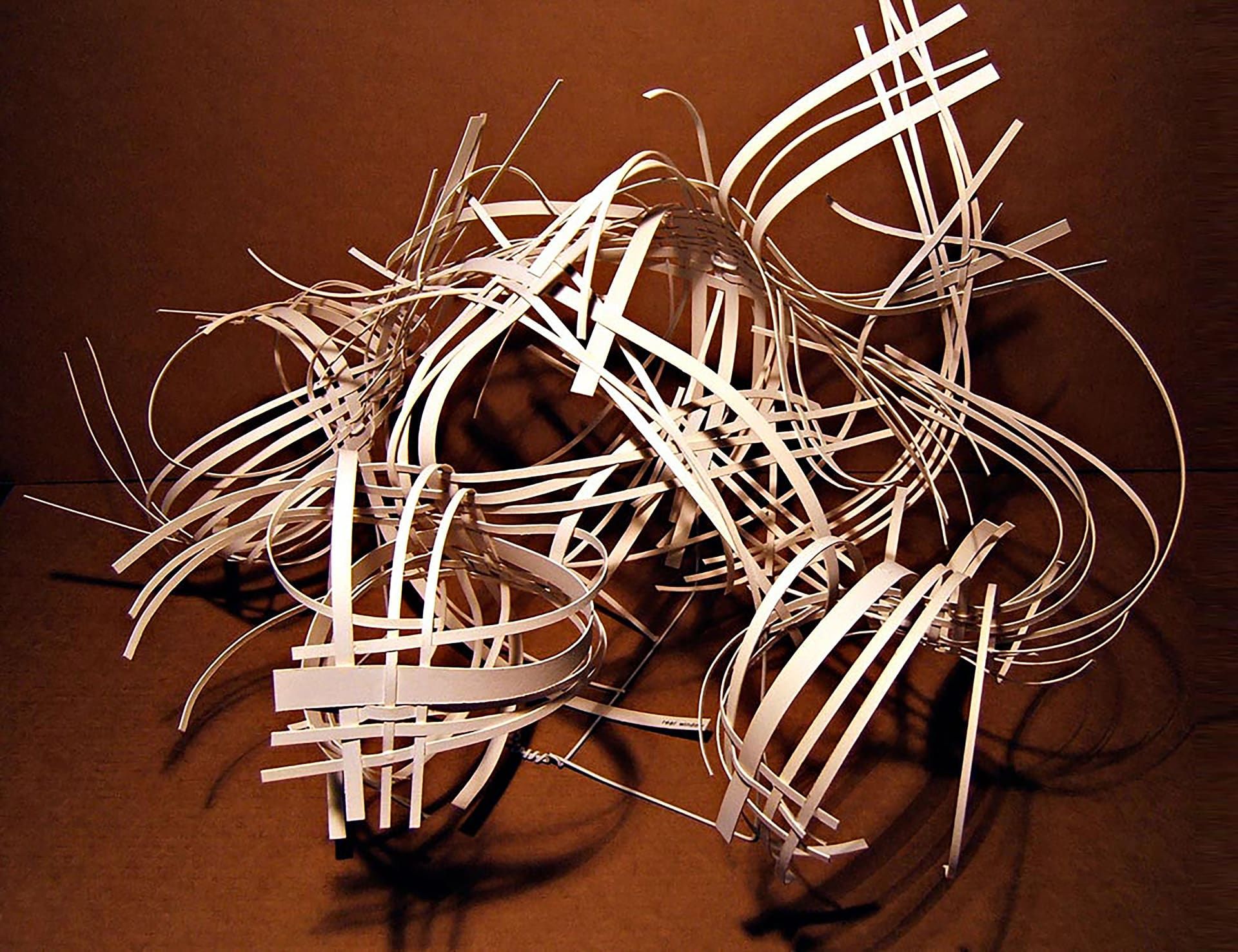
Paper Strips, Conceptual Model
Project Overview
This speculative project examines how architecture can embody narrative, tension, and perception through the act of weaving and layered transparency. Drawing inspiration from Alfred Hitchcock’s Rear Window and its exploration of voyeurism, performance, and psychological unease, the model operates as both a formal study and a conceptual springboard for a pavilion-scale installation. Its central theme is the poetics of looking and being looked at: the interplay of concealment, revelation, and fragmented storytelling made spatial.
Design and Material Strategy
Constructed entirely from thin, pliable white strips, the model develops a field of intersecting lines, woven planes, and warped volumes. These strips function as both structure and skeleton, creating varying densities of enclosure. Tight nodes of woven convergence suggest spatial “rooms” or observation posts, while looser zones offer diffusion, blurring sightlines and producing threshold-like conditions. The weaving thus oscillates between exposure and concealment, echoing the psychological duality of voyeurism: watcher and watched, subject and spectacle.
Conceptual Framework
The woven composition imagines architecture as a system of vantage points. Each nodal cluster could expand at pavilion scale into inhabitable micro-environments — veiled capsules or chambers that allow for observation without direct connection. The interstitial weave acts as a permeable membrane: porous to vision yet resistant to passage. This establishes a narrative choreography where occupants remain visually linked yet spatially distinct, reinforcing themes of isolation, surveillance, and fragmented narrative.
Spatial Performance and Atmosphere
The strips arc, fold, and sweep dynamically, evoking a sense of frozen movement. In some areas, the weave spirals inward, intensifying focus and drawing the eye into tight, concealed moments. Elsewhere, it flares outward, dispersing tension into a looser, more ambiguous field. Shadows cast by the model extend these patterns beyond the physical structure, layering the ground plane with secondary geometries of light and absence. This interplay of material and shadow suggests an optical architecture where perception itself becomes material.
Speculative Pavilion Application
Scaled up, the pavilion would choreograph experiences of glancing, peering, and crossing sightlines. Visitors would move through a fragmented environment where visual access is constant but partial, always layered with awareness of being seen in return. Semi-permeable architectural surfaces could be augmented with digital projections, responsive materials, or interactive systems. Projections might reveal silhouettes, fragmented dialogue, or subtle animations triggered by movement, heightening the cinematic atmosphere and embedding narrative into the act of inhabitation.
Conclusion
Exploring Spatial Weaving situates architecture as both physical and narrative medium. By weaving together form, shadow, and perception, the project proposes a new way of inhabiting psychological space — one where architecture functions as both stage and script, performer and observer. The resulting pavilion is less a static structure than an evolving scene of encounters: an architecture of glances, echoes, and fragmented stories.